
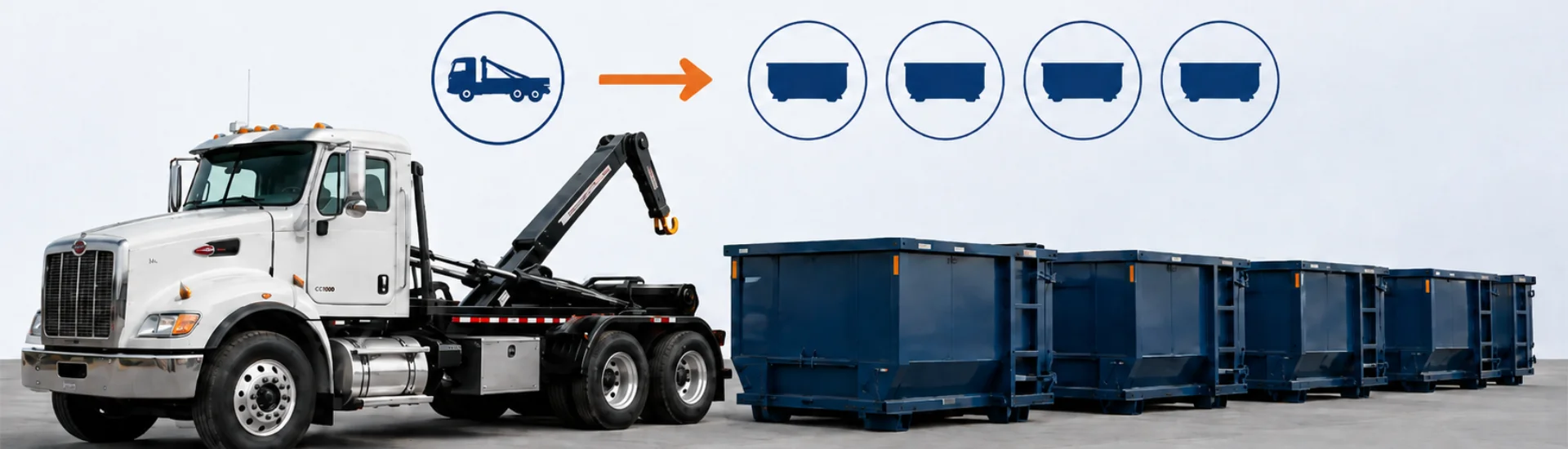
How Many Hooklift Bins Do You Need Per Truck?
A hooklift truck becomes much more useful when it has more than one bin to work with.
Unlike a fixed-body waste truck, a hooklift can leave one container at a customer site, collect another, transport it for disposal or processing and continue working with other bins throughout the day. That interchangeability is one of the main reasons hooklift systems are widely used across waste management, construction, demolition, recycling and industrial operations.
It also raises an important fleet-planning question:
How many hooklift bins should you have for each truck?
There is no universal ratio.
For some operations, two or three bins may be enough to keep a truck productive. A waste contractor servicing multiple customer sites may have dozens of containers in circulation for each truck. The right number depends less on the truck itself and more on how long bins remain away from it.
A useful way to think about the relationship is simple:
The truck moves. The bins wait.
Your container fleet needs to be large enough that the truck is not regularly waiting for a bin to become available.
Why One Bin Per Hooklift Truck Usually Misses the Point
Technically, a hooklift truck can operate with one container.
Operationally, that arrangement gives up much of the flexibility that makes a hooklift system valuable.
Imagine a construction site with one truck and one bin.
The truck delivers the empty container and either remains connected to it or leaves without a container. When the bin becomes full, the truck returns, loads it, drives to the disposal facility, empties it and then brings the same container back.
During that process, the customer may have no bin available.
Add a second container and the operation changes.
The truck arrives with an empty bin, removes the full one and leaves the replacement behind. The customer can continue loading waste while the truck transports the full container.
The truck and bin are no longer tied together.
That separation is the foundation of an efficient hooklift fleet.
Wastecorp manufactures hooklift bins in standard and custom configurations ranging from smaller commercial containers through to large-volume bins for bulk waste and recycling applications. Having interchangeable containers available allows the same hooklift truck to perform different jobs without requiring a dedicated vehicle for every bin.
There Is No Standard Bin-to-Truck Ratio
A ratio such as three bins per truck or five bins per truck sounds convenient, but it can be misleading.
Consider two businesses that each operate one hooklift truck.
The first business uses the vehicle inside a recycling facility. Containers are positioned around the site and exchanged frequently, but they remain relatively close to the truck.
The second operates a commercial waste collection service with bins permanently positioned at customer sites across Sydney.
The first operation may work efficiently with a relatively compact pool of containers.
The second could require many bins for one truck because most containers spend their time sitting at customer premises rather than travelling on the vehicle.
The better question is therefore:
How many bins are simultaneously required across your operation?
That usually includes:
- bins positioned at active customer or work sites
- bins currently being transported
- bins at transfer, disposal or processing facilities
- bins waiting to be cleaned or maintained
- spare containers available for unexpected demand
- additional bins required during peak periods
Once those positions are mapped, the required container fleet becomes much easier to estimate.
A Simple Way to Calculate How Many Hooklift Bins You Need
A practical starting formula is:
Required bins = active site bins + turnaround bins + operational spares
Suppose one hooklift truck services five recurring customer sites.
Each site needs a container permanently available, so five bins are already committed.
The truck also needs the ability to exchange a full container without leaving a customer without a bin. Depending on how the route operates, at least one additional container may therefore be moving through the collection and disposal cycle.
The operator also decides to keep one compatible bin at the depot for urgent replacements, repairs or unexpected jobs.
That gives an illustrative fleet of:
5 site bins + 1 turnaround bin + 1 spare = 7 bins
This does not mean seven bins per truck is an industry standard.
It means this particular operating model requires seven container positions to function without unnecessary interruptions.
Another company with the same truck but only two active construction projects may need far fewer. A large waste contractor servicing 30 permanent customer locations may require considerably more.
Bin Dwell Time Has a Major Effect on the Ratio
One of the most useful figures to measure is bin dwell time.
Dwell time is how long a container remains at a site before it is ready for collection.
Consider a construction bin that takes two weeks to fill.
For most of those two weeks, the truck is somewhere else. The bin is effectively working independently as a stationary waste asset.
Now compare that with a high-volume recycling operation where a container fills every few hours.
The second bin spends far less time sitting idle, but the operation may require several containers cycling rapidly between loading points and processing areas.
Long dwell times generally mean more containers can be deployed per truck because each truck can service a larger number of bins distributed across different locations.
Short dwell times create different pressures. The operator needs enough immediately available containers to maintain the exchange cycle without creating queues or stopping waste handling.
This is particularly relevant for recycling facilities, where containers can be continuously rotated between material streams, loading areas and processing points.
Service Frequency Matters More Than Fleet Size Alone
Two fleets with ten bins may use them completely differently.
If every container requires collection once per month, one hooklift truck may comfortably service the entire pool.
If every bin needs collection once per day, the same container fleet could overwhelm a single vehicle.
When planning the number of hooklift truck bins required, look at both:
how many bins are deployed
and
how frequently each bin needs to move
A basic utilisation review can record:
| Operational Factor | What to Measure |
| Active sites | Number of locations requiring a bin |
| Collection frequency | Daily, weekly, fortnightly or on demand |
| Average fill time | How long each bin remains on site |
| Disposal turnaround | Time from collection to bin availability |
| Route distance | Travel between customers and disposal points |
| Material stream | General waste, recycling, demolition, industrial waste |
| Spare requirement | Containers kept available for breakdowns or urgent work |
| Seasonal demand | Additional bins needed during peak periods |
These figures tell you much more than the number of trucks in the fleet.
More Bins Can Increase Truck Utilisation
A truck is generally the more complex and expensive mobile asset in a hooklift operation.
If a lack of containers causes that vehicle to sit idle, return to the depot unnecessarily or wait for customers to finish loading, the business is not getting the full benefit of the hooklift system.
Additional bins allow more of the waste cycle to happen without the truck being present.
For example, while one bin is being filled at a demolition project, another can be at a recycling facility, another can be awaiting collection from a commercial customer and another can be positioned at the depot.
The hooklift truck connects these separate activities.
This model is especially useful for waste management companies servicing multiple customers because adding another contract may require another container without immediately requiring another truck.
Eventually vehicle capacity becomes the constraint, but container capacity and truck capacity do not necessarily need to grow at the same rate.
More Bins Can Also Reduce Turnaround Pressure
Consider what happens when a customer calls to say a container needs to be exchanged earlier than expected.
With no spare bins available, the operator may have to alter the route, find another container that can be released or wait until an existing bin becomes available.
With suitable spare inventory, the truck can collect a compatible empty container and complete the exchange.
That flexibility becomes more valuable as the fleet grows.
Consider what happens when a customer calls to say a container needs to be exchanged earlier than expected.
With no spare bins available, the operator may have to alter the route, find another container that can be released or wait until an existing bin becomes available.
With suitable spare inventory, the truck can collect a compatible empty container and complete the exchange.
That flexibility becomes more valuable as the fleet grows.
It can also help during:
- unexpected customer demand
- project overruns
- damaged bins
- scheduled maintenance
- changes in waste volume
- additional short-term jobs
- peak construction periods
The purpose of spare capacity is not to have large numbers of unused bins sitting permanently at the depot. It is to prevent a small container shortage from disrupting a much more valuable truck, route or customer relationship.
But More Bins Are Not Automatically Better
There is a point where extra containers stop improving utilisation.
Bins require capital, storage space, maintenance and management.
A company that buys containers faster than it can deploy them may simply create a yard full of underused assets.
The objective is therefore not to achieve the highest possible bin-to-truck ratio.
It is to have enough bins that container availability is rarely the reason a truck cannot perform productive work.
A useful fleet review can identify bins that have remained unused for long periods, containers that are constantly unavailable and particular sizes that regularly become bottlenecks.
Those utilisation patterns can guide the next purchase more reliably than applying a fixed ratio across the entire fleet.
Different Bin Sizes Need to Be Considered Separately
A fleet may technically own 20 hooklift bins but still have a shortage.
Why?
Because the customer may require a particular type or size.
An operation could have plenty of high-volume recycling containers while experiencing constant demand for smaller heavy-duty construction bins.
Container count alone therefore does not tell the full story.
Wastecorp’s hooklift bin range covers capacities from approximately 1.5m³ to 70m³ for different waste and material applications.
Operators should monitor utilisation by bin category, not just total fleet size.
For example:
- small heavy-material bins
- general waste containers
- high-volume recycling bins
- demolition bins
- specialised industrial containers
- custom-purpose bodies
This is particularly important for construction operations where the appropriate container can vary considerably according to material density, site access and project stage.
Standardisation Can Make Every Bin More Useful
The number of bins in a fleet matters less if half of them cannot work with the truck that arrives to collect them.
Compatibility should be considered whenever additional hooklift containers or vehicles are introduced.
Hook height, rail dimensions, container length, locking arrangement and equipment configuration can affect whether a particular bin can be handled by a particular truck.
Standardising these features where practical increases interchangeability.
Instead of managing separate pools of equipment, the operator gains a larger common pool of containers that can be allocated according to demand.
Wastecorp also offers multi-rail hooklift systems for applications where compatibility across differing container configurations is required.
For growing fleets, this should be considered before additional bins are ordered. A slightly larger pool of fully interchangeable containers may provide greater operational flexibility than a much larger collection of incompatible bodies.
Hooklift Trailers Can Change the Equation
The number of bins a truck can move during a route is another consideration.
A hooklift trailer can allow an operation to transport an additional compatible container as part of the vehicle combination where the configuration and operating conditions permit.
Wastecorp supplies standard and tipping hooklift trailer options, with 1060mm rail width listed as standard, for applications including waste collection, recycling and commercial or industrial transport.
For some fleets, trailers can improve container repositioning between depots, customer sites and transfer locations rather than increasing the number of powered vehicles.
They do not eliminate the need for adequate container inventory, but they can change how efficiently that inventory moves around the network.
Don’t Forget Bins That Are Temporarily Out of Service
A fleet plan based on every container being available every day is likely to be too optimistic.
Hooklift bins operate in demanding environments.
Construction waste, demolition material, scrap, industrial waste and repeated loading cycles can eventually require repairs or maintenance. Doors, rollers, locks and structural components also need to remain serviceable.
If ten containers are needed operationally and the business owns exactly ten, a single damaged bin immediately creates a shortage.
A modest spare allowance provides room for maintenance without forcing the operating fleet below its required level.
The same principle applies to the hooklift equipment itself. Wastecorp provides parts and servicing for supplied waste equipment to support ongoing fleet operation.
Route Planning Should Determine Container Investment
A good hooklift fleet plan starts with the service network.
Map where bins are located, how quickly they fill and where they travel after collection.
Then look at the truck.
How many exchanges can it realistically complete in one shift? How much time is spent driving empty? How often does it return to the depot? How frequently does a driver arrive at a site without an immediately available replacement container?
Those questions expose where additional bins may create real value.
The National Heavy Vehicle Regulator notes that loading plans can provide a repeatable process for selecting vehicles, positioning loads and defining loading requirements, helping streamline operations while supporting compliance.
Operational efficiency should still work within safe loading and restraint requirements. The NHVR’s current Load Restraint Guide provides guidance for determining appropriate restraint systems for heavy vehicle loads.
Container availability should make routes easier to manage, not encourage rushed loading or unsuitable transport practices.
When Does It Make Sense to Buy More Bins?
Additional hooklift bins are worth considering when container availability is becoming a recurring constraint.
Common signs include trucks waiting for bins, customers regularly waiting for exchanges, frequent reshuffling of containers between sites, inability to accept short-notice work or certain bin sizes being permanently committed.
Another strong signal is business growth without equivalent truck utilisation.
If the existing hooklift truck still has capacity to complete additional collections but there are not enough containers to place at new customer sites, investing in bins may expand the serviceable customer base without immediately purchasing another truck.
That can be one of the strongest advantages of the hooklift model.
A new customer does not necessarily require a new vehicle.
Sometimes it requires another compatible bin.
When Do You Need Another Truck Instead?
Eventually, adding containers stops solving the problem.
If bins are available but collections are consistently delayed because the existing truck cannot complete enough movements, vehicle capacity has become the constraint.
Signs may include:
- routes regularly reaching their practical daily limit
- containers waiting longer than planned for collection
- excessive overtime
- increasing dead running between distant service areas
- customer growth exceeding available collection slots
- too much dependence on a single vehicle
At this point, increasing the hooklift fleet may be more appropriate than continuing to add containers.
This distinction is important.
Too few bins create an asset-availability problem.
Too few trucks create a transport-capacity problem.
Knowing which constraint you actually have can prevent unnecessary equipment purchases.
Finding the Right Hooklift Bin Ratio for Your Fleet
There is no magic figure such as three, five or ten hooklift bins for every truck.
A contractor servicing long-term customer sites may operate many containers per vehicle. A construction company moving a small number of bins between its own projects may need far fewer. A recycling facility may require a pool of containers that turns over several times within a single day.
Instead of targeting an arbitrary ratio, determine:
How many bins need to be deployed at the same time?
Then add enough turnaround and spare capacity to prevent the container fleet from restricting the truck.
As the operation grows, track utilisation by container size and type. The data will show which bins are working continuously, which are creating shortages and which spend most of their time unused.
That gives you a fleet ratio based on your actual business rather than somebody else’s.
Wastecorp supplies standard and custom hooklift bins, hooklift systems and hooklift trailers for waste, recycling, construction and industrial fleets across Australia.
If you are expanding an existing hooklift fleet or planning the container requirements for a new truck, contact Wastecorp Equipment to discuss compatible bin sizes and configurations for your operation.
FAQ’s
How many hooklift bins should I have per truck?
There is no fixed number. The right ratio depends on how many sites need containers, how long bins remain at those sites, collection frequency, disposal turnaround and how much spare capacity the operation requires. Calculate the number of bins simultaneously committed to the operation rather than applying a generic ratio.
Is two hooklift bins per truck enough?
For a simple operation, two bins may allow basic exchange capability because the truck can replace a full container with an empty one. Multi-site waste contractors generally require more because containers remain deployed at customer locations while the truck continues servicing other sites.
Can one hooklift truck service many bins?
Yes. This is one of the main operational advantages of hooklift equipment. A single truck can service numerous compatible containers positioned across different sites, provided collection frequency and route distances remain within the vehicle’s available working capacity.
Should I buy another hooklift bin or another truck?
Look at the current constraint. If the truck has available collection capacity but cannot service additional customers because there are not enough bins, additional containers may be the better investment. If bins are available but collections are delayed because the truck cannot complete enough movements, additional vehicle capacity may be required.
Should I keep spare hooklift bins?
Some spare capacity is useful for maintenance, damaged containers, urgent customer requests and temporary increases in demand. The appropriate number depends on fleet size and how easily another compatible bin can be substituted.
Do all hooklift bins work with every hooklift truck?
No. Compatibility can depend on rail dimensions, hook height, container length, locking systems and the hooklift configuration. Existing fleet dimensions should be checked before ordering additional containers.
Does having more hooklift bins improve fleet utilisation?
It can. Additional bins allow waste to accumulate at customer or work sites while the truck performs other jobs. Once enough bins are available to meet site and exchange requirements, however, further containers provide diminishing benefit unless demand is also increasing.

 Member of Waste Contractors and Recyclers Association of NSW.