

How Much Can a Hooklift Truck Carry? Payload Guide
How Much Can a Hooklift Truck Carry? Payload, Bin Size and Load Considerations
One of the first questions operators ask when choosing a hooklift truck is simple: how much can it actually carry?
The answer needs a little more consideration than the tonne rating printed on a hooklift specification sheet.
A hooklift truck’s real carrying capacity depends on the truck chassis, Gross Vehicle Mass (GVM), completed vehicle tare weight, hooklift system, empty bin weight, axle configuration and the material being transported. A large bin does not necessarily mean a large payload, and a hooklift rated to lift 20 tonnes does not automatically mean the completed truck can legally carry 20 tonnes of material on the road.
Understanding how these figures work together is essential when specifying a hooklift system for waste collection, construction, demolition, recycling or industrial operations.
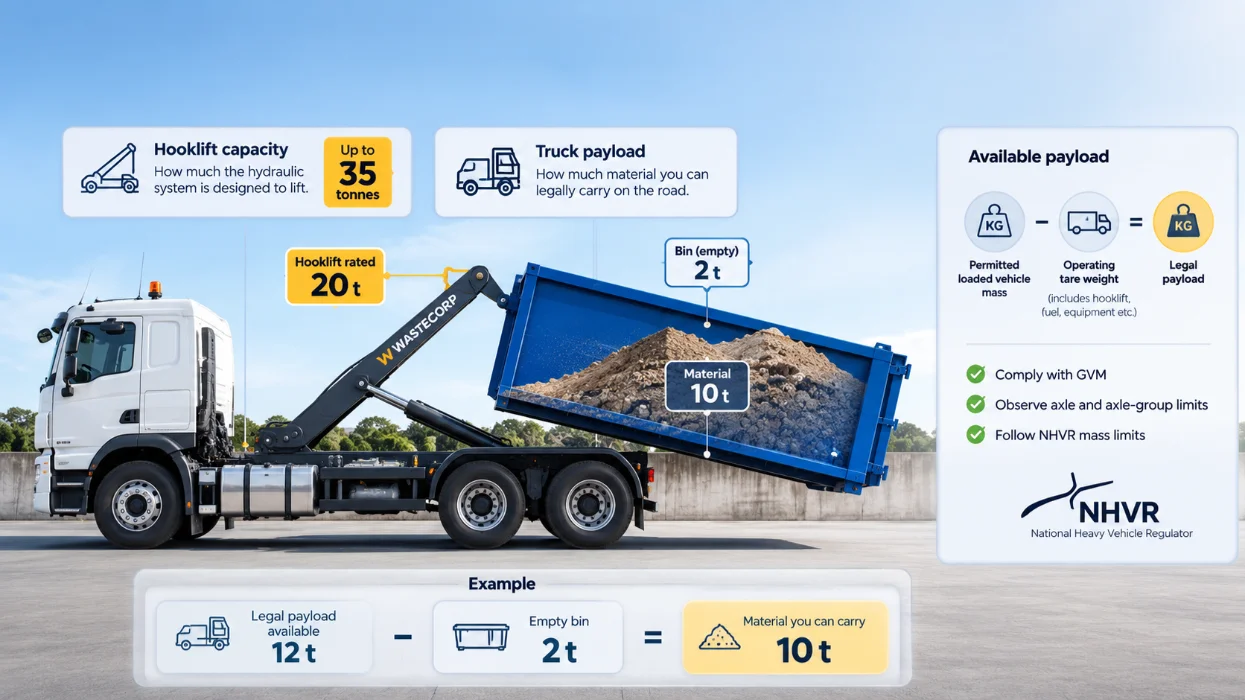
Hooklift Capacity and Truck Payload Are Different Figures
A common source of confusion is the difference between the rated capacity of the hooklift equipment and the legal payload capacity of the completed vehicle.
The hooklift rating tells you how much the hydraulic loading system is designed to handle under its specified operating conditions. Wastecorp, for example, supplies hooklift systems across a broad range of capacities, from smaller systems through to heavy-duty 35-tonne models.
A truck’s road-going payload is calculated differently.
At a basic level:
Available payload = permitted loaded vehicle mass minus the truck’s operating tare weight
The operating tare weight includes more than the chassis. Once the truck has been fitted with the hooklift assembly, fuel, equipment and other permanent components, that completed vehicle weight must be considered.
The empty hooklift bin also consumes some of the remaining payload.
For example, imagine a completed truck has 12 tonnes of legal payload available before the bin is loaded. If the empty bin weighs 2 tonnes, approximately 10 tonnes remains for the material inside it, subject to axle limits, vehicle ratings and other applicable restrictions.
That is why selecting equipment solely according to the hooklift’s nominal tonne rating can produce an incorrect payload calculation.
The Wastecorp 20 tonne hooklift specifications, for example, list models with a maximum loading capacity of 20 tonnes and a recommended minimum GVW of 26 tonnes. Those specifications describe the equipment requirements. The legal mass of the completed vehicle still needs to comply with the applicable truck and road limits.
In Australia, the National Heavy Vehicle Regulator states that loaded vehicle mass must not exceed applicable mass limits or the manufacturer’s ratings, including the GVM of a rigid vehicle. Axle and axle-group limits must also be observed. NHVR General Mass Limits guidance should therefore be considered when determining the usable capacity of a heavy vehicle.
Why Hooklift Bin Size Does Not Tell You How Much You Can Carry
Hooklift bins are normally described according to their volume in cubic metres. This tells you how much physical space is available inside the container, not how much that material weighs.
Wastecorp supplies hooklift bins ranging from approximately 1.5m³ through to 70m³, including standard and custom configurations for different industries and waste streams.
A 30m³ bin filled with lightweight packaging waste may remain well below the truck’s available payload.
The same 30m³ container loaded with soil, concrete or dense demolition material could exceed the allowable payload well before the bin is physically full.
This distinction between volume and mass is one of the most important considerations when specifying hooklift equipment.
A useful estimate is:
Material weight = material density × volume
If a material has an average bulk density of 500kg/m³ and 20m³ is loaded, the material alone would weigh approximately 10,000kg, or 10 tonnes.
Real waste streams are rarely perfectly consistent, however. Moisture, compaction, contamination and the mixture of materials inside a bin can substantially change its final weight. Density calculations are useful for planning, but weighbridge data from your own operation is much more valuable when available.
Material Density Can Change the Right Bin Completely
Two businesses operating similar hooklift trucks may require very different bins because they transport different materials.
A business collecting cardboard, packaging, plastics or other bulky recyclable material usually reaches the physical capacity of the bin before reaching the maximum available payload.
Operators transporting concrete, bricks, soil, masonry or scrap material face the opposite problem. These materials can produce significant weight in a relatively small volume, so using the largest available bin may provide little practical advantage.
This becomes particularly important for construction waste operations and demolition waste handling, where a single bin may contain concrete, timber, soil, masonry, metal and mixed debris.
The ideal bin should therefore be selected around the material being transported rather than simply choosing the greatest cubic capacity the truck can physically accommodate.
| Material Type | Typical Loading Behaviour | Main Capacity Consideration |
| Cardboard and packaging | High volume, relatively low weight | Bin volume |
| General commercial waste | Variable density | Volume and payload |
| Green waste | Often bulky before becoming weight-limited | Bin volume |
| Mixed construction waste | Highly variable | Payload and axle loading |
| Soil, concrete and masonry | High weight at relatively low volume | Payload |
| Scrap metal | Density varies considerably | Payload and weight distribution |
| Recycling material | Depends heavily on material and compaction | Volume, payload and operating method |
This is why hooklift fleets often operate several bin sizes rather than attempting to use one container for every job.
The Empty Bin Uses Part of Your Payload
The tare weight of the container is easy to overlook.
Heavy-duty bins designed for construction, demolition and industrial use may require reinforced floors, thicker walls, stronger doors and additional structural components. Those features are valuable for durability, but they also increase the empty container’s weight.
Suppose two bins provide the same nominal volume but one weighs 800kg more because it has been constructed for a particularly demanding application. That additional 800kg effectively reduces the material payload available on the truck by the same amount if all other limits remain unchanged.
When evaluating a hooklift setup, consider:
- truck and chassis tare
- hooklift assembly weight
- fuel and permanently carried equipment
- driver and operational equipment where relevant to the calculation
- empty container weight
- expected material weight
- applicable vehicle, axle and road mass limits
The objective is not simply to fit the largest possible bin. It is to create a truck and bin combination that maximises useful payload without unnecessarily increasing tare weight.
Axle Loading Can Limit Capacity Before GVM Does
Staying below the vehicle’s overall GVM does not necessarily mean the truck is legally or safely loaded.
How the weight sits across the vehicle matters.
The NHVR notes that load position can affect stability, steering, braking and axle mass. A load positioned too far forward or rearward can change how weight is distributed between axle groups even where total vehicle mass remains within the overall limit. NHVR guidance on load distribution specifically highlights the relationship between load positioning, vehicle behaviour and axle mass limits.
Hooklift configuration, wheelbase, container length and the position of the material inside the bin can therefore influence usable payload.
This becomes particularly relevant with uneven loads.
A bin containing scrap, broken concrete or demolition waste may look reasonably balanced from outside while a large proportion of its mass is concentrated toward one end. Liquid and sludge applications introduce another set of considerations because the contents can move within the body if the container is not specifically designed for the application.
The truck needs to be considered as a complete system rather than treating the hooklift, chassis and container as separate pieces of equipment.
Hooklift Lifting Capacity Still Matters
While the hooklift rating does not equal legal road payload, it remains an essential part of equipment selection.
The system must have sufficient capacity to safely lift and lower the expected loaded container.
Wastecorp’s hooklift range illustrates how widely these requirements can vary. Smaller systems such as the 6 tonne hooklift are available for lighter applications, while 20, 26, 30 and 35 tonne configurations are designed for progressively heavier operating requirements. Wastecorp’s 26-tonne models, for example, list maximum loading capacities of up to 26 tonnes depending on the model.
The correct system should provide appropriate capacity for the loaded bodies it is expected to handle rather than being specified around an average load that may occasionally be exceeded.
Operators should also consider how frequently the truck will load and unload bins. A hooklift performing numerous cycles every day in a waste transfer operation has a different duty profile from a truck moving lighter containers occasionally.
For businesses assessing hooklift equipment for the first time, our guide to how a hooklift truck works explains the loading system, container handling process and common applications in more detail.
The Biggest Bin Is Not Always the Most Productive Bin
Fleet productivity is usually about moving the greatest useful payload efficiently, not simply carrying the greatest possible volume.
Consider a truck servicing a recycling facility where most loads consist of cardboard and light packaging. A high-volume container can reduce the number of collection cycles because volume is likely to become the limiting factor before vehicle mass.
Now consider the same truck transporting concrete rubble.
A substantially smaller container may carry all the weight the vehicle can legally accommodate. Increasing the bin from 10m³ to 20m³ may provide no useful additional payload if the truck reaches its mass limit when the bin is only partly filled.
This is particularly important for recycling facilities and waste management companies running multiple waste streams.
Matching bin capacity to individual waste streams can improve fleet utilisation and make legal loading easier for operators to manage.
What Should You Check Before Choosing a Hooklift Truck?
Start with what the truck will actually do each day.
Look at your current bin weights, weighbridge records and the heaviest loads the vehicle is likely to encounter. Consider whether those loads are occasional exceptions or part of normal operation.
Next, determine the required bin dimensions and volumes. The truck may need to service existing containers, which makes rail dimensions, hook height, container length and compatibility just as important as capacity.
The hooklift rating can then be matched to the expected loaded-bin weight.
Finally, assess the completed vehicle combination against GVM, axle loading and relevant road-access requirements. A suitable engineering and vehicle specification process should account for the chassis, hooklift equipment, container and intended load together.
For operations with unusual containers or specialised waste streams, a custom bin or hooklift configuration may be more effective than trying to adapt a standard system to the job.
Don’t Forget Load Security
Payload is only one part of transporting material safely.
The load also needs to remain contained and appropriately restrained during transport. This can involve container design, doors, covers, locking arrangements and other restraint systems depending on what is being carried.
The NHVR Load Restraint Guide provides guidance on loading and restraint practices for heavy vehicles, including methods for preventing loads from moving or becoming dislodged during transport.
For waste operators, this is particularly relevant where loads contain loose, irregular or potentially shifting material.
So, How Much Can a Hooklift Truck Carry?
There is no single payload figure that applies to every hooklift truck.
The practical capacity is determined by the lowest applicable limit within the complete setup. That may be the hooklift’s rated lifting capacity, the truck’s available payload, GVM, an axle-group limit, the container itself or another applicable vehicle or road restriction.
In practical terms, you need to know:
Truck capacity: What can the completed vehicle legally carry?
Hooklift capacity: What loaded container weight is the hooklift system rated to handle?
Bin tare: How much does the empty container already weigh?
Bin volume: How many cubic metres of material can physically fit?
Material density: How quickly will that volume convert into weight?
Weight distribution: How will the loaded container affect individual axle groups?
When these figures are considered together, operators can select a truck and container combination that delivers useful capacity without relying on guesswork.
For businesses comparing hooklift systems in Australia, Wastecorp supplies hooklift equipment across a wide range of capacities together with standard and custom hooklift bins for waste, recycling, construction and industrial applications.
If you know your chassis, typical material, required bin size or expected loaded-bin weight, contact Wastecorp Equipment to discuss a hooklift configuration suited to the way your fleet actually operates.
FAQ’s
Does a 20 tonne hooklift mean the truck can carry 20 tonnes of waste?
Not necessarily. A 20-tonne rating generally refers to the hooklift system’s maximum loading capacity. The actual amount of material the truck can legally transport depends on the completed truck’s tare weight, permitted vehicle mass, bin weight, axle limits and other applicable restrictions.
Does a larger hooklift bin increase payload?
A larger bin increases volume, not necessarily payload. It can be valuable for lightweight materials such as cardboard or bulky general waste. With dense materials such as concrete or soil, the truck may reach its allowable mass before a large bin is full.
How do I calculate the usable payload of a hooklift truck?
Start with the applicable permitted loaded mass for the vehicle and subtract the truck’s operating tare weight. Then account for the empty bin and any other equipment contributing to vehicle mass. Axle-group limits and equipment ratings must also be checked rather than relying on the overall figure alone.
What size hooklift bin should I use for construction waste?
It depends on the type of construction waste. Lightweight timber and packaging may suit larger-volume bins, while concrete, soil, bricks and other dense materials generally require greater attention to payload and may be better suited to smaller containers. Historical weighbridge data is particularly useful when selecting bin capacity.
What is the best way to choose a hooklift truck in Australia?
Work backwards from your real operating requirements. Identify typical and maximum loaded-bin weights, container sizes, material types and daily loading cycles. These figures can then be matched against the chassis, hooklift rating, bin design and applicable Australian heavy-vehicle mass requirements.

 Member of Waste Contractors and Recyclers Association of NSW.