
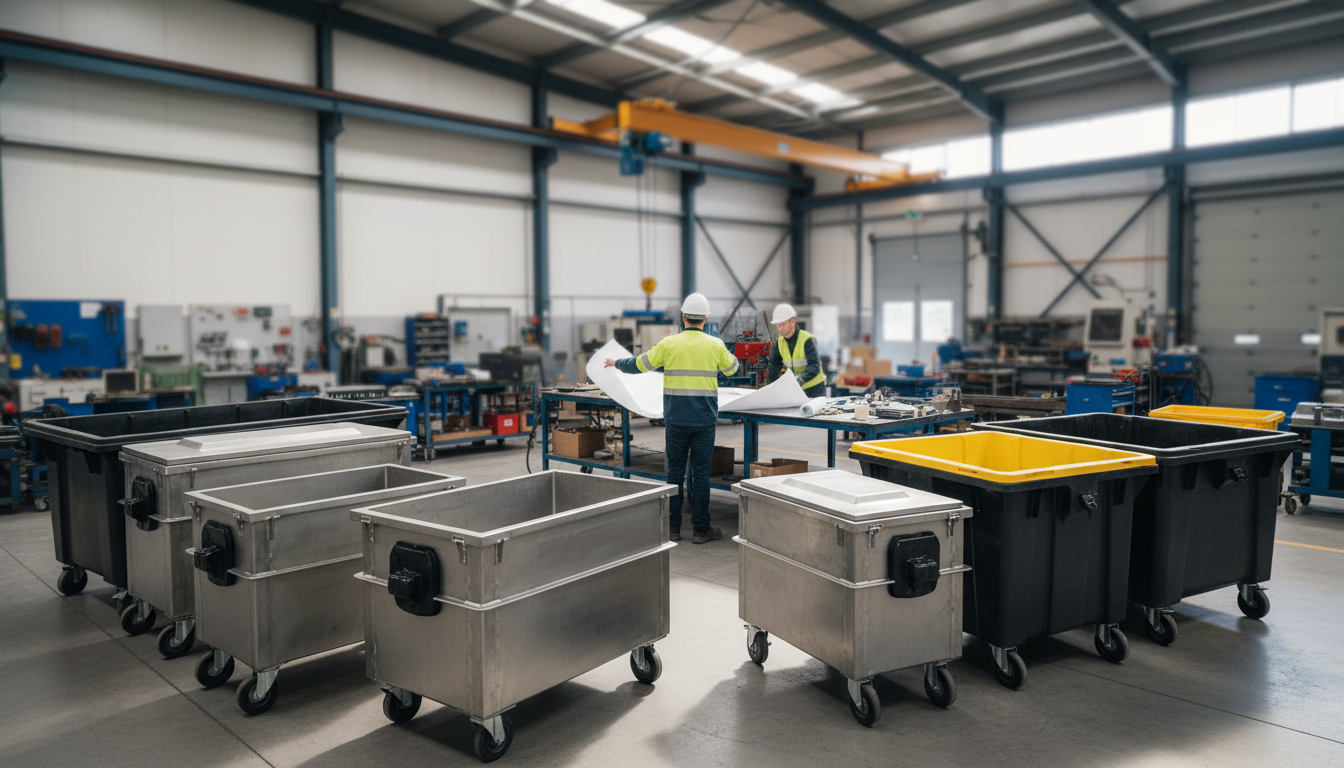
Procurement teams evaluating custom industrial bin investments face a persistent challenge: understanding how engineering specifications translate to budget impact without transparent cost breakdowns. The cost of custom industrial bins in Australia varies significantly based on material grade selection, fabrication complexity, and compliance certification requirements, yet suppliers rarely explain which technical decisions drive the largest price differentials. Fleet managers at Wastecorp Equipment’s St Marys facility consistently request clarity on how structural steel grades, payload capacity specifications, and AS 4024.1 safety compliance certification affect total project costs before committing capital to custom fabrication.
The Australian Bureau of Statistics reported 75.8 million tonnes of waste generated nationally in 2020-21, with construction and demolition waste representing 25.2 million tonnes requiring specialised bin handling capacity (ABS, Waste Account Australia Experimental Estimates 2021). This volume drives demand for application-specific bin designs engineered to handle high-impact loads, abrasive materials, and Heavy Vehicle National Law (HVNL) mass limits that directly influence material selection and structural reinforcement costs. Understanding these cost drivers enables informed procurement decisions that balance upfront investment against total cost of ownership over a ten to fifteen year asset lifecycle.
Industry Data
- —The Australian Bureau of Statistics reported 75.8 million tonnes of waste generated nationally in 2020-21, with construction and demolition waste representing 25.2 million tonnes requiring specialised bin handling capacity (ABS, Waste Account Australia Experimental Estimates 2021)
- —The National Waste Policy 2018 targets an 80% average recovery rate from all waste streams by 2030, driving demand for application-specific bin designs that facilitate source separation and contamination reduction (Department of Climate Change, Energy, the Environment and Water)
Material Grade and Thickness Requirements
Material selection represents the single largest cost variable in custom industrial bin fabrication. Structural steel grade 350 conforming to AS/NZS 3678-350 delivers yield strength of 350 megapascals compared to 250 megapascals for mild steel grade 250, providing superior impact resistance and fatigue life for high-cycle applications. This performance differential typically adds 20-30% to raw material costs, though the premium decreases proportionally as bin volume increases due to economies of scale in steel procurement.
Thickness specifications directly correlate with payload capacity and waste stream characteristics. Bins handling construction and demolition waste typically specify 4mm sidewall thickness and 6mm floor plate thickness to withstand impact loads from concrete, masonry, and steel offcuts. General waste applications may utilise 3mm sidewalls with 4mm floor plates, reducing material costs by approximately 15-20% while maintaining structural integrity for lower-density waste streams. The mild steel versus structural steel specifications decision fundamentally determines both initial investment and long-term maintenance costs, as thinner gauge mild steel requires more frequent wear plate replacement and structural repairs.
Reinforced wear strips at high-abrasion zones add 8-12% to fabrication costs but extend service life by 40-60% in abrasive waste applications. These strips, typically fabricated from 10mm Hardox 450 or equivalent wear-resistant steel, protect floor plates and lower sidewall sections from accelerated degradation. Procurement teams must evaluate whether upfront material grade investment reduces total cost of ownership through extended replacement intervals and reduced downtime for structural repairs.
Bin Volume and Payload Capacity
Bin volume directly influences cost per cubic metre, with larger capacity units achieving better material utilisation and lower fabrication costs per unit volume. A 20m³ bin typically costs 30-40% less per cubic metre than a 10m³ unit due to fixed setup costs, jig preparation, and AS 4024.1 certification expenses that apply regardless of size. However, payload capacity must remain compliant with Heavy Vehicle National Law mass limits, which restrict gross vehicle mass based on axle configuration and bridge formula calculations administered by the National Heavy Vehicle Regulator (NHVR).
A standard rigid truck with three axles operates under a 22.5 tonne gross vehicle mass limit, requiring careful calculation of tare weight (truck chassis, hooklift system, and bin) against payload capacity. A 20m³ bin fabricated from 4mm structural steel grade 350 typically weighs 1,800-2,200 kilograms, leaving approximately 16-17 tonnes for waste payload after accounting for truck and hooklift system weight. Specifying excessive bin volume without considering payload density creates compliance risk and operational inefficiency when handling high-density waste streams such as soil, concrete, or metal scrap.
The bin volume and payload capacity calculations must account for waste stream density, collection route characteristics, and NHVR mass limits to optimise cost per tonne hauled. Bins below 10m³ incur proportionally higher fabrication costs due to fixed engineering and certification expenses, making them cost-effective only for space-constrained sites or low-volume waste generators. Fleet standardisation on 15-20m³ capacity typically delivers optimal cost efficiency across mixed waste applications while maintaining HVNL compliance.
Fabrication Complexity and Welding Standards
Welding quality and fabrication complexity significantly impact both initial cost and long-term structural integrity. Continuous full-penetration welds on all structural joints add 15-20% to labour costs compared to intermittent tack welding, but eliminate stress concentration points that initiate fatigue cracks in high-cycle applications. Fabricators holding AS/NZS ISO 45001 certification and documented welding procedures provide quality assurance that justifies premium pricing through reduced warranty claims and extended service life.
Complex geometries such as tapered sidewalls for improved material discharge, integrated lifting eyes for crane handling, or reinforced corners for impact resistance increase fabrication time and jig setup costs. Standard rectangular bin designs with vertical sidewalls minimise welding complexity and material waste, reducing fabrication costs by 10-15% compared to custom geometries. However, application-specific requirements often justify this premium when improved discharge characteristics reduce cycle times or custom lifting configurations enable dual-purpose crane and hooklift compatibility.
Post-weld heat treatment for stress relief adds 5-8% to fabrication costs but proves essential for bins exceeding 15m³ capacity or handling high-impact loads. This process reduces residual stresses in welded joints that otherwise propagate fatigue cracks over thousands of loading cycles. Wastecorp Equipment’s St Marys facility specifies post-weld heat treatment on all structural steel grade 350 bins exceeding 12m³ capacity to ensure compliance with AS 4024.1 structural integrity requirements and deliver the service life expectations of Waste Contractors and Recyclers Association of NSW (WCRA) member operators.
Lifting System Compatibility and Rail Width
Rail width standardisation directly affects fabrication costs and fleet interoperability. The 1060mm rail width standard for European hooklift systems represents the most cost-effective specification due to widespread jig availability and optimised material cutting patterns. Custom 1200mm rail configurations add 10-15% to fabrication costs through increased material usage and custom jig setup, though fleet operators with existing 1200mm hooklift infrastructure must maintain this specification to preserve bin interchangeability across multiple truck chassis.
The hooklift compatibility and rail width standards determine structural reinforcement requirements at lifting points. Rails fabricated from 120mm x 80mm rectangular hollow section with 6mm wall thickness provide adequate strength for bins up to 18 tonnes gross weight, while heavier capacity units require 150mm x 100mm section with 8mm walls. This material upgrade adds 12-18% to rail fabrication costs but ensures compliance with AS 4024.1 load rating requirements and prevents structural failure at lifting points during high-angle tipping operations.
Lifting eye configurations for auxiliary crane handling add 300-500 dollars per bin through additional reinforcement plates and certified welding procedures. Four-point lifting eye arrangements provide balanced load distribution for crane operations but require engineering certification under AS 4024.1 to verify load ratings and safety factors. Fleet operators requiring dual hooklift and crane compatibility must specify this feature during initial fabrication, as retrofitting certified lifting eyes costs 40-60% more than integrated design due to access limitations and re-certification requirements.
Application-Specific Design Features
Hydraulic rear doors represent the most common application-specific feature, adding 15-25% to base bin costs through integrated cylinder mounting, hinge reinforcement, and hydraulic line routing. These systems enable controlled discharge of cohesive materials such as soil, clay, or wet organics that resist gravity discharge from standard open-top bins. Single-acting hydraulic cylinders with gravity return prove most cost-effective for applications requiring occasional door operation, while double-acting cylinders with position control add 30-40% to hydraulic system costs but provide precise discharge control for sensitive unloading environments.
Integrated weighing systems using load cell technology add 2,500-4,000 dollars per bin but deliver payload data that optimises truck utilisation and prevents NHVR mass limit violations. Four-point load cell configurations mounted at bin corners provide accurate weight measurement within 1-2% tolerance, enabling real-time payload monitoring through cab-mounted displays. This investment proves particularly cost-effective for operators handling variable-density waste streams where visual volume estimation creates compliance risk or suboptimal payload utilisation.
The construction and demolition waste bin specifications frequently include mesh sidewalls for green waste aeration, liquid containment bunding for contaminated soil transport, or drop-down tailgates for compactor integration. Each feature adds 8-15% to fabrication costs through additional material, welding complexity, and engineering certification requirements under AS 4024.1. Procurement teams must evaluate whether application-specific features deliver operational efficiency gains that justify premium pricing, or whether standard bin designs with operational workarounds provide better cost-effectiveness for occasional use cases.
AS 4024 Safety Compliance and Certification Costs
AS 4024.1 safety of machinery compliance certification adds 1,200-2,500 dollars per bin design depending on complexity and feature integration. This standard mandates risk assessment documentation, guarding requirements for moving parts, and structural integrity verification through engineering calculations or physical testing. Custom bins incorporating hydraulic systems, integrated weighing, or complex lifting configurations require more extensive documentation and third-party verification, increasing certification costs proportionally.
Engineering sign-off from a registered professional engineer adds 800-1,500 dollars to certification costs but provides legal protection and insurance compliance verification. This documentation proves particularly important for bins exceeding 15 tonne capacity or incorporating custom lifting configurations that fall outside standard design parameters. Fleet operators subject to Protection of the Environment Operations Act 1997 (NSW) licensing requirements must maintain current AS 4024.1 certification for all waste handling equipment as part of regulatory compliance obligations.
Certification costs represent a fixed expense regardless of bin quantity, making fleet standardisation economically advantageous. A custom bin design certified once for AS 4024.1 compliance distributes certification costs across multiple units, reducing per-bin expense from 2,000 dollars for a single unit to 400-600 dollars per bin for a ten-unit fleet order. This economy of scale favours standardised specifications across fleet operations rather than multiple custom designs for marginal application differences.
Standard Versus Custom Design Specifications
Standard bin designs based on proven geometries and common capacity specifications cost 25-35% less than fully custom fabrication due to existing jig infrastructure, established material cutting patterns, and pre-certified AS 4024.1 documentation. These designs typically cover 80% of general waste handling applications through 10m³, 15m³, and 20m³ capacity options with 1060mm rail width and structural steel grade 350 construction. Fleet operators with standard waste collection requirements achieve better cost-effectiveness through these proven designs rather than custom specifications that deliver marginal operational advantages.
The standard versus custom fabrication performance comparison demonstrates that custom specifications deliver measurable value only when application requirements fall outside standard design parameters. Specialised waste streams such as liquid waste transport requiring full containment bunding, or contaminated soil handling requiring certified load ratings for hazardous materials, justify custom engineering investment. General waste collection, construction debris handling, and mixed recyclables processing typically achieve optimal cost-effectiveness through standard capacity bins with proven structural designs.
Wastecorp Equipment maintains standard bin inventory in 10m³, 15m³, and 20m³ capacities with 1060mm rail width and structural steel grade 350 construction, enabling immediate deployment for fleet expansion or replacement requirements. Custom fabrication remains available for application-specific requirements that justify engineering investment, with full AS 4024.1 certification and WCRA membership quality standards applied to all fabrication work regardless of specification complexity.
Total Cost of Ownership Beyond Purchase Price
Total cost of ownership analysis over a ten to fifteen year asset lifecycle reveals that initial purchase price represents only 40-50% of true ownership costs. Maintenance access design significantly impacts repair efficiency and downtime costs. Bins with removable wear plates secured by bolted connections rather than welded installation reduce wear component replacement time from four hours to ninety minutes, delivering labour cost savings of 150-200 dollars per maintenance event. Over a typical service life requiring three to five wear plate replacements, this design feature saves 600-1,000 dollars in labour costs while reducing operational downtime.
Structural steel grade 350 construction extends service life by 40-60% compared to mild steel grade 250 in high-impact applications, deferring replacement capital expenditure and reducing lifecycle costs per tonne handled. A 15m³ bin fabricated from grade 350 steel typically achieves 12-15 years service life in construction waste applications compared to 7-9 years for grade 250 equivalent, distributing initial investment over significantly more operational cycles. This longevity advantage often justifies the 20-30% material cost premium through reduced annualised ownership costs.
Fleet standardisation delivers substantial cost advantages through interchangeable components, simplified maintenance procedures, and optimised spare parts inventory. A fleet of twenty standardised 15m³ bins requires inventory of two sets of wear plates, one hydraulic cylinder assembly, and common fastener hardware to support field repairs. An equivalent fleet of mixed custom specifications requires three to four times this inventory investment to maintain equivalent service availability, increasing working capital requirements and warehouse space costs.
The hydraulic system maintenance requirements for bins incorporating hydraulic rear doors or integrated compaction systems add 300-500 dollars annually in preventive maintenance costs including seal replacement, fluid changes, and hose inspection. These systems require technicians with hydraulic system competency and access to specialised diagnostic equipment, potentially necessitating third-party service contracts for operators without in-house hydraulic expertise. Standard mechanical bins eliminate these ongoing costs, though operational efficiency gains from hydraulic features often justify maintenance investment in high-cycle applications.
Residual value at end of service life favours quality construction and standard specifications. Well-maintained bins fabricated from structural steel grade 350 with documented maintenance history retain 15-25% of original purchase price in secondary markets, while custom specifications with proprietary features or non-standard dimensions achieve only 5-10% residual value due to limited buyer applicability. This residual value differential reduces true ownership costs and should factor into total cost of ownership calculations when comparing standard versus custom fabrication options.
- ✓
Specify steel grade (AS/NZS 3678 structural steel 350 for heavy-duty applications, grade 250 for general waste) - ✓
Confirm lifting system compatibility (1060mm standard rail width for European hooklifts, custom widths for proprietary systems) - ✓
Define payload capacity within Heavy Vehicle National Law mass limits for your truck configuration - ✓
Identify application-specific features (hydraulic doors, weighing systems, liquid containment, mesh sides) - ✓
Request AS 4024.1 compliance certification and engineering sign-off documentation - ✓
Calculate total cost of ownership including maintenance access, wear component replacement, and fleet standardisation benefits - ✓
Verify fabricator holds AS/NZS ISO 45001 certification and provides documented welding procedures
Frequently Asked Questions
What steel grade should I specify for a custom industrial bin handling construction waste?
Structural steel grade 350 (AS/NZS 3678-350) is standard for construction and demolition waste bins due to superior yield strength and impact resistance compared to mild steel grade 250. Thickness typically ranges from 4mm for sidewalls to 6mm for floor plates, with reinforced wear strips at high-abrasion zones to meet AS 4024.1 guarding requirements. This specification delivers 40-60% longer service life in high-impact applications compared to mild steel alternatives, justifying the 20-30% material cost premium through reduced replacement frequency and lower lifecycle costs per tonne handled.
How does bin volume affect the cost per cubic metre for custom fabrication?
Larger volume bins (20m³ and above) typically achieve lower cost per cubic metre due to economies of scale in material usage and welding time, though payload capacity must remain compliant with Heavy Vehicle National Law mass limits. Bins below 10m³ incur proportionally higher fabrication costs due to fixed setup and certification expenses regardless of size. A 20m³ bin costs approximately 30-40% less per cubic metre than a 10m³ equivalent, making larger capacity specifications more cost-effective for applications where truck payload capacity and site access permit. Fleet operators must balance volume efficiency against NHVR mass limits to avoid compliance violations when handling high-density waste streams.
What design features add the most cost to a custom industrial bin?
Hydraulic rear doors, integrated weighing systems, and custom lifting eye configurations add 15-30% to base fabrication costs. Additional complexity from waste stream-specific features such as liquid containment bunding, mesh sides for green waste aeration, or drop-down tailgates for compactor integration require engineering certification under AS 4024.1, increasing both design and compliance costs. Hydraulic rear doors typically add 15-25% through cylinder mounting and hinge reinforcement, while integrated weighing systems using four-point load cell configurations add 2,500-4,000 dollars per bin. Procurement teams should evaluate whether operational efficiency gains from these features justify premium pricing compared to standard mechanical bin designs with manual operation.
Are there cost differences between 1060mm and 1200mm rail width bins?
Standard 1060mm rail width bins compatible with most European hooklift systems cost 10-15% less than custom 1200mm configurations due to jig availability and material optimisation. However, fleet operators with existing 1200mm hooklift infrastructure must specify matching rail width to maintain interchangeability, making standardisation across the fleet the primary cost consideration rather than individual bin pricing. The 1060mm standard represents the most cost-effective specification for new fleet deployments or mixed hooklift environments, while established fleets with proprietary 1200mm systems must accept the fabrication premium to preserve operational flexibility and avoid compatibility issues that increase downtime costs.
Wastecorp Equipment provides engineering-grade custom bin fabrication with full AS 4024 compliance documentation and WCRA membership standards. Contact our St Marys facility for a detailed cost breakdown specific to your waste stream and fleet configuration.
Official distributor for MEC and OMB. Member of the Waste Contractors and Recyclers Association of NSW.

 Member of Waste Contractors and Recyclers Association of NSW.