
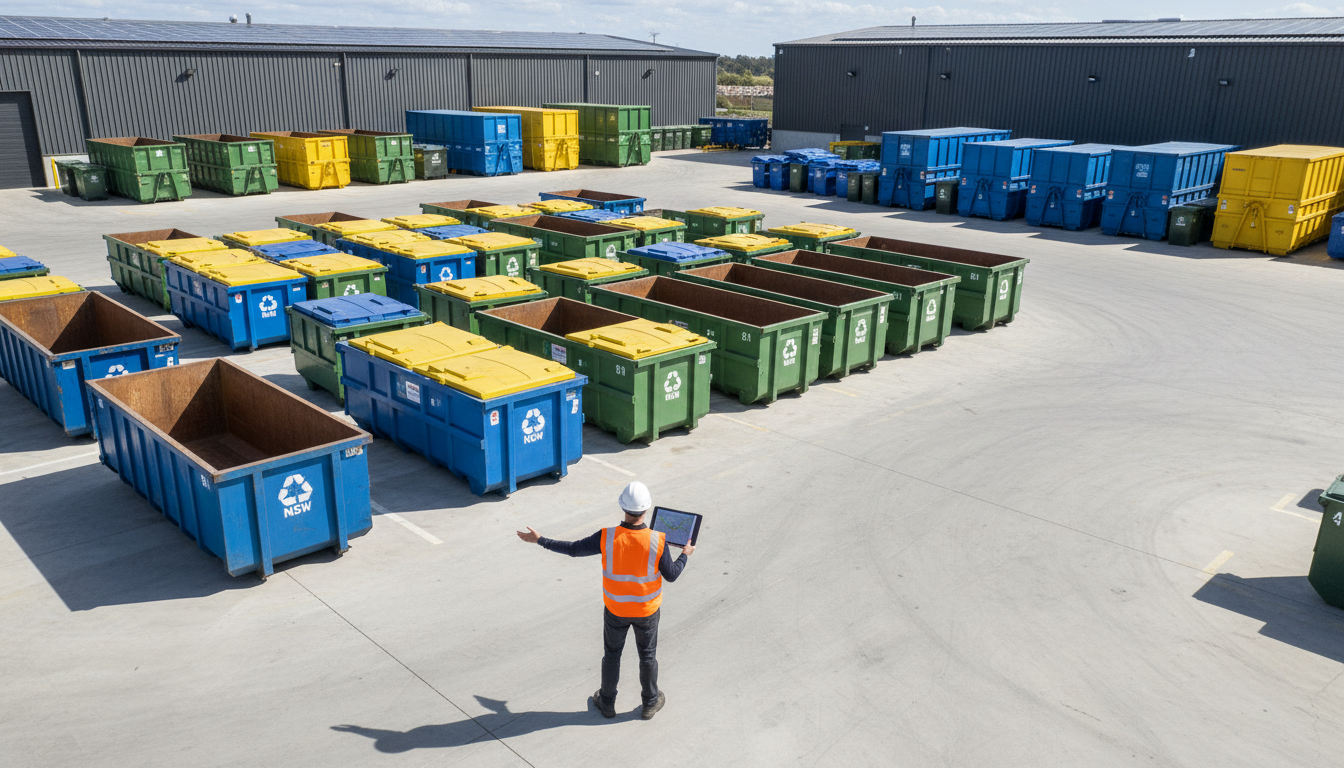
Fleet managers and waste contractors routinely face a critical procurement challenge: selecting custom industrial bins that maximise payload capacity while maintaining compliance with Heavy Vehicle National Law mass limits. Undersized bins increase collection frequency and operational costs, while oversized bins risk exceeding vehicle GVM limits or creating site access problems. This step-by-step guide provides a methodical approach to specifying custom industrial bins from 1.5m³ to 70m³ that integrate with existing collection systems, meet AS 4024 design requirements, and optimise total cost of ownership across your fleet.
Wastecorp Equipment engineers custom industrial bins for waste contractors and industrial facilities throughout NSW, with full compliance certification and payload optimisation for hooklift and skip loader fleets. As an official distributor for MEC and OMB and a member of the Waste Contractors and Recyclers Association of NSW (WCRA), we provide technical advisory services to support bin specification decisions that align with operational requirements and regulatory obligations.
Industry Data
- —The National Waste Policy 2018 (Cth) targets 80% average resource recovery rate by 2030, driving demand for segregated waste bins sized to match material-specific collection frequencies (Department of Climate Change, Energy, the Environment and Water)
- —NSW generated 20.8 million tonnes of commercial and industrial waste in 2020–21, with average bin utilisation rates of 65–75% indicating widespread oversizing in industrial applications (NSW Environment Protection Authority, Waste and Resource Recovery Data)
Material Density and Waste Stream Classification
Accurate material density measurement forms the foundation of correct bin sizing. Industrial waste streams vary significantly in density, from low-density packaging materials at 80–120kg/m³ to high-density masonry rubble at 1,200–1,600kg/m³. Using nominal density figures without site-specific verification leads to either payload underutilisation or Heavy Vehicle National Law non-compliance when actual loads exceed vehicle GVM limits.
Measure actual waste density by weighing representative loads over a minimum two-week period, capturing normal operational variability. For mixed industrial streams, calculate density by dividing total weight by bin volume at typical fill levels. Manufacturing facilities with consistent waste composition can use shorter measurement periods, while facilities with variable production cycles require four-week sampling to capture density fluctuations across different product runs.
Common industrial waste densities include municipal solid waste at 200–280kg/m³, mixed commercial waste at 150–220kg/m³, cardboard and packaging at 80–120kg/m³, mixed construction and demolition waste bin configurations at 600–900kg/m³, concrete and masonry at 1,200–1,600kg/m³, and metal scrap at 400–800kg/m³ depending on void space. These figures provide initial estimates only; site-specific measurement remains essential for accurate payload calculation.
For facilities handling multiple waste streams, specify separate bins sized to each material’s density and generation rate. The National Environment Protection (Used Packaging Materials) Measure encourages source separation, making material-specific bin sizing both operationally efficient and aligned with resource recovery targets under the National Waste Policy 2018 (Cth).
HVNL Mass Limits and Payload Calculation for Custom Industrial Bins
Heavy Vehicle National Law mass limits enforced by the National Heavy Vehicle Regulator (NHVR) establish maximum allowable payload for any bin and vehicle combination. A standard 6×4 hooklift truck operates at 26-tonne GVM, with typical chassis tare weight of 9,500–10,500kg. Subtracting chassis tare and bin tare weight from GVM yields maximum payload capacity, which must also satisfy NHVR axle load limits of 6.0 tonnes per single axle and 16.5 tonnes per tandem axle group under general access conditions.
Calculate maximum bin volume by dividing available payload by measured waste density. For example, a 26-tonne GVM truck with 10,000kg chassis tare and 1,800kg bin tare provides 14,200kg payload capacity. With municipal solid waste at 250kg/m³, maximum bin volume equals 14,200kg ÷ 250kg/m³ = 56.8m³. However, the same truck handling construction waste at 700kg/m³ supports only 14,200kg ÷ 700kg/m³ = 20.3m³ maximum volume.
Bin tare weight increases with volume and structural requirements. Standard hooklift bins range from 800kg for 8m³ mild steel construction to 3,500kg for 30m³ high tensile structural steel bins with reinforced floors for high-density materials. Custom bins over 30m³ typically require structural steel fabrication to AS/NZS 3678 Grade 350 specifications, adding 15–25% tare weight compared to mild steel equivalents but providing necessary structural integrity for heavy industrial applications.
Understanding hooklift system payload capacity ensures bin specifications align with vehicle lifting capacity and HVNL mass management provisions. Hooklift systems rated at 18–20 tonne lifting capacity can handle larger bin volumes, but total combination mass must remain within vehicle GVM and axle load limits regardless of hooklift rating.
Vehicle Compatibility and Collection System Integration
Custom industrial bins must integrate with existing collection equipment, whether hooklift, skip loader, or front-lift systems. Hooklift bins use standardised 1060mm rail width with hook pockets positioned according to bin length and load distribution requirements. Skip loader bins require lifting lugs or chains positioned to suit arm geometry and tipping angle, with practical length limits of 5.5–6.0m to maintain stability during lifting and tipping operations.
Evaluating skip loader versus hooklift operational constraints clarifies dimensional limits for each collection method. Hooklift systems accommodate bins up to 7.5m length on standard truck chassis, with larger bins requiring longer wheelbase vehicles. Skip loaders handle shorter bins more efficiently but provide faster cycle times for high-frequency collection routes with multiple stops.
Dual-compatible bins fitted with both hooklift rails and skip loader lifting points provide fleet flexibility but impose design compromises. Rail positioning for hooklift operation may not align with optimal skip loader balance points, and additional lifting hardware increases bin tare weight. Dual-compatible bins typically range 8–15m³ to suit both collection methods without exceeding skip loader tipping angle limits or hooklift centre of gravity constraints.
Hydraulic hoist capacity, boom reach, and subframe mounting dimensions vary between manufacturers and models. Verify bin rail positioning, hook pocket dimensions, and overall length suit your specific hooklift model before finalising custom bin specifications. Incompatible dimensions require either bin modification or hooklift system upgrades, both adding unexpected costs to procurement budgets.
Site Access Constraints and Bin Footprint Requirements
Physical site constraints often impose tighter limits on bin dimensions than vehicle payload capacity. Industrial facilities with limited manoeuvring space, narrow gates, or overhead clearances require careful measurement before specifying custom bin dimensions. Total vehicle length during bin placement equals truck wheelbase plus bin length plus overhang, typically 10.5–13.0m for standard hooklift combinations.
Measure turning circles, gate widths, and overhead clearances including power lines, building eaves, and loading dock structures. Bins positioned under cover require height clearance for both the bin itself and the hooklift boom during placement and removal operations. Standard hooklift operations require 5.5–6.0m overhead clearance for safe bin handling, increasing to 6.5–7.0m for bins over 25m³ with higher sidewalls.
Ground bearing capacity affects bin footprint requirements, particularly for high-density waste streams. A 20m³ bin filled with construction waste at 700kg/m³ generates 14,000kg ground load concentrated across approximately 8–10m² footprint, requiring 1.4–1.75 tonne/m² bearing capacity. Soft ground, asphalt surfaces in summer heat, or areas with underground services may require concrete pads or load distribution mats to prevent surface damage and bin settlement.
For facilities with severe space constraints, consider multiple smaller bins rather than a single large unit. Three 10m³ bins positioned in different locations often provide better operational flexibility than one 30m³ bin requiring dedicated placement area and longer collection vehicle access routes through the facility.
Bin Construction Standards and Material Selection for 1.5m³–70m³ Range
All custom industrial bins used in commercial waste operations must comply with AS 4024 (safety of machinery) design requirements, covering structural integrity, lifting point design, and operator safety provisions. Bins over 20m³ or handling high-density materials typically require engineering certification demonstrating compliance with AS/NZS 1418.1 for lifting appliances, particularly when custom fabrications deviate from standard designs.
Material selection depends on waste stream characteristics and expected service life. Understanding structural steel versus mild steel bin construction clarifies performance differences for heavy-duty applications. Mild steel suits general commercial waste and light industrial applications up to 15m³, while structural steel to AS/NZS 3678 Grade 350 specifications provides necessary strength for construction waste, metal scrap, or bins over 20m³ where structural loads exceed mild steel capacity.
Floor thickness ranges from 4mm for light commercial waste bins to 10mm for heavy construction waste handling. Sidewall thickness typically ranges 3–6mm depending on bin height and material density. Reinforcing ribs, cross-members, and corner gussets distribute loads and prevent sidewall deformation under heavy or uneven loading. Bins handling abrasive materials benefit from hardened steel floors or replaceable wear plates extending service life in high-volume operations.
Lifting point design must satisfy AS/NZS 1418.1 requirements for rated load capacity with appropriate safety factors. Hooklift rail mounting requires full-length welding to bin underframe with reinforcement plates at stress concentration points. Skip loader lifting lugs require minimum 20mm plate thickness with backing plates distributing loads into bin structure. Inadequate lifting point design causes premature failure and creates serious safety hazards under Protection of the Environment Operations Act 1997 (NSW) load security provisions.
Corrosion protection extends bin service life in outdoor applications or when handling wet waste streams. Hot-dip galvanising provides superior corrosion resistance compared to paint systems, particularly for bins stored outdoors or handling corrosive materials. Two-pack epoxy paint systems offer good protection at lower cost but require periodic maintenance and recoating to maintain effectiveness.
When Standard Bin Sizes Don’t Fit Operational Requirements
Standard bin sizes in 2m³ increments suit most applications, but specific operational requirements sometimes demand custom dimensions. Facilities with fixed collection schedules and known waste generation rates may require bins sized precisely to match weekly or fortnightly accumulation volumes, avoiding both overflow situations and excessive unused capacity.
Exploring custom fabrication for non-standard industrial applications addresses scenarios where standard bins cannot accommodate unusual waste profiles, site constraints, or integration requirements with existing material handling equipment. Custom fabrications include low-profile bins for height-restricted areas, extra-wide bins for bulky materials, and bins with integrated compaction systems or specialised discharge mechanisms.
Manufacturing facilities generating consistent waste volumes benefit from bins sized to match production cycles. A facility generating 18m³ of packaging waste per week gains no advantage from a standard 20m³ bin collected weekly, while an 18m³ custom bin optimises payload utilisation and reduces unnecessary tare weight. The modest premium for custom sizing—typically 8–15% over standard dimensions—delivers ongoing operational savings through improved vehicle utilisation and reduced collection frequency.
Specialised waste streams may require custom features beyond dimensional modifications. Bins handling food waste or organic materials benefit from sealed lids and drainage provisions. Bins for recyclable materials often incorporate segregation dividers or multiple compartments. Bins collecting hazardous or regulated wastes require labelling, bunding, or containment features satisfying Protection of the Environment Operations Act 1997 (NSW) requirements.
Total Cost of Ownership Across Bin Fleet
Bin procurement decisions require total cost of ownership analysis across purchase price, collection frequency, vehicle utilisation, and service life. Larger bins cost more initially but reduce collection frequency and associated labour, fuel, and vehicle operating costs. Smaller bins cost less individually but may require more frequent collection or multiple units to handle total waste volume.
Calculate cost per tonne collected by dividing total annual costs—including bin depreciation, collection frequency, vehicle costs, and disposal fees—by annual tonnage handled. A 15m³ bin collected weekly costs less per tonne than a 10m³ bin collected twice weekly, despite higher initial purchase price, because collection frequency drives total operating costs in most waste management operations.
Consider vehicle procurement and bin fleet integration when planning fleet expansion or replacement. Bins optimised for current vehicle specifications may not suit future fleet upgrades to higher GVM vehicles or different collection systems. Standardising bin dimensions across your fleet simplifies vehicle scheduling, driver training, and maintenance operations while providing flexibility to reassign bins between sites as operational requirements change.
Bin service life varies from 8–12 years for mild steel construction in general waste applications to 15–20 years for structural steel bins in well-maintained fleets. Higher initial investment in structural steel construction and corrosion protection delivers lower annualised costs when amortised over extended service life. Fleet managers should calculate lifecycle costs rather than focusing solely on initial purchase price when comparing bin specifications.
Wastecorp Equipment provides hire fleet options and finance arrangements supporting fleet expansion without large capital outlays. Hire arrangements suit short-term projects or facilities evaluating optimal bin sizing before committing to purchase, while finance options spread acquisition costs across bin service life, improving cash flow management for growing operations.
Custom Industrial Bins: Specification Checklist for Procurement
Use this checklist to ensure custom bin specifications address all operational, regulatory, and integration requirements before finalising procurement decisions.
- ✓
Calculate maximum payload: vehicle GVM minus chassis tare minus bin tare weight, verified against NHVR axle load limits - ✓
Measure actual waste density over minimum 2-week period for variable industrial streams - ✓
Confirm bin rail width (1060mm standard) and overall dimensions suit existing hooklift or skip loader equipment - ✓
Verify site access: bin length + truck wheelbase must clear turning circles, overhead clearances, and gate widths - ✓
Specify material grade: structural steel (AS/NZS 3678 Grade 350) for high-density waste or bins >20m³ - ✓
Confirm AS 4024 compliance certification and lifting point design to AS/NZS 1418.1 for custom fabrications - ✓
Calculate total cost per tonne collected across bin purchase, collection frequency, and vehicle utilisation rates
Frequently Asked Questions
What is the maximum bin size I can use without exceeding HVNL mass limits on a standard hooklift truck?
Under the Heavy Vehicle National Law, a standard 6×4 hooklift truck with 26-tonne GVM typically supports bins up to 25m³ for municipal solid waste (density approximately 250kg/m³) or 12–15m³ for construction waste (density 600–800kg/m³). Payload must account for bin tare weight, vehicle tare, and National Heavy Vehicle Regulator axle load limits. A 26-tonne GVM vehicle with 10,000kg chassis tare and 1,800kg bin tare provides 14,200kg payload capacity. Dividing this by material density yields maximum bin volume: 14,200kg ÷ 250kg/m³ = 56.8m³ for light waste, or 14,200kg ÷ 700kg/m³ = 20.3m³ for construction waste. Operators must verify axle load distribution satisfies NHVR requirements of 6.0 tonnes per single axle and 16.5 tonnes per tandem axle group under general access conditions.
How do I calculate the correct bin volume for industrial waste with variable density?
Measure actual waste density by weighing representative loads over 2–4 weeks, then divide maximum allowable payload (vehicle GVM minus tare weights) by measured density in kg/m³. For mixed industrial streams, use the highest density material as your design constraint to avoid HVNL non-compliance. Record bin weight when empty, then weigh full bins before collection, subtracting tare weight to determine waste mass. Divide waste mass by bin volume at typical fill level to calculate actual density. For example, if a 10m³ bin filled to 90% capacity (9m³) weighs 6,300kg and bin tare is 900kg, waste mass equals 5,400kg and density equals 5,400kg ÷ 9m³ = 600kg/m³. Use this measured density rather than nominal figures to calculate maximum bin volume for HVNL compliance.
Do custom industrial bins over 30m³ require structural certification in NSW?
All bins used in commercial waste operations must comply with AS 4024 (safety of machinery) design requirements. Bins over 30m³ or handling high-density materials typically require structural engineering certification to demonstrate compliance with AS/NZS 1418.1 for lifting appliances and Protection of the Environment Operations Act 1997 (NSW) load security provisions. Certification verifies that lifting points, structural members, and material specifications provide adequate safety factors for rated load capacity. Custom fabrications deviating from standard designs require engineering assessment regardless of size when handling materials exceeding 400kg/m³ density. Operators should request compliance documentation including material test certificates, weld procedure specifications, and structural calculations demonstrating AS 4024 conformity before accepting delivery of custom bins.
What bin dimensions work with both skip loaders and hooklift systems?
Standard 1060mm rail width hooklift bins can be fitted with skip loader lifting points, but arm geometry limits practical bin length to 5.5–6.0m for skip loaders versus 7.0m+ for hooklifts. Dual-compatible bins typically range 8–15m³ to suit both collection methods without exceeding skip loader tipping angle limits. Skip loader arms require lifting points positioned 1.2–1.5m from bin front to maintain balance during lifting and tipping operations, while hooklift rails run the full length of the bin underframe. Adding skip loader lifting lugs to hooklift bins increases tare weight by 80–120kg and requires reinforcement at lug mounting points. Bins over 15m³ become impractical for skip loader operation due to tipping angle constraints and centre of gravity limitations, making dedicated hooklift bins more appropriate for larger volumes.
Wastecorp Equipment engineers custom industrial bins from 1.5m³ to 70m³ with full AS 4024 compliance certification and HVNL payload optimisation for your fleet
Official distributor for MEC and OMB. Member of the Waste Contractors and Recyclers Association of NSW.

 Member of Waste Contractors and Recyclers Association of NSW.