
Industry Data
- —The National Waste Policy 2018 (Cth) targets an 80% resource recovery rate by 2030, driving demand for flexible collection systems that can handle segregated waste streams — a capability where hooklift interchangeable body systems provide operational advantages over fixed-body collection vehicles.
- —According to the NSW Environment Protection Authority’s 2021-22 Waste and Resource Recovery Report, commercial and industrial waste generation in NSW reached 12.8 million tonnes, with construction and demolition waste representing 8.5 million tonnes — sectors where hooklift systems are increasingly specified for their ability to handle diverse bin sizes from 6m³ to 30m³ within a single fleet.
The benefits of hydraulic hooklift trucks for waste management extend beyond simple operational efficiency. Fleet managers across NSW are transitioning from traditional skip loader configurations to hooklift systems in response to regulatory pressure under the Protection of the Environment Operations Act 1997 (NSW) and the National Environment Protection (Used Packaging Materials) Measure, which mandate improved waste segregation and resource recovery. Hooklift systems deliver measurable advantages in bin change cycle times, Heavy Vehicle National Law (HVNL) mass distribution compliance, and workplace safety under AS/NZS ISO 45001 requirements by eliminating manual chain handling. For waste contractors and construction site operators managing diverse material streams, the interchangeable body capability of hooklift systems reduces fleet capital expenditure while maintaining compliance with National Heavy Vehicle Regulator (NHVR) axle loading limits.
Wastecorp Equipment supplies hydraulic hooklift systems from 3 to 45 tonne capacity through our official MEC and OMB distributor partnerships, supporting fleet transitions across commercial, industrial, and municipal waste operations. As a member of the Waste Contractors and Recyclers Association of NSW (WCRA), we provide engineering specifications and NHVR compliance documentation suited to Australian operating conditions.
How Hydraulic Hooklift Systems Deliver Operational Efficiency
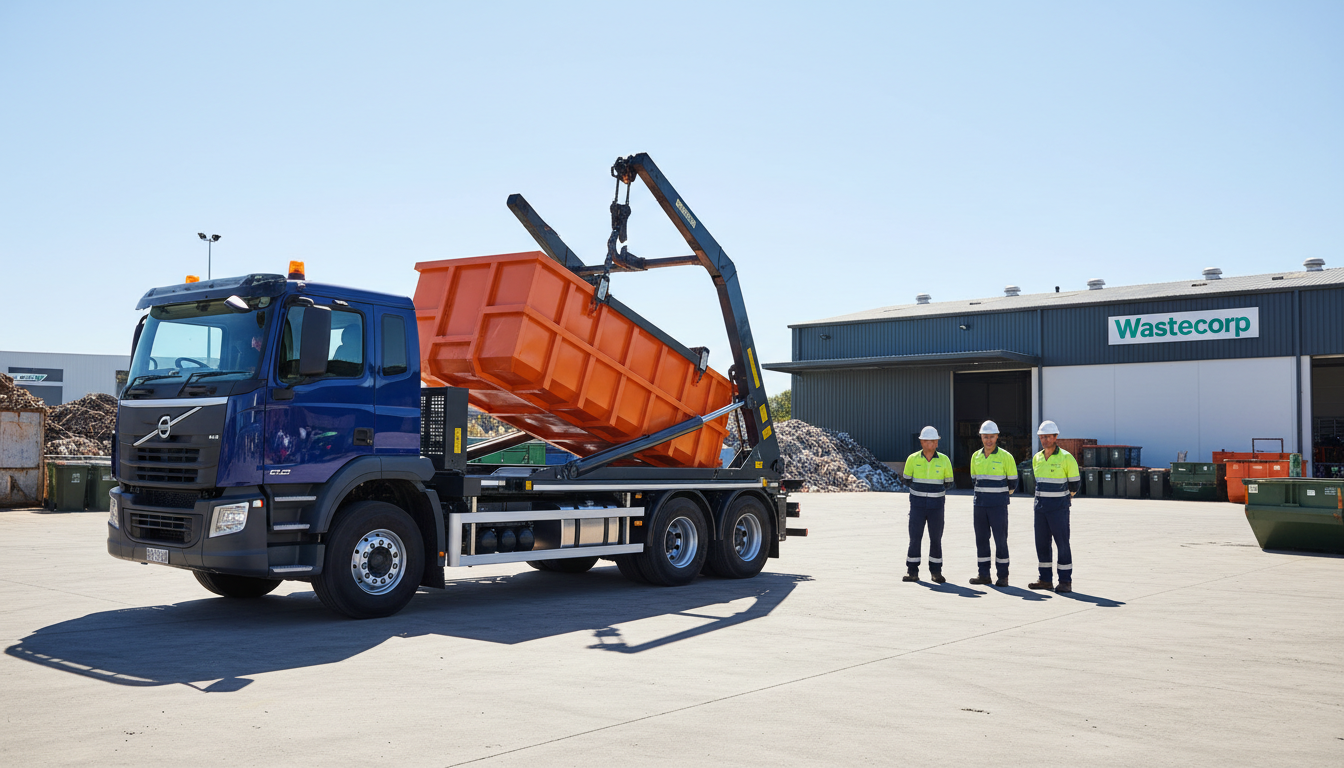
Hydraulic hooklift systems operate through a telescopic hydraulic ram and hook assembly mounted to the truck chassis, eliminating the articulated arm geometry of skip loaders. The hydraulic pump, typically delivering 60-80 litres per minute at 200-250 bar operating pressure, drives the ram through a proportional control valve that allows precise load positioning. Ram extension speeds of 150-200mm per second enable complete bin loading cycles in 60-90 seconds, compared to 3-5 minutes for skip loader chain attachment and lifting operations.
The hook engages with reinforced lifting rails on the bin, creating a direct load path to the chassis that improves mass distribution compliance under HVNL requirements. This geometry positions the bin’s centre of gravity directly over the truck’s rear axle group, reducing the moment arm effect that skip loader systems create when the lifting arm extends rearward. For fleet managers calculating payload capacity against NHVR axle group limits, this consistent load positioning provides predictable weight distribution across operating cycles.
Understanding how hooklift systems operate requires recognising the hydraulic system’s role in both lifting and tipping operations. The same ram assembly that loads the bin extends further to tilt the bin for discharge, eliminating separate tipping mechanisms. This integrated design reduces mechanical complexity and maintenance points compared to skip loaders, which require independent hydraulic circuits for arm articulation, chain tensioning, and bin tipping.
Why Hooklifts Are Replacing Skip Loaders in Mixed-Waste Fleets
The transition from skip loaders to hooklift systems reflects operational requirements driven by the National Waste Policy 2018 (Cth) resource recovery targets. Waste contractors managing segregated streams for recyclables, organics, and residual waste require rapid bin changes across collection routes. Hooklift systems deliver this capability through standardised bin interfaces that allow a single truck to service multiple bin types without manual chain adjustment or load balancing procedures.
Skip loader systems require operators to exit the cab, attach chains to bin lifting points, and verify chain tension before lifting. This manual handling creates AS/NZS ISO 45001 workplace safety risks from repetitive strain injuries and pinch point hazards. Hooklift systems eliminate these risks through cab-controlled hydraulic engagement, where the operator reverses to the bin, engages the hook through proportional valve control, and completes the lift without leaving the cab. For fleet managers calculating total cost of ownership, the reduction in workplace injury claims and associated Workers Compensation premiums represents a quantifiable financial benefit.
The skip loader versus hooklift comparison demonstrates performance differences across construction waste applications, where bin change frequency and diverse material densities create operational challenges. Hooklift systems maintain consistent lifting capacity regardless of bin position on the chassis, whereas skip loader arm geometry creates variable lifting capacity as the arm extends. This mechanical advantage allows hooklift systems to handle heavier loads at the same gross vehicle mass rating, improving payload efficiency within NHVR compliance limits.
Hooklift Capacity Range: 3-45 Tonne Systems for Diverse Applications
Hydraulic hooklift systems are specified by lifting capacity, ranging from 3 tonne light commercial units for 6-8m³ bins to 45 tonne heavy industrial systems handling 30m³ compaction bins with high-density waste loads. The lifting capacity must account for bin tare weight, maximum payload, and a 20% safety margin to maintain structural integrity and AS 4024 machinery safety compliance.
A 12 tonne hooklift system, common in commercial waste collection fleets, handles bins from 8-15m³ with typical tare weights of 800-1200kg and payload capacities of 8-10 tonnes depending on material density. The hydraulic ram diameter, typically 100-120mm for this capacity range, generates sufficient lifting force while maintaining ram extension speeds that complete loading cycles within 75-90 seconds. Fleet managers must verify that the hooklift capacity exceeds the heaviest anticipated bin load, accounting for moisture content in organic waste or compaction ratios in mixed commercial waste that can increase effective density beyond initial calculations.
Heavy industrial applications in construction and demolition waste require 25-45 tonne hooklift systems with reinforced chassis mounting and high tensile structural steel construction. These systems handle bins up to 30m³ containing dense materials such as concrete rubble, steel offcuts, or compacted demolition waste. The hydraulic system specifications increase proportionally, with pump flow rates of 100-120 litres per minute and operating pressures up to 280 bar to maintain lifting speeds under maximum load conditions.
Wastecorp Equipment’s range of MEC hooklift and skip loader systems demonstrates the capacity spectrum available to Australian operators, with engineering specifications matched to vehicle gross vehicle mass ratings and NHVR compliance requirements for specific route applications.
Interchangeable Body Systems Reduce Fleet Capital Expenditure
The economic advantage of hooklift systems derives from the interchangeable body capability, where a single truck services multiple bins across different collection routes or material streams. A waste contractor operating a 12 tonne hooklift truck can maintain a fleet of six bins — two for mixed commercial waste, two for recyclables, one for organics, and one for construction waste — servicing each with the same vehicle. This ratio of bins to trucks reduces fleet capital expenditure compared to dedicated collection vehicles for each waste stream.
The financial calculation accounts for bin costs of 8,000-15,000 AUD depending on capacity and construction specifications, compared to complete collection vehicle costs of 180,000-250,000 AUD for truck and hooklift installation. Fleet managers can deploy additional bins at customer sites for periodic collection while maintaining optimal truck utilisation across daily routes. This operational model suits waste contractors managing variable collection frequencies, where some customers require weekly service while others need monthly or on-demand collection.
Hooklift systems integrate with trailer configurations for transport efficiency in regional operations. Hooklift trailer configurations allow a single prime mover to transport multiple bins from collection sites to transfer stations or landfills, reducing the number of collection vehicles required for long-haul waste transport. The trailer-mounted hooklift system operates identically to truck-mounted units, maintaining consistent bin handling procedures across the fleet.
For municipal waste operations managing kerbside collection and transfer station operations, hooklift systems provide flexibility to redeploy bins between applications as collection demands change. A bin used for green waste collection during peak garden maintenance seasons can be redeployed to construction waste collection during building activity periods, maximising asset utilisation without additional capital expenditure.
HVNL Compliance Advantages: Mass Distribution and Axle Loading
Heavy Vehicle National Law (HVNL) compliance requires waste collection operators to maintain axle group mass limits and ensure load restraint meets National Heavy Vehicle Regulator (NHVR) performance standards. Hooklift systems deliver compliance advantages through consistent load positioning that places the bin’s centre of gravity directly over the rear axle group, optimising weight distribution within the vehicle’s design parameters.
Skip loader systems create variable mass distribution as the lifting arm extends rearward during bin loading. The extended arm geometry shifts the load’s centre of gravity behind the rear axle, increasing rear axle loading and potentially exceeding NHVR axle group limits when handling maximum payload. Fleet managers must reduce payload capacity to maintain compliance, decreasing operational efficiency and increasing the number of collection trips required to service customer bins.
Hooklift systems eliminate this variable geometry by positioning the bin on the chassis rails in a fixed location. The hydraulic ram retracts fully after loading, bringing the bin forward to the optimal position for mass distribution. This consistent geometry allows fleet managers to calculate maximum payload capacity accurately, using the vehicle’s axle group ratings and the bin’s centre of gravity location to determine compliant loading limits.
The load restraint advantage of hooklift systems derives from the positive engagement between the hook and bin rails, which creates a mechanical lock that restrains the bin against longitudinal and lateral movement. This differs from skip loader chain restraint, which relies on chain tension and friction to prevent bin movement. NHVR compliance assessments recognise the superior restraint characteristics of hooklift systems, reducing the documentation burden for operators demonstrating load restraint performance.
Bin Compatibility and Australian Standard AS 4024 Safety Requirements
Hooklift bin compatibility requires adherence to standardised rail width specifications and hook engagement geometry. The Australian standard rail width of 1060mm suits most domestic hooklift systems, though European-manufactured bins may require adapter systems or custom rail fabrication to achieve compatible engagement. Fleet managers transitioning to hooklift systems must verify that existing bin fleets meet these dimensional requirements or budget for bin modifications.
AS 4024 machinery safety standards mandate specific design requirements for hooklift bins, including reinforced lifting points capable of withstanding concentrated lifting forces without structural deformation. The hook engagement zone requires high tensile structural steel construction with minimum yield strength of 350 MPa to prevent rail crushing under maximum load conditions. Bins must incorporate compliant locking mechanisms that engage automatically when the bin reaches the transport position, providing secondary retention independent of hydraulic pressure.
The structural requirements differ significantly from skip bin construction, where load distribution occurs through chain attachment points with different stress profiles. Bin construction standards for hooklift applications address these structural integrity requirements, specifying weld quality, material grades, and inspection procedures that ensure bins maintain safe operation under repeated loading cycles.
Safety features mandated by AS 4024 include operator visibility requirements during bin loading and unloading operations. Hooklift systems must provide clear sightlines to the hook engagement zone, typically through rear-mounted cameras or mirror systems that allow the operator to verify hook position before initiating the lifting cycle. Emergency lowering provisions are required to allow controlled bin descent in the event of hydraulic system failure, preventing uncontrolled load release that could create workplace hazards.
Bin compatibility extends to tipping angle requirements, where the hydraulic ram must extend sufficiently to achieve complete material discharge. Standard tipping angles of 50-60 degrees suit most waste materials, though sticky or cohesive materials may require steeper angles or bin vibration systems to ensure complete discharge. Fleet managers must verify that the hooklift system’s maximum tipping angle matches the bin’s design specifications and the material characteristics of collected waste streams.
Maintenance Requirements and Total Cost of Ownership
Hydraulic hooklift systems require scheduled maintenance at 250-hour intervals under Australian operating conditions, with service procedures including hydraulic oil analysis, filter replacement, and ram seal inspection. The maintenance schedule accounts for high-temperature environments common across NSW and Queensland waste operations, where hydraulic oil degradation accelerates and seal materials experience increased wear rates.
Hydraulic oil quality directly affects system performance and component longevity. Contamination from moisture ingress or particulate matter reduces hydraulic pump efficiency and accelerates wear on proportional control valves. Oil analysis at scheduled intervals identifies contamination before it causes component failure, allowing preventive maintenance that reduces downtime costs. Fleet managers must maintain service records demonstrating compliance with manufacturer specifications and AS 4024 safety requirements, particularly for hydraulic hose condition where failure under pressure creates serious workplace safety risks.
The total cost of ownership calculation for hooklift systems accounts for reduced labour costs from faster bin change cycles and elimination of manual chain handling. A waste contractor operating ten collection vehicles can reduce crew size from two operators per vehicle to single-operator configurations, as hooklift systems eliminate the need for a second person to attach chains and guide bin loading. This labour reduction generates annual savings of 600,000-800,000 AUD across a ten-vehicle fleet, assuming average operator wages of 65,000-75,000 AUD including on-costs.
Component replacement costs favour hooklift systems over skip loaders due to simpler mechanical design. The hydraulic ram and hook assembly represent the primary wear components, with replacement intervals of 8,000-12,000 operating hours depending on load conditions and maintenance quality. Skip loader systems require more frequent replacement of articulated arm bushings, chain assemblies, and hydraulic cylinders due to the complex mechanical loads created by arm extension and retraction cycles.
Understanding hydraulic system maintenance protocols provides fleet managers with preventive maintenance frameworks applicable across hooklift and compactor systems, reducing the technical knowledge burden for maintenance personnel managing diverse equipment types.
What Fleet Managers Should Evaluate Before Transitioning to Hooklifts
Fleet transition planning requires assessment of current bin fleet compatibility, vehicle chassis specifications, and operational route characteristics. Fleet managers must conduct a comprehensive equipment audit to determine which existing bins can be modified for hooklift compatibility and which require replacement. This audit includes dimensional verification of rail width, structural assessment of lifting point integrity, and calculation of bin tare weights against proposed hooklift capacity ratings.
Vehicle chassis selection affects hooklift system performance and NHVR compliance outcomes. The chassis frame must provide sufficient strength to support hooklift mounting loads, typically requiring reinforced rear frame sections or subframe installations. Fleet managers must verify that the proposed hooklift system’s mounting requirements suit the chassis manufacturer’s specifications, as improper installation can void vehicle warranties and create structural failure risks.
Route analysis determines optimal hooklift capacity specifications based on bin sizes, collection frequencies, and material densities encountered across service areas. A contractor servicing light commercial waste in urban areas requires different capacity specifications than an operator managing construction waste in industrial zones. The analysis should account for seasonal variations in waste generation, where garden waste volumes increase during spring and summer months, affecting bin payload calculations.
Financial modelling must incorporate capital costs for hooklift installation, bin fleet modifications or replacement, operator training, and maintenance program establishment. The model should project payback periods based on labour cost reductions, improved vehicle utilisation, and decreased workplace injury costs. Most fleet transitions achieve payback within 24-36 months when accounting for all operational cost reductions, though this varies based on fleet size and current operational efficiency.
Comprehensive waste collection truck procurement considerations address the broader decision framework for fleet managers evaluating equipment transitions, including financing options, supplier support capabilities, and parts availability through Australian distribution networks.
- ✓
Verify hooklift lifting capacity matches your heaviest anticipated bin load plus 20% safety margin — systems range from 3 tonne (light commercial) to 45 tonne (heavy industrial) with corresponding hydraulic pressure specifications. - ✓
Confirm bin fleet compatibility with hooklift hook height and rail width specifications — Australian standard rail width is 1060mm but European bins may require adapter systems. - ✓
Assess HVNL compliance for your operating routes — hooklift systems improve mass distribution but require accurate bin weight data and compliant load positioning to meet National Heavy Vehicle Regulator (NHVR) axle group limits. - ✓
Calculate total cost of ownership including reduced labour costs from faster bin changes (60-90 seconds versus 3-5 minutes for skip loaders) and elimination of manual chain handling. - ✓
Evaluate hydraulic system specifications including pump flow rate, ram extension speed, and proportional control features that affect cycle time and operator precision. - ✓
Confirm AS 4024 safety compliance including secondary bin retention systems, operator visibility requirements, and emergency lowering provisions. - ✓
Review maintenance access for hydraulic components and availability of replacement parts through Australian suppliers to minimise downtime.
Frequently Asked Questions
What are the main operational benefits of hooklift trucks compared to skip loaders?
Hooklift trucks deliver faster bin change cycles (typically 60-90 seconds versus 3-5 minutes for skip loaders), eliminate manual chain handling which reduces AS/NZS ISO 45001 workplace injury risk, and allow a single truck to service multiple bin types across waste streams. The hydraulic hook system provides consistent load positioning which improves Heavy Vehicle National Law (HVNL) mass distribution compliance compared to variable skip loader arm geometry.
Do hooklift systems require different bin construction standards than skip bins?
Yes — hooklift bins require reinforced lifting points designed to AS 4024 machinery safety standards, with structural steel construction at hook engagement zones to withstand concentrated lifting forces. Bins must incorporate compliant locking mechanisms and secondary retention systems, whereas skip bins distribute load through chain attachment points with different stress profiles.
How do hooklifts improve compliance with NHVR mass management requirements?
Hooklift systems position bins directly over the truck chassis centreline, optimising axle weight distribution and reducing the risk of exceeding National Heavy Vehicle Regulator (NHVR) axle group limits. The consistent load geometry allows fleet managers to calculate payload capacity more accurately than skip loaders, where arm extension creates variable moment forces that affect rear axle loading.
What maintenance intervals apply to hydraulic hooklift systems in Australian conditions?
Hydraulic hooklift systems typically require 250-hour service intervals for hydraulic oil analysis, filter replacement, and ram seal inspection under Australian operating conditions. Operators must maintain service records demonstrating compliance with manufacturer specifications and AS 4024 safety requirements, with particular attention to hydraulic hose condition in high-temperature environments common across NSW and Queensland waste operations.
Wastecorp Equipment supplies hydraulic hooklift systems from 3 to 45 tonne capacity with full NHVR compliance documentation and AS 4024 safety certification. Contact our St Marys team for engineering specifications suited to your fleet transition requirements.
Official distributor for MEC and OMB. Member of the Waste Contractors and Recyclers Association of NSW.

 Member of Waste Contractors and Recyclers Association of NSW.