
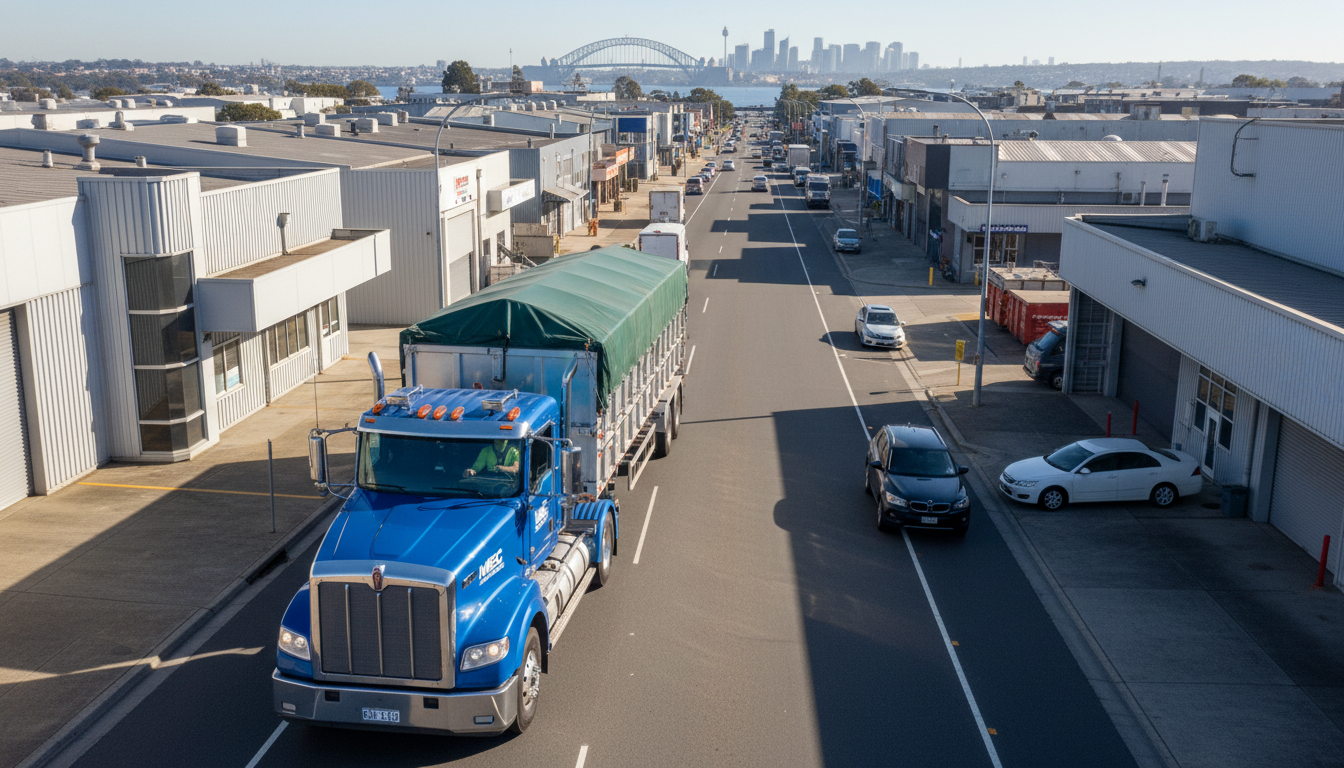
Fleet managers operating bulk waste transport face a persistent operational challenge: maximising payload capacity while maintaining compliance with Heavy Vehicle National Law mass limits. Every kilogram of tare weight reduces revenue-generating payload, increasing per-tonne transport costs and requiring additional trips to move the same volume of material. MEC waste trailers address this inefficiency through engineered tare weight reduction, optimised axle configurations, and integration with hooklift systems that eliminate container handling delays at transfer stations and consolidation facilities.
As the official distributor for MEC in Australia, Wastecorp Equipment supplies MEC waste trailers engineered to National Heavy Vehicle Regulator compliance standards, delivering measurable improvements in daily tonnage throughput for construction and demolition waste, recovered materials transport, and bulk residual waste movements. This technical explainer examines how MEC tipping trailers reduce transport costs through specific engineering characteristics that increase payload efficiency under regulatory mass limits.
Industry Data
- —The Australian Bureau of Statistics reported 75.8 million tonnes of waste generated nationally in 2020-21, with construction and demolition waste representing 25.2 million tonnes requiring bulk transport solutions (ABS, Waste Account Australia Experimental Estimates 2021)
- —The National Waste Policy 2018 targets an 80% average recovery rate from all waste streams by 2030, driving demand for efficient bulk transport systems to move recovered materials from consolidation points to reprocessing facilities (Department of Climate Change, Energy, the Environment and Water)
How MEC Waste Trailers Reduce Payload Cycles Through Optimised Tare Weight
Tare weight directly determines payload capacity under Heavy Vehicle National Law mass limits. MEC waste trailers achieve tare weights of 4-5 tonnes for tri-axle configurations through high tensile structural steel construction and optimised chassis design, compared to 5.5-6.5 tonnes for equivalent capacity fixed-body trucks. This 1-2 tonne reduction translates to additional revenue-generating payload on every trip, reducing the number of cycles required to transport a given tonnage of material.
For a waste contractor transporting 500 tonnes of construction and demolition waste per week, a 1.5 tonne tare weight advantage delivers approximately 7.5% additional payload per trip under general access mass limits. This reduces weekly transport cycles by 3-4 trips on typical urban collection routes, lowering fuel consumption, driver hours, and vehicle wear proportionally. The operational advantage compounds in high-volume applications where material consolidation and reprocessing facility access requires maximising tonnage per vehicle movement.
NHVR Mass Limits and Axle Configuration for MEC Tipping Trailers
MEC tipping trailers operate under Heavy Vehicle National Law mass limits administered by the National Heavy Vehicle Regulator, with payload capacity determined by axle configuration, spacing, and whether the combination operates under general access or Performance-Based Standards certification. A typical tri-axle MEC trailer paired with a compliant prime mover achieves 42.5 tonnes gross combination mass under general access provisions, delivering 20-25 tonnes of payload capacity depending on prime mover tare weight.
Performance-Based Standards Level 2B certification permits higher mass limits on approved route networks through demonstrated compliance with bridge formula loading, offtracking performance, and braking efficiency requirements. MEC trailers engineered to PBS specifications can achieve up to 10% additional payload capacity on designated networks, requiring certification by an accredited PBS assessor and registration with the National Heavy Vehicle Regulator. This certification pathway delivers measurable cost reduction for operators with consistent routes between consolidation facilities and reprocessing sites on PBS-approved networks.
Axle spacing on MEC tri-axle configurations complies with NHVR bridge formula requirements, distributing load to maintain pavement loading limits while maximising payload. Tandem axle groups with 1.25-1.3 metre spacing achieve optimal load distribution for bulk waste transport, where material density varies significantly between construction timber, concrete rubble, and mixed demolition waste. Operators must verify axle group mass limits through weighbridge certification to maintain compliance with Heavy Vehicle National Law provisions and avoid penalty unit exposure under Protection of the Environment Operations Act 1997 (NSW) for overloaded vehicles accessing waste facilities.
How MEC Trailers Integrate with Hooklift Systems for Rapid Container Exchange
MEC waste trailers integrate with hooklift systems paired with compliant trailers to eliminate manual container handling and reduce vehicle idle time at transfer stations. The trailer chassis incorporates standardised hook-lift rail mounting points and hydraulic stabilisation systems that enable container exchange in 90-120 seconds, compared to 8-12 minutes for manual tipping and reloading of fixed-body trucks.
This rapid exchange capability increases daily tonnage throughput by 15-25% in bulk waste applications where vehicles operate between collection zones and consolidation facilities. A single prime mover can service multiple pre-loaded containers staged at collection points, eliminating wait time while material is loaded and enabling continuous vehicle utilisation. For construction and demolition waste contractors operating on project sites with restricted access windows, this operational flexibility reduces demurrage costs and maintains compliance with site access conditions.
The integration requires hydraulic compatibility between prime mover hooklift systems and trailer mounting points, with MEC trailers engineered to ISO 1726 dimensional standards for interchangeability across mixed fleets. Operators must verify hydraulic pressure ratings and hook engagement geometry during procurement to ensure safe container transfer under AS 4024.1 safety of machinery requirements, particularly where trailers will be deployed across multiple prime movers with varying hooklift specifications.
MEC Tipping Trailers vs Standard Hook-Lift Trailers: Operational Differences
MEC tipping trailers differ from standard hook-lift trailers through integrated hydraulic tipping mechanisms that enable material discharge without requiring separate tipping infrastructure at disposal sites. Standard hook-lift trailers rely on detachable containers with independent tipping systems, adding 300-500 kilograms of tare weight per container and requiring additional hydraulic power pack maintenance across the container fleet.
The MEC skip loader and hooklift comparison demonstrates how trailer-mounted tipping systems reduce total fleet tare weight by centralising hydraulic components on the trailer chassis rather than duplicating them across multiple detachable containers. This configuration suits high-volume bulk waste operations where material discharge occurs at a limited number of transfer stations or landfill sites equipped with suitable tipping areas.
Chassis and Body Construction: Material Specifications for Bulk Waste Transport
MEC waste trailer chassis utilise high tensile structural steel with minimum 450 MPa yield strength, providing the structural rigidity required for bulk waste transport while minimising material thickness and overall tare weight. The structural steel specifications for heavy-duty applications demonstrate how material grade selection affects both payload capacity and service life under cyclic loading conditions typical of waste transport operations.
Body construction employs 4-6mm structural steel plate for floor sections and 3-4mm plate for sidewalls, with reinforcement ribs at 400-600mm centres to maintain structural integrity under point loading from construction debris and demolition material. This specification balances impact resistance against tare weight optimisation, with thicker gauge material reserved for high-wear zones including tailgate hinges, hydraulic cylinder mounting points, and axle suspension attachment areas.
Corrosion protection through hot-dip galvanising or epoxy primer systems extends service life in applications involving wet waste, organic material, or exposure to marine environments common in coastal NSW operations. Material selection must account for the chemical composition of transported waste streams, particularly where recovered materials include treated timber, plasterboard, or concrete with embedded reinforcement that accelerates corrosion through galvanic action.
Hydraulic System Maintenance for MEC Tipping Trailers
Hydraulic tipping mechanisms on MEC trailers require scheduled maintenance to maintain safe operation under AS 4024.1 safety of machinery requirements and AS/NZS ISO 45001 occupational health and safety management systems. The hydraulic system maintenance protocols applied to trailer tipping cylinders include fluid analysis, seal inspection, and pressure testing at 250 operating hour intervals or quarterly, whichever occurs first.
Hydraulic fluid contamination represents the primary failure mode in trailer tipping systems, with particulate ingress through damaged rod seals causing accelerated cylinder wear and pressure loss. Fluid sampling should measure ISO 4406 cleanliness codes, with target values of 18/16/13 or cleaner for systems operating at 180-220 bar working pressure typical of MEC tipping cylinders. Contamination beyond these levels requires fluid replacement and filter element inspection to identify ingress points.
Cylinder rod chrome plating requires visual inspection for scoring, pitting, or corrosion that compromises seal effectiveness. Minor surface damage can be addressed through re-chroming, while deep scoring exceeding 0.3mm typically requires cylinder rod replacement to prevent catastrophic seal failure and hydraulic fluid loss during tipping operations. Operators must implement lockout-tagout procedures compliant with AS/NZS ISO 45001 before conducting hydraulic system maintenance, with particular attention to residual pressure in accumulator systems that can cause unexpected cylinder extension.
Bulk Waste Applications: Construction and Demolition Material Transport
Construction and demolition waste represents the primary application for MEC tipping trailers, with the Australian Bureau of Statistics reporting 25.2 million tonnes of C&D waste requiring efficient transport from generation points to consolidation facilities and reprocessing sites. The construction waste collection system selection process must account for material density variation, with concrete and masonry waste achieving 1.4-1.6 tonnes per cubic metre compared to 0.3-0.5 tonnes per cubic metre for timber and lightweight demolition debris.
This density variation affects payload optimisation, with volumetric capacity often limiting payload before mass limits are reached in timber and mixed waste applications. MEC trailers with 25-30 cubic metre body capacity enable operators to maximise payload across diverse material streams, achieving mass limit compliance on dense concrete loads while providing sufficient volume for lightweight demolition waste. Operators must implement load planning procedures that account for material density to avoid volumetric overloading that compromises vehicle stability and creates compliance exposure under Heavy Vehicle National Law provisions.
The National Waste Policy 2018 target of 80% resource recovery by 2030 drives increased demand for efficient C&D waste transport between consolidation facilities and material reprocessing sites. MEC trailers support this recovery infrastructure by reducing per-tonne transport costs, making regional reprocessing facilities economically viable for recovered concrete aggregate, timber, and metal streams that previously faced landfill disposal due to transport cost barriers.
Fuel Efficiency Gains from Reduced Empty Running and Optimised Load Distribution
Fuel consumption in bulk waste transport correlates directly with payload efficiency and empty running distance. MEC waste trailers reduce fuel consumption per tonne-kilometre through two mechanisms: increased payload capacity that reduces total trips required for a given tonnage, and hooklift integration that enables backloading opportunities by exchanging empty containers for loaded units at collection points.
A waste contractor transporting 500 tonnes per week over an average 40-kilometre round trip achieves approximately 12% fuel cost reduction by increasing payload from 18 tonnes to 22 tonnes per trip through MEC trailer deployment. This reduction compounds with decreased empty running, where hooklift container exchange enables vehicles to collect loaded containers on return trips from disposal sites, reducing empty running from 40-50% of total kilometres to 15-25% in optimised route configurations.
Load distribution affects fuel consumption through axle loading patterns that influence rolling resistance and brake wear. MEC trailers with adjustable axle positions enable operators to optimise weight distribution for varying material densities, maintaining even axle loading that reduces tyre wear and improves fuel economy by 3-5% compared to fixed axle configurations with uneven load distribution. This adjustment capability requires operator training in load positioning and weighbridge verification to maintain NHVR compliance while achieving fuel efficiency targets.
Procurement Considerations for MEC Waste Trailers Under Heavy Vehicle National Law
Fleet managers evaluating MEC waste trailer procurement must assess total cost of ownership including purchase price, financing costs, maintenance requirements, and operational efficiency gains measured in reduced per-tonne transport costs. The procurement considerations for waste collection vehicles framework applies equally to trailer acquisition, with particular attention to NHVR compliance verification and Performance-Based Standards certification pathways.
Compliance verification requires documented evidence of Heavy Vehicle National Law conformity, including axle group mass ratings, bridge formula compliance calculations, and brake system certification to ADR 38/05 or equivalent standards. Operators must verify that trailer specifications match prime mover coupling capacity and that combined gross combination mass remains within general access limits or PBS certification parameters. This verification process should occur before purchase commitment to avoid post-delivery compliance issues that restrict operational deployment.
Wastecorp Equipment provides technical support for fleet integration analysis, including payload optimisation calculations that account for specific material densities, route characteristics, and NHVR mass limit compliance. This analysis quantifies expected operational improvements in per-tonne transport costs, enabling fleet managers to justify capital expenditure through documented efficiency gains. Financing options through commercial equipment lenders and operating lease structures provide cash flow management alternatives to outright purchase, particularly for contractors expanding fleet capacity to service new contract awards requiring immediate deployment.
Operators should evaluate hire fleet availability for short-term capacity requirements or trial deployments before committing to purchase. Wastecorp Equipment maintains hire fleet inventory of MEC waste trailers suitable for project-specific deployments, enabling contractors to assess operational performance in their specific application before proceeding with fleet acquisition. This trial approach reduces procurement risk and provides operational data for total cost of ownership calculations.
Frequently Asked Questions
What is the maximum payload capacity of MEC waste trailers under NHVR mass limits?
MEC waste trailers are engineered to comply with Heavy Vehicle National Law mass limits, typically achieving 20-25 tonne payload capacity on tri-axle configurations when paired with compliant prime movers. Actual payload depends on tare weight, axle spacing, and whether operating under general access or higher mass limits under the National Heavy Vehicle Regulator’s Performance-Based Standards scheme. Operators must verify gross combination mass through weighbridge certification to maintain compliance with NHVR provisions and avoid penalty exposure under state and territory heavy vehicle legislation.
How do MEC tipping trailers reduce transport costs compared to fixed-body trucks?
MEC tipping trailers reduce per-tonne transport costs by maximising payload per trip through optimised tare weight (typically 4-5 tonnes for tri-axle configurations) and enabling rapid container exchange via hooklift systems, reducing vehicle idle time at transfer stations. This increases daily tonnage throughput by 15-25% compared to fixed rear-lift compactor trucks in bulk waste applications. The operational advantage derives from higher payload capacity under Heavy Vehicle National Law mass limits and elimination of manual container handling delays that reduce productive vehicle utilisation hours.
What maintenance intervals apply to hydraulic tipping mechanisms on MEC trailers?
Hydraulic tipping cylinders and power pack systems on MEC trailers require inspection every 250 operating hours or quarterly, whichever occurs first, in accordance with AS 4024.1 safety of machinery requirements. This includes hydraulic fluid analysis, seal inspection, and pressure testing to maintain safe operation under AS/NZS ISO 45001 occupational health and safety management systems. Operators must document maintenance activities and maintain inspection records as evidence of compliance with work health and safety legislation, with particular attention to lockout-tagout procedures before conducting hydraulic system maintenance.
Are MEC waste trailers compliant with PBS Level 2B bridge formula requirements?
MEC waste trailers can be engineered to Performance-Based Standards Level 2B specifications, which permit higher mass limits on approved routes through optimised axle spacing and load distribution. Compliance requires certification by an accredited PBS assessor and registration with the National Heavy Vehicle Regulator, delivering up to 10% additional payload capacity on designated networks. Operators must verify that intended routes are approved for PBS Level 2B operation and maintain certification documentation as evidence of compliance with Heavy Vehicle National Law provisions governing higher mass limit vehicles.
Wastecorp Equipment supplies MEC waste trailers engineered to NHVR compliance standards with full technical support for fleet integration. Contact our St Marys team for payload optimisation analysis and PBS certification guidance.
Official distributor for MEC and OMB. Member of the Waste Contractors and Recyclers Association of NSW.

 Member of Waste Contractors and Recyclers Association of NSW.