
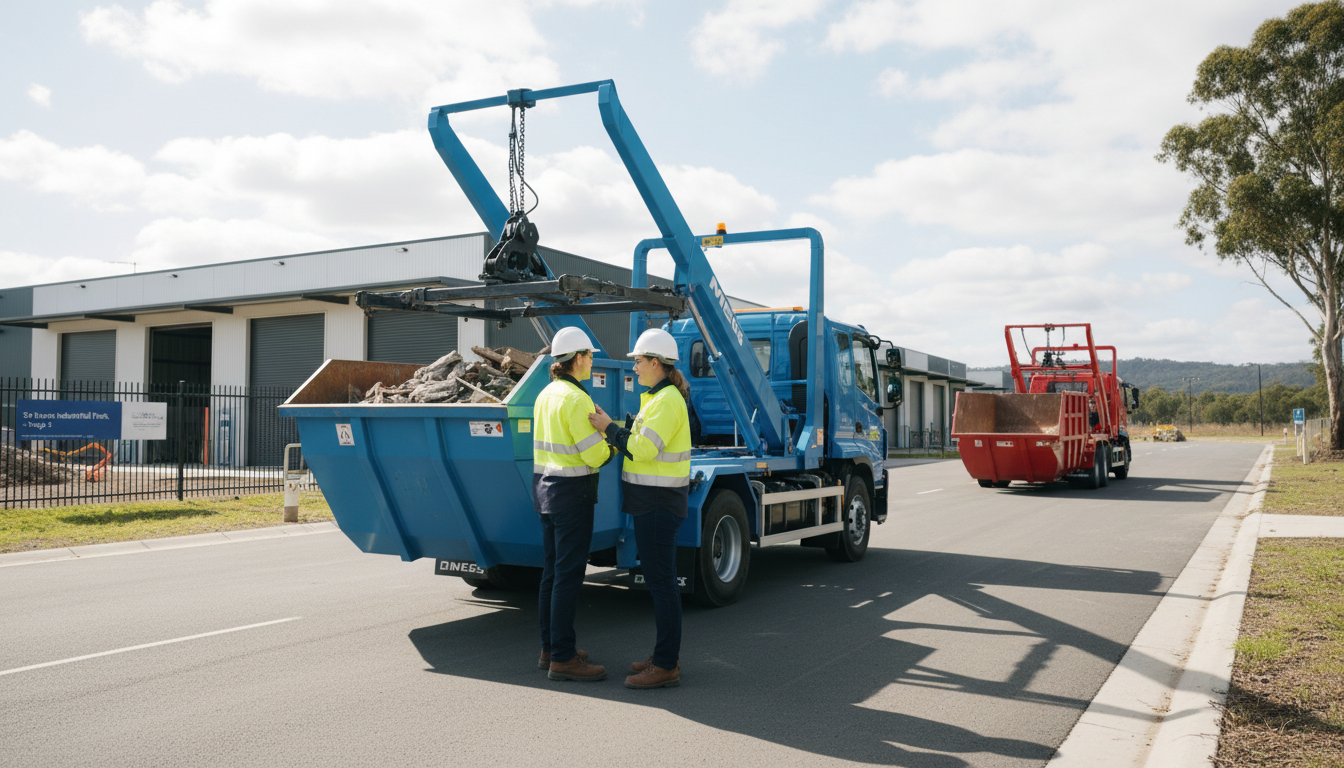
Fleet managers evaluating MEC skip loader systems against hooklift alternatives face a procurement decision that directly impacts operational efficiency, cycle time performance, and total cost of ownership. While both systems serve bin collection and transport functions, their hydraulic mechanisms, load capacity thresholds, and operational characteristics suit distinctly different applications. Understanding when a MEC skip loader system delivers superior performance over a hooklift configuration requires analysis of lifting geometry, bin compatibility constraints, and compliance considerations under Heavy Vehicle National Law mass distribution requirements.
This comparison addresses the technical and operational factors that determine optimal system selection for Australian waste contractors, with specific reference to MEC skip loader advantages in high-frequency urban collection, hooklift capacity for heavy scrap metal applications, and National Heavy Vehicle Regulator compliance considerations for rigid chassis configurations.
Industry Data
- —According to the Australian Bureau of Statistics, Australia generated 75.8 million tonnes of waste in 2020-21, with construction and demolition waste representing 25.2 million tonnes — a sector where equipment cycle time directly impacts collection efficiency
- —The National Waste Policy 2018 (Cth) targets an 80% average recovery rate from all waste streams by 2030, driving demand for flexible collection systems that can service both compactable municipal waste and source-separated recyclables
MEC Skip Loader System: Core Technical Advantages
MEC skip loader systems employ a hydraulic lifting arm with adjustable geometry that engages side-mounted bin lugs, lifting the bin vertically before tilting it over the chassis. This vertical lift mechanism provides several operational advantages over horizontal chain-pull hooklift systems, particularly in applications requiring rapid cycle times and precise bin placement in confined spaces.
The load-sensing proportional flow control system used in MEC skip loaders adjusts hydraulic pressure based on bin weight, delivering smooth lifting action across varying payload masses. This proportional control reduces shock loading on the chassis and bin structure, extending service life for both components. Typical cycle times for MEC skip loader systems range from 45 to 60 seconds for complete bin engagement, lift, and placement — approximately 40 to 50 per cent faster than comparable hooklift systems operating in the same weight class.
MEC skip loaders demonstrate particular advantage in urban collection environments where multiple bin exchanges occur within confined industrial estates or commercial precincts. The vertical lift geometry allows operators to position bins closer to building lines and service access points, reducing the footprint required for bin exchange operations. This spatial efficiency translates to measurable productivity gains on routes with 15 or more collection points per shift.
Wastecorp Equipment supplies MEC skip loader systems with load capacities ranging from 5 to 20 tonnes, suitable for general waste, construction debris, and light recyclable materials. As official distributor for MEC in Australia, Wastecorp Equipment provides full technical support for system specification, chassis integration, and compliance verification under National Heavy Vehicle Regulator requirements. For broader context on how MEC systems compare to other manufacturers, refer to our comprehensive skip loader brand comparison.
Hooklift System: When Chain-Pull Mechanisms Are Optimal
Hooklift systems utilise a horizontal chain-pull mechanism that engages a top-mounted hook point on the bin, dragging the bin onto the chassis via bottom-mounted rollers. This horizontal load path distributes lifting forces across the bin floor structure rather than concentrating stress at side-mounted lifting points, making hooklifts preferable for heavy, dense materials where bin structural integrity under point loading becomes a limiting factor.
Load capacity represents the primary advantage of hooklift systems over skip loaders. Heavy-duty hooklift configurations handle bins up to 45 tonnes, significantly exceeding the 20-tonne upper threshold for most skip loader systems. This capacity advantage makes hooklifts the standard choice for scrap metal yards, demolition contractors handling structural steel, and recycling operations processing dense materials such as concrete, brick, and ferrous metals.
The chain-pull mechanism also provides operational advantages when handling bins with uneven load distribution or materials that shift during transport. The horizontal engagement path maintains more consistent load geometry throughout the lifting cycle, reducing the risk of bin tipping or payload shift that can occur with vertical lift systems when centre of gravity positioning is suboptimal.
Cycle times for hooklift systems typically range from 90 to 120 seconds, reflecting the longer horizontal travel distance required for bin engagement and the need for precise hook alignment before initiating the pull cycle. While slower than skip loader systems, this cycle time differential becomes less significant in applications where bin exchange frequency is lower and load capacity takes priority over speed.
Hydraulic System Design and Cycle Time Comparison
The fundamental difference between skip loader and hooklift hydraulic systems lies in their force application geometry and control architecture. MEC skip loader systems use a joystick-controlled proportional valve bank that modulates flow to the lifting arm cylinders, allowing operators to adjust lift speed and positioning with precision. This proportional control requires higher operator skill but delivers superior bin placement accuracy in confined spaces.
Hooklift systems employ a simpler on-off valve configuration for chain drive motors, with load sensing achieved through pressure relief valves rather than proportional flow control. This simpler hydraulic architecture reduces system complexity and operator training requirements, but provides less granular control over lifting speed and bin positioning. For detailed explanation of hooklift hydraulic operation, see our technical guide on how hooklift hydraulic systems operate.
Hydraulic pump capacity requirements differ significantly between systems. MEC skip loaders typically specify 80 to 120 litre per minute pump flow at 200 to 250 bar operating pressure, while hooklift systems require 100 to 150 litre per minute flow at similar pressure ranges. The higher flow requirement for hooklifts reflects the need to maintain chain speed under load, while skip loader systems can modulate flow based on instantaneous lifting requirements.
Cycle time performance directly impacts fleet productivity on high-frequency collection routes. A skip loader completing 20 bin exchanges per shift at 50 seconds per cycle consumes approximately 17 minutes of total lifting time, compared to 40 minutes for a hooklift system at 120 seconds per cycle. This 23-minute differential represents measurable productivity advantage on urban commercial waste routes where collection density justifies skip loader deployment.
Construction and Demolition Waste Collection
Construction and demolition waste applications present specific operational requirements that influence system selection. Site access constraints, material density variation, and bin exchange frequency all factor into the skip loader versus hooklift decision for contractors servicing building sites, renovation projects, and demolition operations.
MEC skip loader systems demonstrate advantage in residential and light commercial construction applications where site access requires tight turning circles and bin placement near building lines. The vertical lift geometry allows operators to service bins positioned against fences, retaining walls, or building facades where horizontal hooklift engagement would require additional clearance. This spatial efficiency proves particularly valuable in urban infill developments and renovation projects with limited street frontage.
Material density considerations favour hooklifts for heavy demolition waste streams. Concrete, brick, and structural steel demolition debris frequently exceeds the 20-tonne capacity threshold for skip loader systems, necessitating hooklift deployment to avoid overloading. However, mixed construction waste containing timber framing, plasterboard, and general building debris typically falls within skip loader capacity ranges, making MEC systems suitable for the majority of residential and light commercial construction waste applications.
For comprehensive analysis of system selection factors specific to construction waste operations, refer to our detailed comparison of skip loader vs hooklift for construction waste applications.
Scrap Metal and Recycling Operations
Scrap metal and heavy recycling operations represent the operational domain where hooklift systems demonstrate clear superiority over skip loaders. Ferrous scrap, structural steel offcuts, and dense non-ferrous materials such as copper and brass generate bin weights that routinely exceed skip loader capacity limits, making hooklifts the standard equipment choice for metal recycling yards and industrial scrap collection.
Material density for steel scrap averages 1.8 to 2.2 tonnes per cubic metre, meaning a standard 12 cubic metre bin filled to capacity with ferrous scrap weighs 21.6 to 26.4 tonnes — well beyond the structural capacity of skip loader lifting arms. Hooklift systems rated to 35 or 45 tonnes handle these loads within design parameters, with the horizontal chain-pull mechanism distributing lifting forces across the bin floor structure rather than concentrating stress at side-mounted lifting points.
However, MEC skip loader systems remain viable for lighter recycling streams where rapid cycle times and high collection frequency take priority over maximum load capacity. Cardboard, plastics, aluminium cans, and mixed paper recycling operations typically generate bin weights in the 3 to 8 tonne range, well within skip loader capacity. The faster cycle times of MEC systems provide productivity advantages in high-volume recycling facilities processing multiple material streams with frequent bin exchanges.
Bin structural requirements also differ between scrap metal and general recycling applications. Heavy scrap bins require high tensile structural steel construction with reinforced floors and corner posts, adding 800 to 1,200 kilograms to empty bin weight. This structural mass further reduces payload capacity on skip loader systems, reinforcing the hooklift preference for heavy scrap applications.
Municipal and Commercial Waste Routes
Municipal and commercial waste collection routes present operational characteristics that favour MEC skip loader deployment. High collection frequency, multiple bin exchanges per route, and urban site access constraints all align with skip loader operational advantages in cycle time, manoeuvrability, and spatial efficiency.
Commercial waste collection from retail precincts, office complexes, and hospitality venues typically involves 15 to 30 bin exchanges per shift, with bin weights ranging from 2 to 6 tonnes depending on waste stream composition and compaction. These operational parameters sit squarely within MEC skip loader optimal performance range, where the 45 to 60 second cycle time delivers measurable productivity gains over hooklift alternatives.
Municipal waste collection from multi-unit residential developments and public facilities presents similar operational profiles. Bin weights for general municipal waste average 3 to 5 tonnes, with collection frequencies ranging from twice weekly to daily depending on facility size and waste generation rates. The vertical lift geometry of skip loader systems allows bin placement in basement loading docks, narrow service lanes, and other confined spaces common in urban municipal facilities.
Route efficiency modelling demonstrates that skip loader cycle time advantages compound across multiple collection points. A 25-stop commercial route completed with a skip loader at 50 seconds per bin exchange requires 21 minutes of total lifting time, compared to 50 minutes for a hooklift at 120 seconds per exchange. This 29-minute differential allows operators to service additional routes or reduce shift duration, directly impacting labour cost per tonne collected.
Bin Compatibility and Fleet Standardisation
Bin compatibility represents a critical constraint in skip loader versus hooklift system selection, as bin designs are system-specific and not interchangeable without costly modification. Skip loader bins require side-mounted lifting lugs or pockets positioned to engage the hydraulic lifting arm, while hooklift bins use top-mounted hook points and bottom-mounted rollers for horizontal chain engagement.
Fleet standardisation decisions carry significant capital implications. A waste contractor operating 50 bins across multiple collection routes faces complete bin replacement costs when transitioning between systems, with bin replacement representing 40 to 60 per cent of total system changeover cost. This capital requirement makes mixed-system fleets economically challenging unless operational requirements clearly justify maintaining separate bin inventories for different collection applications.
Bin construction materials and durability considerations also factor into system selection. Skip loader bins experience concentrated stress at lifting lug attachment points, requiring reinforced construction around engagement zones. Hooklift bins distribute lifting forces across the floor structure, allowing lighter construction for equivalent payload capacity. For detailed analysis of bin structural requirements, see our guide on bin construction materials and durability.
Standardisation on MEC skip loader systems provides advantages for contractors servicing diverse waste streams within skip loader capacity ranges. The adjustable arm geometry on MEC systems accommodates varying bin sizes and lug positions, providing greater flexibility across mixed bin fleets compared to fixed-geometry skip loaders from other manufacturers. This adaptability reduces the need for multiple truck configurations when servicing customers with different bin specifications.
Total Cost of Ownership: Skip Loader vs Hooklift
Total cost of ownership analysis must account for capital acquisition cost, operational efficiency gains, maintenance requirements, and asset depreciation over typical equipment service life of 10 to 15 years. While hooklift systems generally carry lower initial acquisition cost than skip loaders of equivalent quality, operational cost differentials can offset this capital advantage in high-frequency collection applications.
Capital cost for MEC skip loader systems installed on suitable rigid chassis ranges from 85,000 to 125,000 Australian dollars depending on lifting capacity, control system specification, and chassis configuration. Comparable hooklift systems range from 75,000 to 110,000 dollars, reflecting simpler hydraulic architecture and lower component count. This 10,000 to 15,000 dollar capital differential narrows when factoring in bin fleet costs, as hooklift bins for heavy applications require more robust construction than skip loader bins for lighter waste streams.
Operational cost modelling demonstrates that cycle time advantages translate to measurable labour cost savings on high-frequency routes. A skip loader completing 25 bin exchanges per shift saves approximately 30 minutes of operator time compared to a hooklift, equating to 125 hours annually at five shifts per week. At 45 dollars per hour fully loaded labour cost, this time saving represents 5,625 dollars annual operational cost advantage — recovering the capital premium over 2 to 3 years of operation.
Fuel consumption differences between systems prove minimal in typical collection applications, as lifting cycle energy represents a small fraction of total route fuel consumption. Chassis weight differential of 400 to 600 kilograms between skip loader and hooklift systems has negligible impact on fuel economy for rigid trucks operating in urban collection environments.
For comprehensive framework on evaluating total cost of ownership across equipment options, refer to our guide on waste collection truck procurement considerations.
Maintenance Requirements and Downtime Considerations
Maintenance requirements differ significantly between skip loader and hooklift systems due to their distinct hydraulic architectures and mechanical complexity. MEC skip loader systems require more frequent inspection of lifting arm pivot points, hydraulic cylinder rod seals, and proportional valve assemblies compared to simpler hooklift chain-pull mechanisms.
Australian Standard AS 4024.1 safety of machinery standards mandate regular inspection of hydraulic lifting equipment, with inspection frequency determined by duty cycle and operating environment. Skip loader lifting arms operating in high-frequency urban collection typically require quarterly inspection of pivot bushings, cylinder mounting pins, and structural welds, compared to semi-annual inspection intervals for hooklift systems in similar applications.
Hydraulic system maintenance protocols apply to both system types, with particular attention required for proportional valve cartridges in skip loader systems. Contamination of proportional valve spools causes erratic lifting behaviour and reduced control precision, necessitating strict hydraulic oil filtration standards and regular filter replacement. For detailed maintenance procedures applicable to both systems, see our hydraulic system maintenance protocols.
Component replacement costs favour hooklift systems for high-wear items. Chain replacement for hooklift systems costs 2,500 to 4,000 dollars and occurs at 5,000 to 8,000 operating hours depending on load profile. Skip loader hydraulic cylinder replacement costs 3,500 to 6,000 dollars per cylinder and typically occurs at 8,000 to 12,000 hours, but systems require two cylinders compared to a single chain assembly for hooklifts.
Downtime for major component replacement differs between systems. Hooklift chain replacement requires 4 to 6 hours labour, while skip loader hydraulic cylinder replacement requires 6 to 8 hours due to the need for lifting arm removal and reinstallation. This downtime differential impacts fleet availability calculations for contractors operating near capacity with limited backup equipment.
NHVR Compliance and Load Distribution Considerations
National Heavy Vehicle Regulator compliance requirements under Heavy Vehicle National Law apply equally to skip loader and hooklift systems, but load distribution characteristics differ between lifting mechanisms and impact axle group mass compliance on rigid chassis configurations.
MEC skip loader vertical lift geometry positions the loaded bin’s centre of gravity closer to the chassis centreline compared to hooklift systems, which position bins further rearward due to horizontal engagement geometry. This centre of gravity differential affects weight distribution across steer axle and drive axle groups, with skip loaders typically achieving more balanced distribution that provides compliance margin on rear axle group limits.
For 6×4 rigid chassis configurations common in waste collection applications, National Heavy Vehicle Regulator axle group mass limits specify 6.0 tonnes for single steer axles and 16.5 tonnes for tandem drive axle groups under general access conditions. Skip loader load distribution typically results in 5.2 to 5.8 tonnes on the steer axle and 14.0 to 15.5 tonnes on drive axles when carrying 12 to 15 tonne payloads, providing compliance margin for route variations and payload density fluctuations.
Hooklift systems with bins positioned further rearward generate 4.8 to 5.4 tonnes on steer axles and 15.0 to 16.0 tonnes on drive axles with equivalent payloads, reducing compliance margin and increasing risk of exceeding axle group limits when handling dense materials or overloaded bins. This load distribution characteristic makes skip loaders preferable for operations on weight-restricted local roads where NHVR compliance margin provides operational flexibility.
Chassis selection impacts compliance outcomes for both systems. Longer wheelbase configurations provide greater flexibility for load distribution adjustment, while shorter wheelbases constrain bin positioning options and increase risk of exceeding axle group limits. Wastecorp Equipment, as a member of the Waste Contractors and Recyclers Association of NSW, provides technical consultation on chassis specification and bin positioning to optimise NHVR compliance for both MEC skip loader and hooklift installations.
- ✓
Assess typical bin weights and material densities — hooklifts handle 25-45t loads; MEC skip loaders optimal for 5-20t applications - ✓
Calculate daily collection cycle requirements — skip loaders offer 40-50% faster cycle times for high-frequency urban routes - ✓
Evaluate site access constraints — skip loaders provide tighter turning circles and better manoeuvrability in confined industrial estates - ✓
Review existing bin fleet compatibility — system change requires complete bin replacement or costly retrofit modifications - ✓
Consider hydraulic system complexity — skip loaders use proportional flow controls requiring higher operator skill; hooklifts offer simpler chain-pull operation - ✓
Analyse maintenance infrastructure — skip loader arm geometry requires more frequent inspection under AS 4024.1 safety of machinery standards - ✓
Verify NHVR compliance for intended routes — skip loader load distribution may provide axle mass advantages on weight-restricted local roads
Frequently Asked Questions
What is the main operational difference between a MEC skip loader and a hooklift system?
A MEC skip loader system uses a hydraulic lifting arm with adjustable geometry to lift bins vertically before tilting, while a hooklift uses a horizontal chain-pull mechanism to drag bins onto the chassis. Skip loaders offer faster cycle times (typically 45-60 seconds vs 90-120 seconds for hooklifts) and greater precision in confined spaces, making them preferable for high-frequency urban collection routes. The vertical lift geometry of skip loaders also positions the bin’s centre of gravity closer to the chassis centreline, providing better load distribution for National Heavy Vehicle Regulator compliance on axle group mass limits.
Can I use the same bins for both skip loader and hooklift systems?
No — skip loader bins require side-mounted lifting lugs or pockets positioned for vertical arm engagement, while hooklift bins use top-mounted hook points and bottom rollers for horizontal chain engagement. Bin design is system-specific and not interchangeable without modification, which impacts fleet standardisation decisions for mixed-system operators. The structural reinforcement requirements also differ, with skip loader bins requiring strengthened lug attachment zones and hooklift bins requiring reinforced floor structures to distribute chain-pull forces. Contractors considering system changes must budget for complete bin fleet replacement, which typically represents 40 to 60 per cent of total system changeover cost.
Which system is better for scrap metal and recycling operations in Australia?
Hooklift systems are generally preferred for scrap metal and heavy recycling operations due to their higher load capacity (up to 45 tonnes vs 20 tonnes for most skip loaders) and ability to handle larger, heavier bins without the structural stress placed on skip loader lifting arms. Ferrous scrap metal averages 1.8 to 2.2 tonnes per cubic metre, meaning a 12 cubic metre bin filled to capacity weighs 21.6 to 26.4 tonnes — well beyond skip loader capacity limits. However, MEC skip loaders with load-sensing hydraulics are suitable for lighter scrap streams such as aluminium, mixed plastics, and cardboard recycling, where their faster cycle times provide productivity advantages in high-volume processing facilities with frequent bin exchanges.
Do MEC skip loaders require different NHVR compliance considerations than hooklifts?
Both systems must comply with Heavy Vehicle National Law mass and dimension limits, but skip loaders typically achieve better load distribution due to their vertical lift geometry, which positions the bin’s centre of gravity closer to the chassis centreline. This can provide compliance advantages on axle group mass limits under National Heavy Vehicle Regulator requirements, particularly for 6×4 rigid configurations operating on weight-restricted local roads. Skip loaders typically generate 5.2 to 5.8 tonnes on steer axles and 14.0 to 15.5 tonnes on drive axles with 12 to 15 tonne payloads, compared to 4.8 to 5.4 tonnes steer and 15.0 to 16.0 tonnes drive for hooklifts with equivalent loads. This improved distribution provides greater compliance margin for route variations and payload density fluctuations.
Wastecorp Equipment supplies MEC skip loader systems and hooklift configurations engineered for Australian operating conditions, with full NHVR compliance support and WCRA-aligned service infrastructure across NSW
Official distributor for MEC and OMB. Member of the Waste Contractors and Recyclers Association of NSW.

 Member of Waste Contractors and Recyclers Association of NSW.