
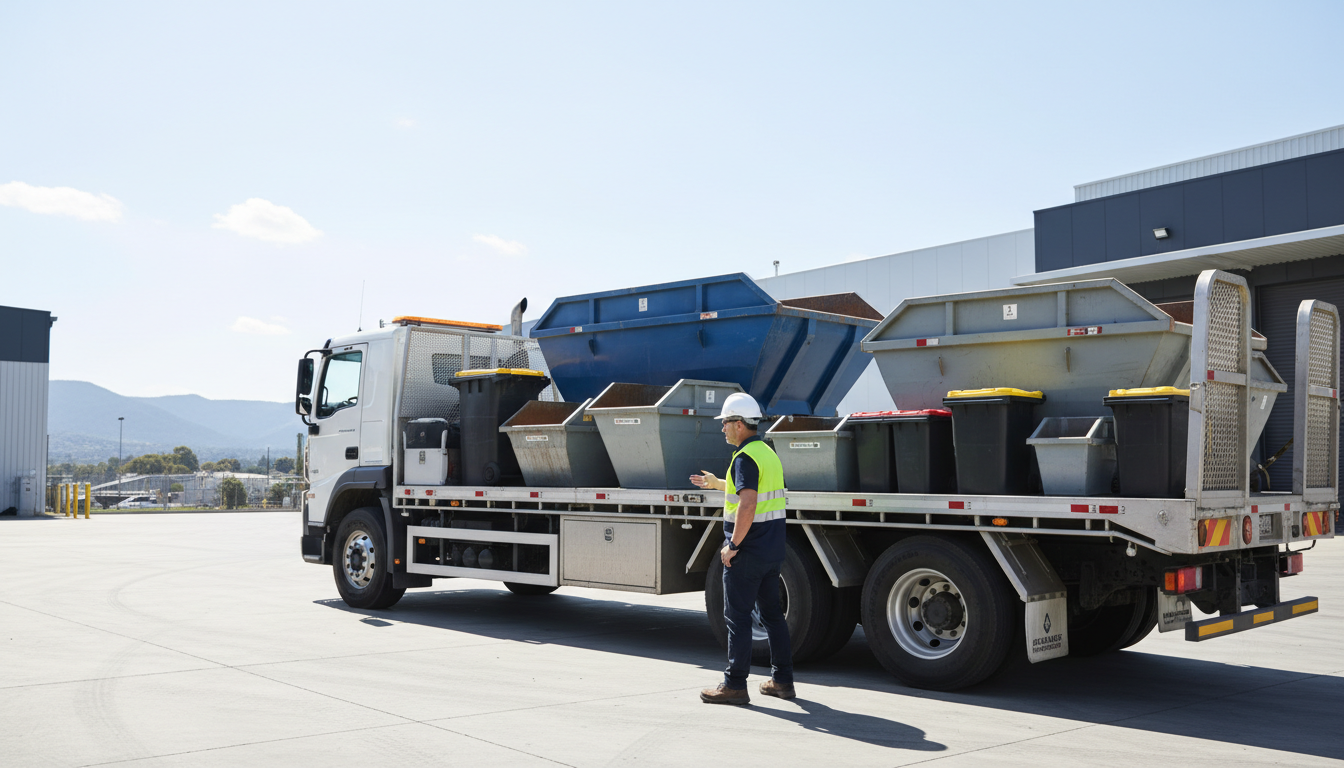
Selecting the best skip loader brand Australia requires evaluating hydraulic system architecture, structural steel specifications, and compliance with Heavy Vehicle National Law mass management obligations. Australian waste contractors and fleet managers procuring skip loader systems must balance European hydraulic engineering proven in high-cycle applications against locally-manufactured solutions offering proximity to parts supply chains and engineering support networks. This technical comparison examines MEC, Palfinger, and Australian-manufactured skip loader systems through the lens of hydraulic pressure ratings, AS 4024.1 safety of machinery compliance, and National Heavy Vehicle Regulator (NHVR) certification requirements.
Wastecorp Equipment engineers custom skip loader systems with proportional hydraulic controls and NHVR-compliant structural design, serving as the official distributor for MEC equipment across Australian waste collection markets. Member of the Waste Contractors and Recyclers Association of NSW (WCRA), Wastecorp Equipment provides technical specification guidance for fleet procurement decisions under Protection of the Environment Operations Act 1997 (NSW) operational frameworks.
Industry Data
- —According to the Waste Management and Resource Recovery Association of Australia, the Australian waste collection vehicle fleet comprises approximately 4,200 specialised units, with skip loaders representing 18% of commercial waste collection systems deployed across construction and industrial sectors.
- —The Department of Climate Change, Energy, the Environment and Water (DCCEEW) reports that Australia generated 75.8 million tonnes of waste in 2020-21, with construction and demolition waste accounting for 27 million tonnes requiring skip bin collection infrastructure.
- —The National Heavy Vehicle Regulator (NHVR) data indicates that waste collection vehicles account for 7.3% of heavy vehicle compliance breaches related to mass limits, emphasising the importance of accurate skip loader capacity specification and payload management systems.
What Defines a Commercial-Grade Skip Loader in Australian Conditions
Commercial-grade skip loaders engineered for Australian waste collection applications must withstand ambient temperature ranges from 5°C to 45°C, corrosive coastal environments, and high-cycle urban operations exceeding 20 lifts per operational day. Hydraulic systems require pressure ratings between 200–280 bar to manage 8–14 tonne lifting capacities typical of construction and demolition waste collection. Structural components must utilise high-tensile structural steel with yield strength exceeding 350 MPa, meeting AS 4024.1 safety of machinery standards for load-bearing welded assemblies.
The National Waste Policy 2018 (Cth) emphasises infrastructure investment in waste collection systems capable of supporting circular economy objectives, while the National Environment Protection (Used Packaging Materials) Measure influences commercial waste collection system specifications through increased material recovery requirements. Skip loaders serving these regulatory frameworks require proportional flow hydraulic controls for precise bin placement during material segregation operations and structural capacity for variable density loads ranging from lightweight packaging waste (150 kg/m³) to heavy construction debris (1,400 kg/m³).
MEC Skip Loader Systems: Engineering Specifications and Market Position
MEC skip loader systems manufactured in Italy incorporate load-sensing hydraulic architectures with variable displacement piston pumps, delivering proportional flow control through pilot-operated joysticks. Typical MEC configurations specify 220 bar operating pressure with 250 bar relief valve settings, supporting lifting capacities from 8 to 16 tonnes across model ranges. Hydraulic cylinders utilise chrome-plated piston rods with polyurethane seals rated for 10,000-hour service intervals under Australian operating conditions.
As official distributor for MEC equipment, Wastecorp Equipment provides NHVR-compliant installation certification and local parts inventory supporting 48-hour component replacement timeframes across New South Wales operations. MEC systems require compliance certification under Heavy Vehicle National Law when installed on Australian truck chassis, including mass distribution calculations and Australian Design Rule documentation. Structural steel components meet EN 10025 S355 specifications, equivalent to Australian AS/NZS 3678 Grade 350 high-tensile steel.
Palfinger Skip Loaders: European Design Adapted for Australian Compliance
Palfinger skip loader systems integrate with manufacturer-supplied truck bodies, offering complete chassis-body engineering packages certified under Heavy Vehicle National Law mass limits. Hydraulic systems specify fixed displacement gear pumps with flow rates to 80 litres per minute, suitable for standard-cycle operations in metropolitan waste collection routes. Palfinger proportional controls utilise electrohydraulic joysticks with load moment indication systems, supporting AS/NZS ISO 45001 occupational health and safety compliance through operator feedback on approaching capacity limits.
Palfinger Australian operations provide factory-backed warranty coverage and service networks across capital cities, though regional parts availability may require extended lead times compared to locally-stocked alternatives. Structural engineering documentation includes finite element analysis reports for welded assemblies, supporting compliance with AS 4024.1 requirements for machinery safety and structural integrity verification.
Australian-Manufactured Skip Loader Brands: Local Engineering Advantages
Australian-manufactured skip loader systems from suppliers including Wastecorp Equipment deliver custom-engineered solutions with hydraulic component selection tailored to specific operational environments and fleet integration requirements. Local manufacturing enables specification of corrosion-resistant surface treatments for coastal operations, hydraulic oil formulations optimised for Australian temperature extremes, and structural steel grades sourced from domestic mills meeting AS/NZS 3678 specifications.
Proximity to engineering support networks reduces downtime during hydraulic system troubleshooting and structural modifications required for specialised applications such as forestry waste collection or mining site operations. Australian manufacturers maintain parts inventory for hydraulic pumps, cylinders, and control valves within local distribution networks, supporting same-day or next-day component replacement compared to imported systems requiring international freight for proprietary components.
Key Procurement Criteria for Skip Loader Systems
Fleet managers evaluating skip loader procurement must establish lifting capacity requirements based on maximum loaded bin mass plus 20% safety margin, calculated against truck chassis GVM limits under Heavy Vehicle National Law. A comprehensive waste collection truck procurement framework addresses chassis selection, body integration, and NHVR compliance documentation requirements before specifying skip loader brand and model.
- 01Calculate Maximum Lifting Capacity RequirementsDetermine loaded bin mass including tare weight (800–1,200 kg for structural steel construction) plus maximum payload density for primary waste streams. Add 20% safety margin to establish minimum skip loader tonnage rating.
- 02Verify NHVR Mass ComplianceConfirm combined truck chassis, skip loader body, and maximum loaded bin remain within NHVR-approved mass limits. Request mass distribution calculations from body builder demonstrating compliance with Heavy Vehicle National Law axle load requirements.
- 03Assess Hydraulic System ServiceabilityEvaluate hydraulic component accessibility for scheduled maintenance, parts availability within 200 km of operating depot, and supplier capacity to provide hydraulic oil analysis and pressure testing services meeting AS 4024.1 maintenance requirements.
- 04Review Structural Engineering DocumentationObtain structural engineering certification for high-tensile steel construction, welding procedure specifications, and fatigue analysis reports demonstrating compliance with AS 4024.1 safety of machinery standards for load-bearing assemblies.
Hydraulic System Design and Serviceability Comparison
Proportional flow hydraulic systems utilising load-sensing variable displacement pumps provide superior control precision compared to fixed displacement architectures, enabling operators to modulate lifting and tilting speeds according to load stability and site constraints. According to Sustainability Victoria’s 2022 infrastructure audit, skip loader systems with proportional hydraulic controls demonstrate 23% fewer workplace safety incidents compared to fixed-speed systems, supporting AS/NZS ISO 45001 compliance objectives.
Hydraulic system serviceability depends on component standardisation and local parts supply networks. MEC systems specify Parker or Bosch Rexroth hydraulic components with cross-reference availability through Australian industrial hydraulic suppliers, while proprietary systems may require manufacturer-specific parts with extended procurement timeframes. Implementing effective hydraulic system maintenance protocols requires access to pressure testing equipment, hydraulic oil analysis services, and technical support for troubleshooting electrohydraulic control systems.
Structural Integrity and Load Capacity Standards
Skip loader structural components must withstand cyclic loading from repeated lift operations, shock loads during bin engagement, and torsional stress from uneven terrain conditions. High-tensile structural steel meeting AS/NZS 3678 Grade 350 specifications provides yield strength of 350 MPa minimum, suitable for welded assemblies subjected to dynamic loading. Structural engineering analysis must demonstrate compliance with AS 4024.1 requirements for load-bearing machinery components, including fatigue life calculations for welded joints and stress concentration points.
Bin capacity ratings interact with skip loader structural design through load centre calculations and moment arm geometry. The relationship between structural steel specifications for waste bins and skip loader lifting capacity determines maximum safe working loads under variable payload distributions. Fleet managers must verify that bin tare weight plus maximum payload density remain within skip loader rated capacity at maximum reach extension, accounting for load centre shift during tilting operations.
Notice:
NHVR Compliance and Heavy Vehicle National Law Considerations
Skip loader installations must comply with National Heavy Vehicle Regulator mass and dimension requirements, including accurate payload management systems preventing overloading beyond truck GVM limits. The Heavy Vehicle National Law requires operators to maintain mass management accreditation or demonstrate compliance through certified weighbridge records and load distribution calculations. Skip loader body builders must provide Australian Design Rule compliance documentation and engineering certification for chassis modifications affecting structural integrity or mass distribution.
Imported skip loader systems require compliance verification including Australian Design Rule certification, electrical system compliance with ADR 42/05 (general safety requirements), and hydraulic system compliance with AS 4024.1 safety of machinery standards. Local body builders installing imported skip loader equipment must hold appropriate engineering qualifications and provide structural certification for welded assemblies and chassis mounting points. Fleet managers should verify warranty coverage includes Australian compliance certification and local technical support for NHVR inspection requirements.
When to Choose a Skip Loader Over Alternative Collection Systems
Skip loaders suit applications requiring frequent bin exchange at construction sites, demolition projects, and commercial waste collection routes with multiple service points per shift. The skip loader versus hooklift system comparison demonstrates skip loaders provide faster cycle times for standard bin sizes (4–12 m³) and superior manoeuvrability in confined urban environments compared to hooklift systems requiring additional chassis length for rail mechanisms.
Mixed fleet operators may deploy skip loaders alongside rear lift systems for residential collection routes, with rear lift system selection criteria addressing different operational requirements including automated bin lifting and compaction capabilities. Skip loaders excel in applications requiring visual load verification, manual load adjustment, and compatibility with non-standardised bin designs common in construction and industrial waste streams.
Total Cost of Ownership: Purchase Price vs Lifecycle Operating Costs
Total cost of ownership analysis for skip loader procurement must account for capital purchase price, scheduled hydraulic maintenance costs, structural inspection requirements, and parts replacement over typical 12–15 year service life. Hydraulic system maintenance represents the primary operating cost variable, with proportional flow systems requiring hydraulic oil analysis every 500 hours and seal replacement at 10,000-hour intervals. Australian-manufactured systems may demonstrate lower total cost of ownership through reduced parts freight costs and faster component replacement timeframes minimising vehicle downtime.
- ✓
Verify skip loader lifting capacity matches maximum loaded bin mass plus 20% safety margin under NHVR mass limits - ✓
Confirm hydraulic system includes proportional flow controls with load-sensing joysticks meeting AS 4024.1 requirements - ✓
Request structural engineering certification for high-tensile steel construction and welding standards documentation - ✓
Assess local parts availability and service network coverage within 200km of primary operating depot - ✓
Obtain Heavy Vehicle National Law compliance documentation including ADR certification and mass distribution calculations - ✓
Evaluate hydraulic pump specifications for Australian ambient temperature ranges (5°C to 45°C operating envelope) - ✓
Confirm warranty terms include hydraulic component coverage and structural steel corrosion protection guarantees - ✓
Review total cost of ownership projections including scheduled maintenance intervals and hydraulic fluid replacement costs
Finance options for skip loader procurement include operating leases preserving capital for fleet expansion, hire-purchase agreements suitable for established operators with predictable cash flow, and chattel mortgage structures optimising tax treatment for equipment depreciation. Fleet managers should evaluate total cost of ownership over projected service life rather than capital purchase price alone, accounting for hydraulic maintenance costs, structural inspection requirements, and parts availability affecting vehicle utilisation rates.
Wastecorp Equipment engineers custom skip loader systems with proportional hydraulic controls and NHVR-compliant structural design. Contact our technical team for specification guidance tailored to your fleet requirements and operational environment.
Official distributor for MEC and OMB. Member of the Waste Contractors and Recyclers Association of NSW.
Frequently Asked Questions
What is the best skip loader brand for Australian waste contractors?
The optimal skip loader brand depends on operational requirements: MEC systems offer proven European hydraulic engineering with Australian support networks, Palfinger provides integrated truck-body solutions compliant with Heavy Vehicle National Law, while Australian manufacturers like Wastecorp Equipment deliver custom-engineered systems with local parts availability and NHVR-compliant engineering. Fleet managers should prioritise hydraulic system serviceability, structural steel specifications meeting AS 4024.1, and supplier proximity for maintenance support.
Are MEC skip loaders compliant with Australian heavy vehicle regulations?
MEC skip loaders require compliance certification under the Heavy Vehicle National Law when installed on Australian truck chassis, including National Heavy Vehicle Regulator mass and dimension approvals. All hydraulic systems must meet AS 4024 safety of machinery standards, with installation performed by accredited body builders holding appropriate engineering certifications. Operators must verify that imported systems include Australian Design Rule compliance documentation and local warranty support infrastructure.
What lifting capacity skip loader do I need for 10m³ construction bins?
A 10m³ construction bin typically requires a skip loader with 8–12 tonne lifting capacity, accounting for bin tare weight (approximately 800–1,200kg for structural steel construction) plus maximum payload density. Fleet managers must calculate total loaded mass against truck GVM limits under Heavy Vehicle National Law, ensuring the combined truck chassis, skip loader body, and loaded bin remain within NHVR-approved mass limits. Proportional hydraulic flow controls are essential for safe handling of variable load centres.
How do proportional flow controls improve skip loader safety?
Proportional flow hydraulic controls provide variable speed adjustment through load-sensing joysticks, allowing operators to modulate lifting and tilting speeds according to load stability and site conditions. This technology reduces shock loading on structural components, improves compliance with AS/NZS ISO 45001 occupational health and safety requirements, and minimises risk of load shift during collection cycles. Systems meeting AS 4024.1 must include pressure relief valves and emergency lowering functions as mandatory safety features.
What is the typical service life of a commercial skip loader in Australia?
Commercial-grade skip loaders engineered to AS 4024 standards typically achieve 12–15 years operational life in Australian waste collection applications, subject to preventative hydraulic maintenance and structural inspections. High-cycle urban operations (20+ lifts daily) require hydraulic oil analysis every 500 hours and structural fatigue assessment at 5-year intervals. Australian-manufactured systems often demonstrate superior corrosion resistance in coastal environments when constructed from high-tensile structural steel with appropriate surface treatments.

 Member of Waste Contractors and Recyclers Association of NSW.