
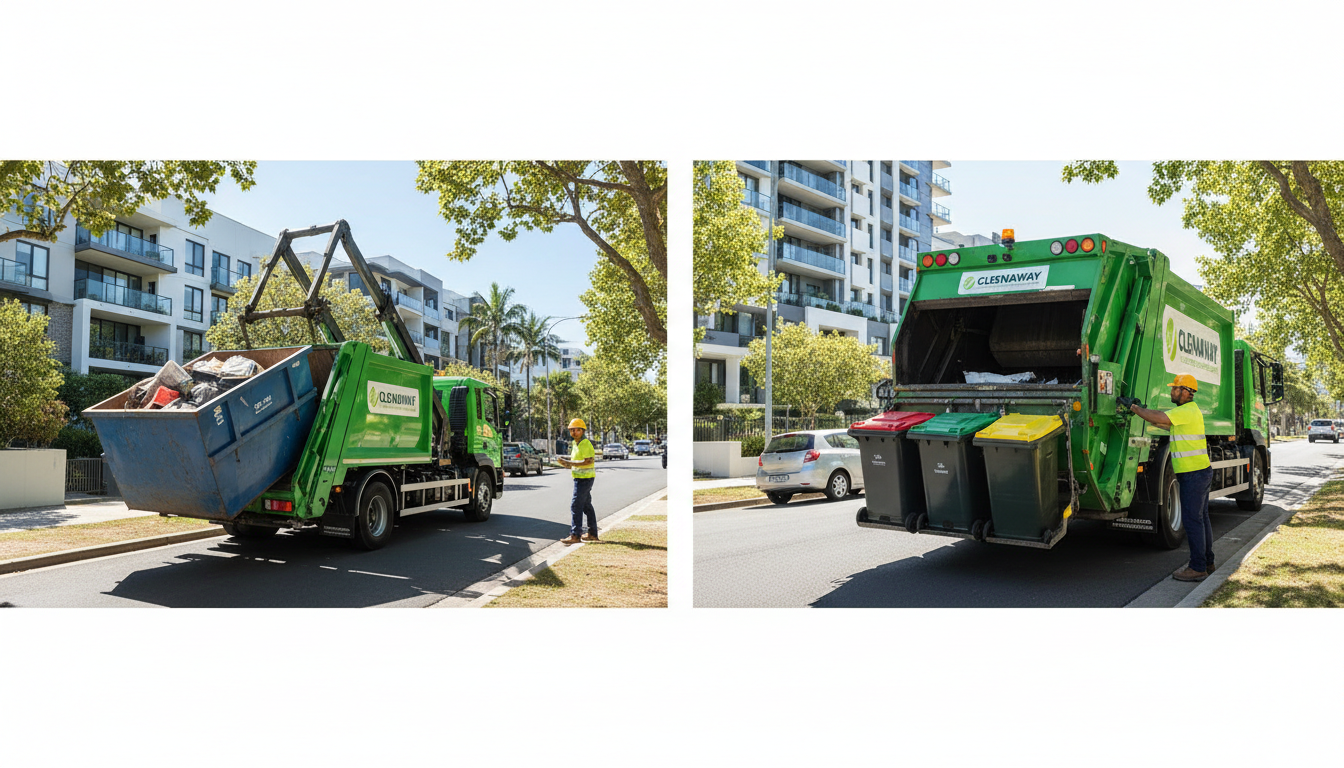
Fleet managers evaluating collection systems for urban waste routes face a fundamental decision that affects operational efficiency, payload utilisation, and total cost of ownership for the next decade. The skip loader vs rear lift comparison centres on matching system capabilities to route characteristics, material types, and collection frequency requirements in high-density metropolitan environments where access constraints, Heavy Vehicle National Law (HVNL) mass limits, and cycle time performance determine profitability. Wastecorp Equipment supplies both MEC skip loaders and OMB rear lift compactors engineered for Australian urban collection environments, with full National Heavy Vehicle Regulator (NHVR) compliance documentation and Waste Contractors and Recyclers Association of NSW (WCRA) standard aftermarket support across NSW.
The Australian Bureau of Statistics reports that 67 million tonnes of waste was generated nationally in 2020-21, with metropolitan collection representing the largest single operational cost for municipal waste services. According to the National Waste Policy 2018 (Cth), improving collection efficiency in urban environments is identified as a priority action to reduce per-tonne collection costs and support resource recovery targets. System selection directly influences these outcomes through differences in cycle time, compaction capability, and vehicle utilisation rates.
Industry Data
- —The Australian Bureau of Statistics reports that 67 million tonnes of waste was generated nationally in 2020-21, with metropolitan collection representing the largest single operational cost for municipal waste services
- —According to the National Waste Policy 2018 (Cth), improving collection efficiency in urban environments is identified as a priority action to reduce per-tonne collection costs and support resource recovery targets
Skip Loader Systems: Operational Characteristics in Urban Environments
Skip loaders employ a hydraulic hoist mechanism mounted behind the driver cabin, lifting bins ranging from 2 to 12 cubic metres via a hook-and-chain or telescopic arm configuration. The system operates at hydraulic pressures between 180-220 bar, with cycle times of 45-90 seconds for bin exchange depending on bin size and operator proficiency. This rapid exchange capability makes skip loaders particularly effective for high-frequency commercial collection routes where multiple services occur daily and bins remain at customer premises between collections.
The operational advantage in urban environments stems from forward vehicle positioning requirements. Skip loaders service bins placed kerbside or in accessible locations without requiring rear access clearance, making them superior for constrained environments common in inner Sydney commercial precincts, Melbourne CBD laneways, and mixed-use developments with limited manoeuvring space. Australian Standard AS 4024 (safety of machinery) requirements for operator protection systems on skip loaders focus on load stability during transit and secure bin engagement mechanisms, with modern MEC units incorporating automatic locking systems and load-sensing hydraulics that prevent operation outside safe parameters.
Skip loaders handle loose or lightly compacted material with payload capacity determined by bin volume and material density rather than onboard compaction. For operators managing source-separated recyclables, construction waste, or commercial refuse under the Protection of the Environment Operations Act 1997 (NSW) waste transport licensing framework, this characteristic allows material inspection and contamination identification before transport. The skip loader brand comparison demonstrates how MEC units incorporate high tensile structural steel chassis construction and sealed hydraulic circuits engineered for Australian operating conditions.
Rear Lift Compactor Systems: Technical Performance in High-Density Areas
Rear lift compactor systems integrate a hydraulic lifting mechanism with an onboard compaction chamber, operating at hydraulic pressures between 250-300 bar to achieve compaction ratios of 3:1 to 4:1 for municipal solid waste and packaging materials. The compaction ram applies forces exceeding 20 tonnes across the hopper floor, reducing material volume and increasing payload efficiency within NHVR mass limits. Cycle times range from 2-4 minutes per service including bin lift, material discharge, and compaction cycle completion.
OMB rear lift compactors supplied by Wastecorp Equipment incorporate wear-resistant hopper liners, progressive compaction sequences, and sealed tailgate mechanisms that prevent leachate discharge during transit. These features address National Environment Protection (Used Packaging Materials) Measure requirements for contamination prevention and support operators managing mixed municipal waste streams where compaction efficiency directly affects collection route economics. The higher hydraulic system pressures require more robust component specifications including reinforced cylinder rods, high-pressure seals rated for continuous duty cycles, and hydraulic oil cooling systems that maintain operating temperatures within manufacturer specifications.
Rear lift systems require rear access clearance of 3-4 metres for safe bin positioning and lifting operations, limiting applicability in tight laneways or against building lines without vehicle repositioning. Australian Standard AS 4024 compliance for rear lift compactors addresses operator exclusion zones during compaction cycles, emergency stop systems accessible from ground level, and interlock mechanisms preventing compaction ram operation with the tailgate open. The rear lift system procurement criteria outlines specification requirements for operators evaluating compaction performance, hydraulic system reliability, and maintenance access in urban fleet applications.
Cycle Time Comparison: Collection Efficiency in Constrained Access Zones
Cycle time performance determines daily service capacity and labour productivity across urban collection routes. Skip loaders complete bin exchanges in 45-90 seconds, allowing a single operator to service 40-60 bins per shift on high-density commercial routes with minimal travel distances between service points. The rapid exchange capability becomes particularly valuable for operators managing multiple daily services at high-volume commercial premises including shopping centres, food service precincts, and industrial estates where bins fill multiple times daily.
Rear lift compactors require 2-4 minutes per service including bin positioning, lifting, discharge, and compaction cycle completion. This extended cycle time reduces daily service capacity to 25-35 bins per shift, but the compaction capability allows each collection to transport 40-60% more waste by volume within Heavy Vehicle National Law mass limits. For municipal solid waste collection routes with weekly or fortnightly service frequencies, the payload advantage outweighs the cycle time disadvantage by reducing total collection trips and fuel consumption per tonne collected.
In constrained access zones including heritage precincts, narrow laneways, and mixed-use developments with limited turning circles, skip loader cycle time advantages compound across daily operations. A 90-second cycle time differential repeated across 50 services per shift represents 75 minutes of additional productive time, equivalent to 8-10 additional service stops or reduced overtime requirements for operators completing extended routes.
NHVR Mass and Dimension Compliance for Urban Collection Routes
The National Heavy Vehicle Regulator (NHVR) administers Heavy Vehicle National Law (HVNL) compliance requirements that affect system selection for urban collection routes. Skip loaders mounted on rigid truck chassis typically operate within general access mass limits of 22.5 tonnes gross vehicle mass (GVM) for two-axle configurations and 26 tonnes GVM for three-axle configurations. Payload capacity depends on chassis tare weight, skip loader body weight, and bin tare weight, with operators required to maintain payload records demonstrating compliance with axle load limits and bridge formula requirements.
Rear lift compactors achieve higher payload efficiency through compaction, allowing operators to transport more waste volume within the same NHVR mass limits. A rear lift compactor with 3:1 compaction ratio effectively carries three times the waste volume of a skip loader within identical mass constraints, reducing collection trips and fuel consumption per tonne collected. This advantage becomes particularly significant for municipal solid waste collection where material density averages 150-250 kg per cubic metre before compaction.
Dimension compliance affects route planning in urban environments with height-restricted underpasses, narrow street widths, and turning circle constraints. Skip loaders with bins loaded typically operate at overall heights of 3.2-3.8 metres depending on bin size, while rear lift compactors range from 3.4-4.0 metres with tailgate closed. Operators managing routes through heritage precincts or established residential areas with mature street tree canopies must verify clearance heights and obtain local council permits for restricted access routes.
When Skip Loaders Outperform Rear Lift Systems
Skip loaders demonstrate superior performance in high-frequency commercial collection environments where bins require multiple daily services and rapid exchange capability determines route economics. Food service precincts, shopping centres, and commercial office developments generate concentrated waste volumes requiring 2-3 daily collections, with skip loaders completing these services in 45-90 seconds per stop compared to 2-4 minutes for rear lift compactors. The cycle time advantage allows a single skip loader to service 40-60 locations per shift, effectively replacing 1.5-2 rear lift compactor units on equivalent routes.
Source-separated recyclables including cardboard, commingled containers, and organic waste streams benefit from skip loader systems that maintain material segregation and allow visual contamination inspection before transport. The National Environment Protection (Used Packaging Materials) Measure framework encourages source separation to improve material recovery rates, with skip loaders supporting this objective by transporting discrete material streams in dedicated bins without cross-contamination risks inherent in compacted mixed loads.
Constrained access environments including inner-city laneways, heritage precincts, and mixed-use developments with limited manoeuvring space favour skip loaders that service bins from forward vehicle positions without requiring rear access clearance. The skip loader vs hooklift comparison demonstrates how MEC skip loaders operate effectively in locations where rear lift compactors cannot position safely or require extensive reversing manoeuvres that increase cycle times and safety risks under Australian Standard AS/NZS ISO 45001 (occupational health and safety) requirements.
Construction and demolition waste applications favour skip loaders for their ability to handle heavy, bulky materials including concrete, timber, and metal that resist compaction and may damage rear lift compactor ram seals or hopper liners. The skip loader applications in construction waste outlines how operators manage diverse material streams with varying densities and handling characteristics using skip bins sized from 2-12 cubic metres.
When Rear Lift Compactors Are the Optimal Choice
Municipal solid waste collection with weekly or fortnightly service frequencies benefits from rear lift compactor payload efficiency that reduces collection trips and fuel consumption per tonne collected. The 3:1 to 4:1 compaction ratio allows operators to service 40-60% more households per trip within NHVR mass limits compared to skip loaders handling loose material, directly reducing per-tonne collection costs and supporting National Waste Policy 2018 (Cth) objectives for improved collection efficiency.
Low-density residential routes with extended travel distances between service points favour rear lift compactors that maximise payload per trip and minimise return journeys to disposal facilities. For operators managing suburban collection routes with 5-15 kilometre distances to transfer stations or landfills, the compaction advantage reduces daily trips from 4-5 loads per shift to 2-3 loads per shift, representing 30-40% fuel savings and reduced vehicle wear across annual operations.
Mixed municipal waste streams including general refuse, organic waste, and packaging materials achieve optimal transport efficiency through compaction that reduces air voids and increases material density. OMB rear lift compactors incorporate progressive compaction sequences that apply increasing pressure across multiple ram cycles, achieving consistent compaction ratios regardless of material composition variations between service points. This capability supports operators managing diverse waste streams under the Protection of the Environment Operations Act 1997 (NSW) framework where material characterisation and transport efficiency affect licensing compliance and operational costs.
High-volume commercial premises including shopping centres, hospitals, and educational institutions generate concentrated waste volumes that benefit from onboard compaction rather than multiple bin exchanges. A rear lift compactor servicing a single high-volume location can compact material from multiple 240-litre or 660-litre bins into the hopper, reducing collection frequency requirements and eliminating the need for multiple large skip bins that consume valuable site space.
Material Type and Collection Frequency Considerations
Material characteristics determine compaction effectiveness and system suitability across different waste streams. Municipal solid waste with average bulk density of 150-250 kg per cubic metre compacts effectively at 3:1 to 4:1 ratios in rear lift systems, while source-separated cardboard and packaging materials achieve 4:1 to 5:1 compaction ratios due to higher air void content. Skip loaders handle these materials in loose form, with payload capacity limited by bin volume and material density rather than compaction capability.
Heavy, dense materials including construction waste, green waste, and soil resist compaction and may damage rear lift compactor components including ram seals, hopper wear plates, and hydraulic cylinders. These materials suit skip loader systems that transport material in bins without subjecting collection equipment to compaction forces. The skip loader applications in construction waste demonstrates how operators manage material streams with densities exceeding 800 kg per cubic metre using appropriately sized skip bins and chassis configurations rated for higher payload weights.
Collection frequency requirements influence system selection through their effect on bin sizing and vehicle utilisation. High-frequency commercial collection with daily or multiple daily services favours skip loaders that exchange bins rapidly without compaction cycle delays. Low-frequency residential collection with weekly or fortnightly services favours rear lift compactors that maximise payload per trip and reduce total collection vehicle requirements across service areas. Operators managing mixed route portfolios often deploy both system types, allocating skip loaders to high-frequency commercial routes and rear lift compactors to residential collection areas.
Maintenance Requirements and Downtime Comparison
Skip loaders incorporate simpler hydraulic circuits and fewer moving components than rear lift compactors, resulting in 30-40% lower annual maintenance expenditure per unit according to fleet managers operating mixed collection systems. Maintenance requirements focus on hydraulic hoist cylinder seals, chain or cable wear on lifting mechanisms, and structural integrity of the mounting frame and subframe. Service intervals typically occur at 250-500 operating hours depending on duty cycle intensity and operating environment.
Rear lift compactors require more intensive maintenance schedules addressing compaction ram seals, hopper wear plates, tailgate seals, and hydraulic system components operating at 250-300 bar pressures. The compaction ram seal replacement represents a major service item occurring every 2000-3000 compaction cycles, with labour requirements of 4-6 hours and parts costs of 2000-3500 dollars depending on compactor size and seal specifications. Hopper wear plates require replacement every 12-18 months in high-volume municipal collection applications, with replacement costs of 3000-5000 dollars including labour.
Hydraulic system maintenance requirements differ significantly between systems due to pressure and duty cycle variations. Skip loaders operating at 180-220 bar require hydraulic oil changes every 2000 operating hours, while rear lift compactors operating at 250-300 bar require changes every 1000-1500 operating hours to maintain component protection and prevent seal degradation. The hydraulic system maintenance protocols outlines preventive maintenance schedules that minimise unplanned downtime and extend component service life across both system types.
Downtime comparison across fleet operations demonstrates skip loader availability rates of 92-95% compared to rear lift compactor availability rates of 88-92%, with the differential attributable to more frequent scheduled maintenance requirements and higher component wear rates in compaction systems. For operators managing time-sensitive collection contracts with penalty clauses for missed services, the higher availability rates of skip loaders reduce operational risk and support consistent service delivery.
Total Cost of Ownership: Skip Loader vs Rear Lift Analysis
Total cost of ownership analysis over a 10-year asset life requires evaluation of capital cost, maintenance expenditure, fuel consumption, payload efficiency, and residual value. Skip loaders demonstrate lower capital costs with MEC units priced at 85,000-120,000 dollars depending on lifting capacity and chassis configuration, compared to OMB rear lift compactors priced at 145,000-195,000 dollars for equivalent chassis specifications. The capital cost differential of 60,000-75,000 dollars per unit represents a significant consideration for operators establishing new fleets or expanding existing operations.
Maintenance cost analysis demonstrates skip loader annual expenditure of 8,000-12,000 dollars per unit compared to rear lift compactor expenditure of 12,000-18,000 dollars per unit, representing a 4,000-6,000 dollar annual differential. Over a 10-year asset life, this differential compounds to 40,000-60,000 dollars per unit, partially offsetting the lower initial capital cost of skip loaders. Operators managing large fleets of 10-20 vehicles must factor these maintenance cost differentials into procurement decisions and budget planning.
Fuel consumption analysis requires route-specific evaluation of payload efficiency, collection trip frequency, and travel distances to disposal facilities. Skip loaders handling loose material require more frequent disposal trips, with fuel consumption of 35-45 litres per 100 kilometres on urban collection routes. Rear lift compactors achieve 40-60% fewer disposal trips through compaction, reducing total fuel consumption by 25-35% despite similar per-kilometre consumption rates. For operators managing routes with 15-25 kilometre distances to disposal facilities, the fuel savings of rear lift compactors offset higher maintenance costs within 3-5 years of operation.
The waste collection truck procurement guide provides detailed cost modelling frameworks that incorporate capital expenditure, operating costs, payload efficiency, and residual value across different system types and route configurations. Wastecorp Equipment offers finance arrangements through commercial lending partners that structure repayments based on projected cash flow from collection contracts, supporting operators managing capital constraints while establishing or expanding urban collection operations.
Frequently Asked Questions
What is the typical cycle time difference between skip loaders and rear lift compactors in urban collection?
Skip loaders typically complete bin exchanges in 45-90 seconds depending on bin size and positioning, while rear lift compactors require 2-4 minutes per service including compaction cycle. In high-frequency commercial routes with multiple daily services, skip loaders demonstrate superior productivity for non-compactable or source-separated materials. The cycle time differential compounds across daily operations, with skip loaders servicing 40-60 bins per shift compared to 25-35 bins per shift for rear lift compactors. For operators managing time-sensitive collection contracts in constrained urban environments, the rapid exchange capability of skip loaders reduces labour costs and supports consistent service delivery schedules.
Do skip loaders or rear lift systems have better access in narrow Sydney laneways?
Skip loaders require only forward vehicle positioning and operate with bins placed kerbside, making them superior for constrained access environments common in inner Sydney, Surry Hills, and Newtown commercial precincts. Rear lift systems require rear access clearance of 3-4 metres and cannot service bins in tight alcoves or against building lines without repositioning. The forward-loading capability of skip loaders eliminates reversing manoeuvres in narrow laneways, reducing safety risks under Australian Standard AS/NZS ISO 45001 (occupational health and safety) requirements and improving cycle time performance in heritage precincts with limited turning circles. Operators managing routes through established urban areas with mature street tree canopies and overhead service lines benefit from skip loader manoeuvrability and reduced clearance requirements.
Which system offers lower maintenance costs for urban waste fleets?
Skip loaders have fewer moving components than rear lift compactors—no compaction ram, no hopper seals, and simpler hydraulic circuits—resulting in 30-40% lower annual maintenance expenditure per unit. Rear lift compactors require regular ram seal replacement, hopper wear plate maintenance, and more frequent hydraulic oil changes due to higher system pressures and duty cycles. Annual maintenance costs for skip loaders average 8,000-12,000 dollars per unit compared to 12,000-18,000 dollars per unit for rear lift compactors, with the differential compounding to 40,000-60,000 dollars over a 10-year asset life. Fleet managers evaluating total cost of ownership must balance lower skip loader maintenance costs against the payload efficiency advantages of rear lift compactors that reduce fuel consumption and collection trip frequency on routes with extended travel distances to disposal facilities.
Can rear lift compactors achieve better payload efficiency than skip loaders under NHVR mass limits?
Rear lift compactors with 3:1 to 4:1 compaction ratios can carry 40-60% more waste by volume within Heavy Vehicle National Law mass limits compared to skip loaders handling loose or lightly compacted material. For municipal solid waste and packaging materials, this translates to fewer collection trips and reduced fuel consumption per tonne collected. The compaction advantage becomes particularly significant on low-density residential routes with extended travel distances to disposal facilities, where rear lift compactors reduce daily trips from 4-5 loads per shift to 2-3 loads per shift. Operators must maintain payload records demonstrating compliance with National Heavy Vehicle Regulator (NHVR) axle load limits and bridge formula requirements, with weighbridge verification conducted regularly to ensure compacted loads remain within legal mass limits for the chassis configuration and axle arrangement.
Wastecorp Equipment supplies MEC skip loaders and OMB rear lift compactors engineered for Australian urban collection environments, with full NHVR compliance documentation and WCRA-standard aftermarket support across NSW.
Official distributor for MEC and OMB. Member of the Waste Contractors and Recyclers Association of NSW.

 Member of Waste Contractors and Recyclers Association of NSW.