
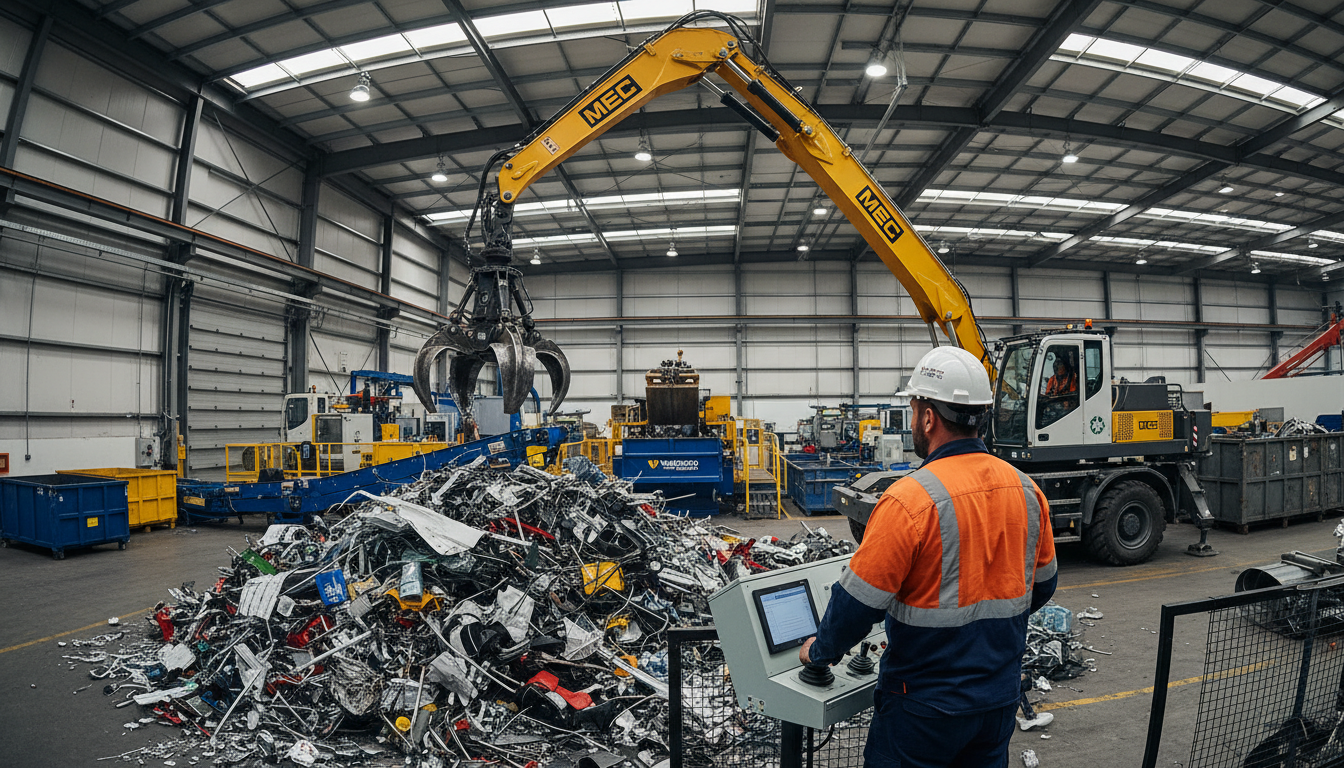
Scrap metal and waste handling operations face a persistent challenge: material throughput bottlenecks that limit revenue per operating hour. Inefficient grab cycle times, inadequate hydraulic flow rates, and poor boom control translate directly to reduced tonnage processed per shift. For operators managing high-volume scrap yards or waste transfer stations, crane performance specifications determine operational capacity as much as site layout or labour allocation.
The MEC recycling crane addresses these efficiency constraints through engineered hydraulic system design, proportional control valve technology, and boom construction optimised for continuous material handling under load. Wastecorp Equipment supplies MEC recycling cranes with full hydraulic system specifications and engineering support for scrap handling operations across NSW and Australia, backed by our official MEC distributor status and membership in the Waste Contractors and Recyclers Association of NSW (WCRA).
This technical analysis examines how specific MEC crane engineering parameters — hydraulic flow rates, proportional valve response, grab cycle sequences, and slew bearing design — impact material throughput, fuel consumption, and compliance with Heavy Vehicle National Law (HVNL) and AS 4024 safety requirements for machinery.
Industry Data
- —Australia generated 75.8 million tonnes of waste in 2020-21, with metal recycling representing 8% of total waste streams (Australian Bureau of Statistics, Waste Account Australia Experimental Estimates 2021)
- —Hydraulic crane cycle time reductions of 20-30% can increase daily material throughput by 15-25 tonnes in scrap handling operations (industry operational data)
Hydraulic System Design and Flow Rate Performance
Hydraulic flow rate measured in litres per minute directly determines grab cycle time in material handling operations. MEC recycling cranes typically operate within 60-120 litres per minute depending on boom reach and grab capacity specifications. This flow rate range supports complete open-close-lift sequences in 12-18 seconds under optimal conditions, compared to 20-25 seconds for lower-flow systems common in older crane designs.
The hydraulic circuit design in MEC waste cranes prioritises consistent flow delivery across multiple simultaneous functions — slew rotation, boom extension, and grab actuation. Dual-pump configurations maintain pressure stability when operators execute combined movements, preventing the flow starvation that reduces precision during material placement. This design approach aligns with hydraulic system maintenance protocols that emphasise filter cleanliness and oil viscosity management to preserve flow rate performance over equipment lifespan.
Flow rate specifications must match power take-off (PTO) capacity on the host truck chassis. Undersized PTO installations limit achievable flow rates regardless of crane hydraulic capacity, creating throughput constraints that operators often misattribute to crane performance rather than chassis integration issues.
Proportional Control Valve Technology and Operator Precision
Proportional hydraulic control valves modulate flow in response to joystick input intensity, allowing operators to vary movement speed from 5% to 100% of maximum flow rate. This technology contrasts with fixed-flow on-off valve systems that operate at full hydraulic capacity regardless of task requirements. The precision enabled by proportional hydraulic control systems reduces fuel consumption by 15-20% in typical scrap handling duty cycles by eliminating unnecessary full-flow actuation during positioning movements.
Operator fatigue decreases measurably with proportional control implementation. Fine material placement — positioning scrap into sorting bins or onto conveyor feed points — requires multiple small corrections with fixed-flow systems, each consuming full hydraulic capacity. Proportional valves allow operators to execute these corrections at 10-20% flow rates, reducing physical input effort and improving placement accuracy.
The fuel efficiency gains from proportional control compound across operating hours. A crane executing 200 grab cycles per shift with proportional control consumes approximately 8-12 litres less diesel than equivalent fixed-flow systems, translating to 2,000-3,000 litres annual savings in continuous operation. These savings justify the higher initial capital cost of proportional valve packages within 18-24 months for high-utilisation operations.
Grab Cycle Time Analysis: Open-Close-Lift Sequence Efficiency
Complete grab cycle time encompasses four distinct phases: grab open (descent to material), grab close (material capture), lift (vertical elevation), and slew (horizontal rotation to discharge point). MEC recycling cranes achieve 12-15 second complete cycles in optimal conditions with 80-100 litres per minute flow rates and 0.4-0.6m³ grab capacity.
Grab closing force specifications determine material capture reliability. Mixed ferrous scrap requires 800-1,200kg closing force to penetrate material pile surfaces and maintain grip during slew rotation. Insufficient closing force results in material spillage during rotation, requiring repeat cycles that eliminate any theoretical cycle time advantages from higher hydraulic flow rates.
Cycle time analysis must account for operator skill variation. Experienced operators reduce cycle times by 15-20% compared to newly trained personnel through optimised movement sequencing — initiating slew rotation during lift phase completion rather than waiting for full vertical elevation. This technique requires proportional control precision to avoid load swing that compromises safety and placement accuracy.
Material type significantly impacts achievable cycle times. Light non-ferrous scrap (aluminium extrusions, copper wire) allows faster grab closure and lower closing force requirements, reducing cycle times to 10-12 seconds. Dense ferrous plate or structural steel sections require maximum closing force and slower material penetration, extending cycles to 16-20 seconds regardless of hydraulic flow capacity.
Boom Construction and Material Handling Capacity
MEC crane boom construction utilises high tensile structural steel with yield strengths of 350-450 MPa, providing the strength-to-weight ratio necessary for extended reach without excessive chassis loading. Boom geometry — typically hexagonal or octagonal cross-sections — distributes bending moments more effectively than rectangular profiles, reducing material thickness requirements and overall boom weight.
Telescopic boom sections extend working radius from 4-6 metres in retracted position to 8-12 metres fully extended, depending on model specifications. Hydraulic extension cylinders must maintain position under load without drift, requiring cylinder seal specifications and counterbalance valve integration that prevents boom creep during material handling. This engineering consideration relates directly to structural steel specifications for heavy-duty applications where material selection impacts long-term dimensional stability under cyclic loading.
Boom reach capacity decreases with extension due to moment arm physics. A crane rated for 1,200kg lift capacity at 6 metres may reduce to 600-700kg at 10 metres extension. Operators must understand these capacity curves to avoid overload conditions that trigger load moment indicator warnings or automatic function lockouts required under AS 4024 machinery safety standards.
NHVR Compliance and Crane Mounting Specifications
Crane-mounted vehicles must comply with National Heavy Vehicle Regulator (NHVR) General Mass Limits under Heavy Vehicle National Law (HVNL), which specifies maximum axle loads and Gross Vehicle Mass (GVM) ratings. MEC crane mounting requires chassis manufacturer certification that crane weight, mounting position, and operational loads maintain axle weight distribution within legal limits during all operating configurations.
Typical MEC recycling crane installations add 1,800-3,200kg to chassis weight depending on boom reach and slew bearing specifications. This weight must be accounted against vehicle GVM along with grab weight, hydraulic oil capacity, and PTO installation. Operators frequently underestimate total crane system weight, discovering compliance issues during weighbridge verification that require payload reduction or chassis upgrade to heavier GVM ratings.
Crane mounting position affects axle load distribution significantly. Rear-mounted cranes behind the cab place weight primarily on rear axles, potentially exceeding rear axle group limits even when total GVM remains compliant. Engineering analysis must verify axle loads in multiple configurations: crane stowed, boom extended without load, and boom extended with maximum rated load at minimum radius. Understanding these heavy vehicle compliance requirements for waste equipment prevents costly post-installation modifications.
Slew Bearing Design and 360° Rotation Under Load
Slew bearing design determines crane rotation smoothness and load stability during material transfer. MEC cranes utilise ball or roller bearing slew rings with diameters of 800-1,200mm depending on crane capacity, providing the load path for vertical forces and overturning moments generated during boom operation.
Slew drive torque specifications must overcome bearing friction, boom weight, and material load inertia during rotation initiation. Hydraulic slew motors typically deliver 3,000-8,000 Nm torque through planetary gear reduction, achieving rotation speeds of 2-4 rpm under full load. Higher rotation speeds reduce cycle time but increase load swing amplitude, requiring operator skill to control material positioning accuracy.
Bearing preload adjustment maintains rotational smoothness over equipment lifespan. Excessive preload increases slew motor current draw and accelerates bearing wear, while insufficient preload allows axial play that creates boom oscillation during rotation. Maintenance protocols specify preload verification at 500-hour service intervals using torque measurement of slew ring rotation resistance.
Continuous 360° rotation capability eliminates the productivity loss associated with limited-rotation cranes that require reverse slewing to return to neutral position. MEC crane hydraulic routing through the slew centre column uses rotary unions that maintain pressure integrity through unlimited rotation cycles, supporting efficient material handling patterns in confined scrap yard layouts.
Total Cost of Ownership: Fuel Consumption and Cycle Time Analysis
Total cost of ownership analysis for MEC recycling cranes must account for fuel consumption, maintenance intervals, and throughput capacity over 10-15 year equipment lifespan. Fuel consumption during crane operation typically ranges from 4-8 litres per hour depending on duty cycle intensity, hydraulic system efficiency, and PTO engagement strategy.
Proportional control systems reduce fuel consumption by 15-20% compared to fixed-flow designs, generating annual savings of 1,200-2,000 litres for operations running 2,000 hours per year. At current diesel costs, this represents ongoing operational savings of 2,400-4,000 AUD annually, offsetting higher initial capital costs within the first 24-36 months of operation.
Cycle time improvements directly impact revenue generation capacity. Reducing average cycle time from 18 seconds to 14 seconds increases daily grab cycles from 800 to 1,028 in an 8-hour shift (accounting for breaks and non-productive time). At 250kg average grab weight, this represents 57 additional tonnes processed per week, or 2,964 tonnes annually. For operations processing scrap at 40-60 AUD per tonne revenue, cycle time efficiency generates 118,000-178,000 AUD additional annual revenue capacity.
Maintenance cost projections must include hydraulic component replacement, slew bearing service, and boom structural inspection intervals specified by manufacturer engineering documentation. MEC cranes typically require major hydraulic service at 2,000-hour intervals and slew bearing inspection at 4,000 hours, with structural weld inspection recommended at 8,000 hours or 5 years. Operators should reference the commercial waste equipment procurement checklist when evaluating total ownership costs against operational requirements.
AS 4024 Safety Features: Load Moment Indicators and Overload Protection
AS 4024 safety of machinery standards require load moment indicators (LMI) and overload protection systems on cranes exceeding specified capacity thresholds. MEC recycling cranes incorporate electronic LMI systems that monitor boom angle, extension length, and hydraulic pressure to calculate real-time load moment against rated capacity curves.
LMI systems provide progressive warnings as load approaches rated capacity: visual alerts at 90% capacity, audible warnings at 100% capacity, and automatic function lockout at 110% capacity. Function lockout prevents further boom extension or load lifting while permitting boom retraction and load lowering, allowing operators to safely reduce load moment without complete system shutdown.
Pressure relief valves provide secondary overload protection independent of electronic LMI systems. These valves limit maximum hydraulic pressure to 250-280 bar, preventing structural overload even if LMI systems fail or operators attempt override procedures. Dual protection systems align with AS 4024 requirements for redundant safety mechanisms on machinery presenting crush or overturn hazards.
Operator training requirements under AS/NZS ISO 45001 occupational health and safety standards mandate documented competency verification for crane operation, including load capacity calculation, stability assessment, and emergency procedure execution. Employers must maintain training records and conduct periodic competency reassessment at intervals specified in workplace safety management systems.
Wastecorp Equipment provides engineering support and compliance documentation for MEC crane installations, ensuring operators receive manufacturer specifications, load capacity charts, and maintenance schedules required for AS 4024 compliance verification during workplace safety audits.
Frequently Asked Questions
What hydraulic flow rate does a MEC recycling crane require for optimal cycle times?
MEC recycling cranes typically require 60-120 litres per minute hydraulic flow depending on model and boom reach. Flow rate directly impacts grab cycle time — higher flow reduces open-close-lift sequences from 18-22 seconds to 12-15 seconds, increasing material throughput by 25-30% in scrap handling operations. Flow rate must be matched to PTO capacity on the host truck chassis to achieve specified performance. Undersized PTO installations limit achievable flow regardless of crane hydraulic capacity, creating throughput constraints that operators often misattribute to crane performance rather than chassis integration issues.
Are MEC waste cranes compliant with NHVR mass and dimension requirements?
MEC cranes are designed for mounting on Heavy Vehicle National Law (HVNL) compliant truck chassis, with mounting specifications that maintain axle load distribution within National Heavy Vehicle Regulator (NHVR) General Mass Limits. Operators must verify crane weight, boom extension, and payload against their vehicle’s Gross Vehicle Mass (GVM) and Gross Combination Mass (GCM) ratings. Crane installation typically adds 1,800-3,200kg to chassis weight depending on boom reach specifications. Operators must obtain updated vehicle placards reflecting revised GVM ratings from chassis manufacturer or approved vehicle examiner prior to road operation under NHVR compliance requirements.
What grab capacity is required for mixed scrap metal handling?
Mixed ferrous scrap handling typically requires 0.3-0.8m³ grab capacity with 800-1,200kg closing force. MEC cranes pair grab capacity with boom reach and slew torque to maintain material control during 360° rotation, critical for safe loading into bins or onto sorting lines in compliance with AS 4024 machinery safety requirements. Grab capacity selection must account for material density — light non-ferrous scrap allows larger volume grabs at lower closing force, while dense ferrous plate requires maximum closing force regardless of grab volume. Insufficient closing force results in material spillage during slew rotation, requiring repeat cycles that eliminate throughput advantages from higher hydraulic flow rates.
How does proportional hydraulic control improve MEC crane efficiency?
Proportional control valves allow operators to modulate hydraulic flow in real-time, reducing fuel consumption by 15-20% compared to fixed-flow systems. This technology enables precise grab positioning and controlled material release, reducing spillage and improving load accuracy in high-volume scrap operations. Proportional valves modulate flow from 5% to 100% of maximum capacity in response to joystick input intensity, allowing fine positioning movements at low flow rates while maintaining full flow availability for primary lift and slew functions. The fuel efficiency gains compound across operating hours — a crane executing 200 grab cycles per shift with proportional control consumes approximately 8-12 litres less diesel than equivalent fixed-flow systems.
Wastecorp Equipment supplies MEC recycling cranes with full hydraulic system specifications, NHVR compliance documentation, and engineering support for scrap handling operations across NSW and Australia.
Official distributor for MEC and OMB. Member of the Waste Contractors and Recyclers Association of NSW.

 Member of Waste Contractors and Recyclers Association of NSW.