
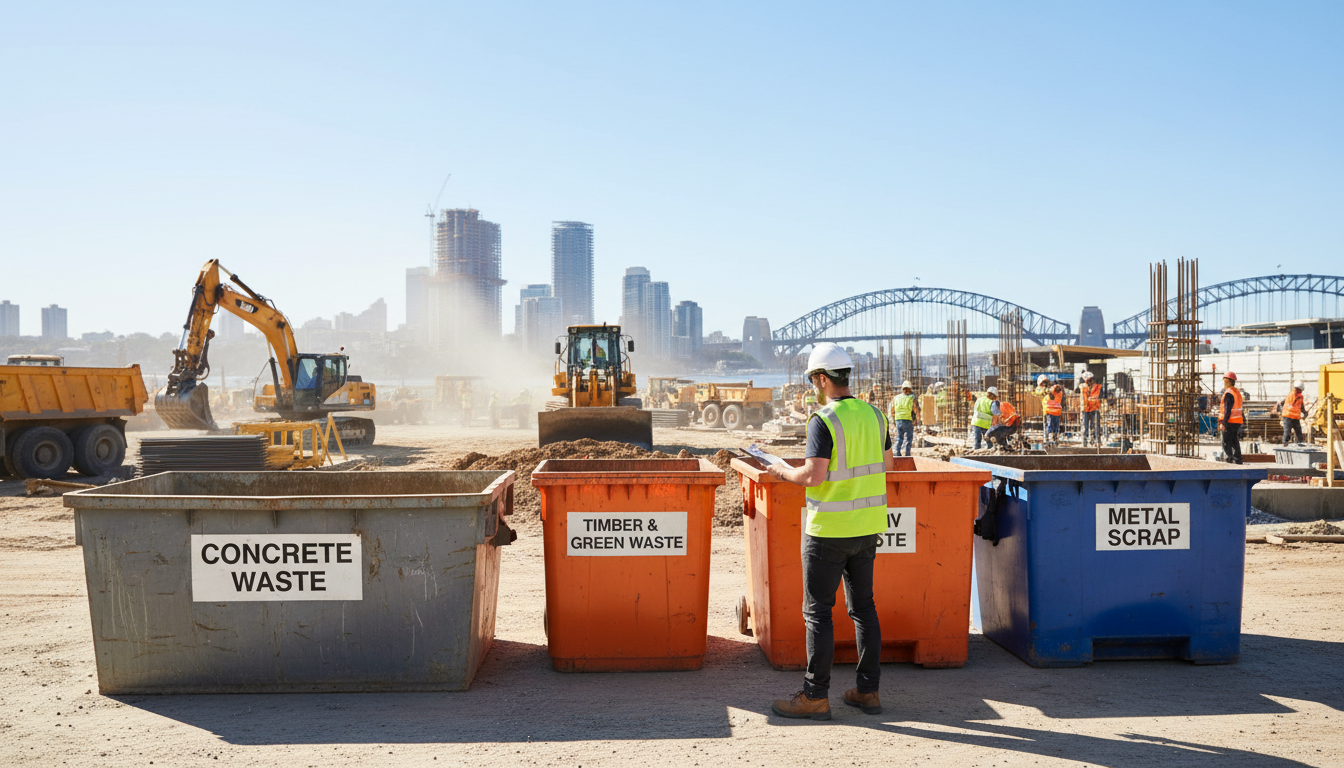
Construction and demolition waste presents distinct handling challenges that standard municipal waste bins cannot address. Material density variations from 0.3 tonnes per cubic metre for timber framing to 1.8 tonnes per cubic metre for concrete rubble demand purpose-engineered bins with structural capacity matched to payload characteristics. Selecting the best waste bins for construction and demolition waste requires understanding material construction specifications, Heavy Vehicle National Law (HVNL) mass limits, and how bin design impacts both operational efficiency and regulatory compliance under National Heavy Vehicle Regulator (NHVR) requirements.
Construction and demolition waste accounts for 38% of total waste generated in Australia, representing approximately 27 million tonnes annually according to the Department of Climate Change, Energy, the Environment and Water (DCCEEW) National Waste Report 2022. The National Waste Policy 2018 (Cth) sets an 80% resource recovery target for construction and demolition waste by 2030, driving demand for material-specific bin systems that enable source separation. Fleet managers and waste contractors procuring bins for C&D operations must balance structural durability against vehicle payload limits while maintaining compliance with Australian Standard AS 4024 (safety of machinery) and Protection of the Environment Operations Act 1997 (NSW) for hazardous materials including asbestos-containing waste.
Industry Data
- —Construction and demolition waste accounts for 38% of total waste generated in Australia, representing approximately 27 million tonnes annually according to the Department of Climate Change, Energy, the Environment and Water (DCCEEW) National Waste Report 2022
- —The National Waste Policy 2018 (Cth) sets an 80% resource recovery target for construction and demolition waste by 2030, driving demand for material-specific bin systems that enable source separation
C&D Waste Stream Characteristics and Bin Selection Criteria
Construction and demolition waste streams vary significantly in density, abrasiveness, and handling requirements. Concrete and masonry waste generates high impact loads during loading and transport, requiring reinforced floor construction with minimum 6mm structural steel thickness. Timber framing and formwork occupy high volume relative to mass, necessitating larger bin capacities to maximise payload efficiency under HVNL gross vehicle mass limits. Mixed C&D waste containing plasterboard, metals, insulation, and packaging materials demands bins with capacity-to-payload ratios optimised for average density around 0.8 to 1.2 tonnes per cubic metre.
Material separation at source drives bin specification decisions for contractors targeting resource recovery rates aligned with National Waste Policy 2018 (Cth) objectives. Dedicated bins for steel and non-ferrous metals require lower side walls for manual loading and unloading, while concrete and brick rubble bins benefit from drop door or tailgate configurations enabling mechanical discharge at recycling facilities. Contamination control for recyclable C&D streams requires bins with adequate volume to prevent overfilling and material spillage during transport, which creates compliance risk under Protection of the Environment Operations Act 1997 (NSW).
Bin selection criteria must account for site access constraints common in urban construction environments. Narrow residential streets and congested demolition sites limit vehicle manoeuvrability, favouring smaller 8m³ to 12m³ bins that can be positioned and exchanged efficiently. Large-scale commercial and infrastructure projects with dedicated waste management areas accommodate 20m³ to 30m³ bins that reduce collection frequency and haulage costs. Wastecorp Equipment supplies bins across this capacity range with structural specifications matched to Australian C&D waste characteristics and NHVR compliance requirements.
Material Construction: Structural Steel vs Mild Steel for C&D Applications
Bin material construction determines service life and total cost of ownership when handling abrasive construction and demolition waste. Structural steel manufactured to AS/NZS 3679.1 Grade 300 specifications provides yield strength of 300 megapascals, significantly exceeding mild steel’s typical 250 megapascal rating. This strength differential translates to reduced floor and sidewall deformation when bins are loaded with dense concrete rubble or subjected to impact from excavator buckets and demolition equipment. The structural steel specifications for heavy-duty bins directly address the mechanical stresses inherent in C&D waste handling operations.
Floor thickness represents the critical specification for bins handling concrete, bricks, and masonry waste. Structural steel floors of 6mm thickness withstand repeated impact loading and abrasion from sharp concrete edges and steel reinforcement bars, maintaining structural integrity over 10 to 15 year service periods. Mild steel bins with 4mm to 5mm floors experience accelerated wear, developing holes and cracks that compromise load containment and create safety hazards. Side wall construction typically employs 4mm to 5mm structural steel, providing adequate strength for lateral loads while minimising tare weight that reduces available payload capacity under HVNL limits.
Welding quality and reinforcement placement distinguish professionally fabricated bins from inferior alternatives. Continuous welds along floor-to-sidewall joints and corner reinforcement plates distribute stress concentrations that develop during loading and transport. Bins manufactured under AS/NZS ISO 45001 occupational health and safety management systems incorporate design features that prevent weld failure and structural collapse during operation. As an official distributor for MEC and OMB, Wastecorp Equipment provides bins with documented material certifications and fabrication quality assurance that meets Australian Standard requirements for commercial waste handling equipment.
Bin Capacity and Hooklift Compatibility (8m³ to 30m³ Range)
Bin capacity selection must align with hooklift system lifting capacity and vehicle gross vehicle mass ratings under Heavy Vehicle National Law (HVNL). Standard C&D bin sizes range from 8m³ for residential demolition and renovation work to 30m³ for large commercial construction projects. The relationship between bin volume and loaded mass determines whether a specific bin-truck combination remains compliant with NHVR mass limits when handling dense materials like concrete rubble at 1.8 tonnes per cubic metre.
An 8m³ bin loaded with concrete rubble generates approximately 14.4 tonnes of payload, plus 0.8 to 1.2 tonne bin tare weight, totalling 15.2 to 15.6 tonnes. This load suits medium-duty hooklift trucks with 18 tonne lifting capacity and vehicle configurations rated for 22 to 26 tonne GVM. A 20m³ bin containing the same material would generate 36 tonnes of payload, exceeding most single-axle truck configurations and requiring semi-trailer or B-double arrangements for legal transport. The hydraulic hooklift systems for rapid bin exchange must provide lifting capacity with minimum 20% safety margin above maximum loaded bin weight per AS 4024 requirements.
Mixed C&D waste with lower average density of 0.8 to 1.0 tonnes per cubic metre allows larger bin volumes within HVNL mass limits. A 20m³ bin containing mixed timber, plasterboard, and packaging materials generates 16 to 20 tonnes of payload, remaining within capacity for heavy-duty single-chassis trucks. This volume-to-mass ratio optimisation reduces collection frequency and haulage costs for contractors managing high-volume, lower-density waste streams. The skip loader versus hooklift system comparison helps contractors understand which collection system suits their C&D waste volumes and site access constraints.
Hooklift compatibility extends beyond lifting capacity to include bin mounting systems and hydraulic connection points. Bins must incorporate reinforced lifting eyes or sub-frame channels positioned to match hooklift arm geometry and load distribution requirements. The MEC skip loader and hooklift system capabilities provide technical specifications for matching bin sizes to vehicle lifting capacity across the 8m³ to 30m³ range common in Australian C&D operations.
HVNL Mass Limits and NHVR Compliance for Loaded C&D Bins
Heavy Vehicle National Law (HVNL) establishes maximum mass limits for vehicle configurations operating on Australian roads, with enforcement administered by the National Heavy Vehicle Regulator (NHVR). Two-axle rigid trucks face 16.5 tonne axle group limits, constraining total vehicle mass to approximately 22 to 26 tonnes depending on axle spacing and suspension type. Three-axle rigid trucks accommodate up to 42.5 tonnes under general access provisions, providing substantially greater payload capacity for large C&D bins.
Bin selection must account for vehicle tare weight, hooklift system mass, and bin tare weight to determine available payload capacity. A typical 12m³ structural steel bin weighs 1.2 to 1.5 tonnes empty, consuming payload capacity before any waste is loaded. When this bin contains concrete rubble at 1.8 tonnes per cubic metre, total loaded mass reaches 22.8 to 23.1 tonnes, requiring careful vehicle configuration to maintain axle load compliance. Overloading creates significant penalties under HVNL and increases mechanical stress on hooklift hydraulic systems and vehicle chassis components.
Load distribution between front and rear axles requires attention when bins are positioned on hooklift systems. Bins loaded predominantly at the front end shift weight forward, potentially exceeding front axle limits even when total vehicle mass remains compliant. Proper bin design incorporates load-spreading features including reinforced floors and strategic placement of discharge doors that encourage even material distribution during loading. The NHVR compliance requirements for waste collection vehicles explain how bin selection impacts vehicle GVM and axle load compliance across different truck configurations.
Standard Bin Sizes vs Custom Fabrication for Specialist C&D Streams
Standard bin sizes in 8m³, 12m³, 15m³, 20m³, and 30m³ capacities address the majority of construction and demolition waste handling requirements. These configurations offer immediate availability, established pricing, and proven performance across diverse C&D applications. Standard bins benefit from economies of scale in manufacturing, reducing per-unit cost compared to custom fabrication while maintaining structural specifications appropriate for mixed C&D waste streams.
Custom fabrication becomes justified when waste stream characteristics or site constraints demand specialised bin features. Asbestos removal contractors require sealed bins with lockable lids, rubber gaskets, and signage meeting AS 4123.7 standards for Class 1 and Class 2 asbestos transport under Protection of the Environment Operations Act 1997 (NSW). Concrete recycling operations benefit from bins with full-width drop doors and reinforced hinge systems enabling rapid mechanical discharge into crushing equipment. Steel and metal recycling contractors specify low-profile bins with reduced side wall height facilitating manual sorting and material handling.
The standard bins versus custom fabrication for heavy-use applications decision requires analysis of fleet utilisation and material handling volumes. Contractors managing consistent waste streams across multiple sites achieve better return on investment with custom bins optimised for specific materials. Operations with variable waste types and project-based work favour standard bins offering flexibility across different C&D applications. Wastecorp Equipment provides both standard bin inventory and custom fabrication services with engineering support for specialist C&D waste handling requirements.
Bin Design Features: Tailgates, Drop Doors, and Material Discharge
Discharge mechanism selection impacts operational efficiency at transfer stations and recycling facilities. Tailgate bins employ hinged rear doors that swing open for gravity discharge, suitable for materials that flow readily including timber offcuts, packaging waste, and mixed C&D debris. Tailgate designs require adequate clearance behind the bin during discharge, limiting their application in confined facility layouts. Locking mechanisms must withstand vibration and impact during transport while remaining operable by site personnel without specialised tools.
Drop door configurations incorporate full-width floor sections that release via hydraulic or mechanical actuation, enabling rapid discharge of heavy materials including concrete rubble and soil. This design suits high-volume operations where discharge time directly impacts vehicle cycle rates and facility throughput. Drop doors require robust hinge and locking systems engineered to support loaded floor weight, with reinforcement preventing deformation under repeated use. Australian Standard AS 4024 (safety of machinery) requires guarding and safety interlocks preventing accidental door release during transport or when personnel are positioned beneath the bin.
Open-top bins without discharge mechanisms rely on mechanical excavators or front-end loaders for material removal, common in applications where bins remain at construction sites for extended periods. This configuration minimises bin complexity and maintenance requirements while maximising structural strength for the bin floor and sidewalls. Material removal efficiency depends on excavator access and operator skill, with discharge times typically longer than tailgate or drop door systems. Site layout and material handling equipment availability determine whether open-top or mechanical discharge bins provide superior operational performance for specific C&D applications.
AS 4024 Safety Requirements for C&D Waste Bin Design
Australian Standard AS 4024 (safety of machinery) establishes design requirements for waste handling equipment including bins used in commercial operations. These requirements address hazard identification, risk assessment, and implementation of safety measures protecting operators and site personnel. Bin manufacturers must document compliance with AS 4024 through engineering assessments and design verification processes, with particular attention to mechanical hazards including crushing, shearing, and entanglement risks.
Load restraint systems represent a critical safety requirement for bins transported on public roads under HVNL. Bins must incorporate features preventing load shift and material spillage during transport, including adequate side wall height relative to material characteristics and vehicle acceleration forces. The National Heavy Vehicle Regulator (NHVR) Load Restraint Guide specifies that loads must be contained within the vehicle’s load-carrying area and restrained to prevent movement exceeding 25mm in any direction under normal driving conditions. Bins carrying loose materials including soil, sand, and demolition debris require covers or netting systems preventing material loss during transport.
Access provisions for maintenance and cleaning must comply with AS 4024 requirements for safe working at height and confined space entry. Bins requiring internal cleaning or inspection need ladder access points, fall protection anchor points, and adequate internal dimensions for personnel entry. Bins handling hazardous materials including asbestos-containing waste must incorporate features preventing personnel contact with contaminated surfaces during normal operation and maintenance activities. As a member of the Waste Contractors and Recyclers Association of NSW (WCRA), Wastecorp Equipment supplies bins manufactured under AS/NZS ISO 45001 occupational health and safety management systems with documented compliance to AS 4024 safety requirements.
Total Cost of Ownership: Bin Durability vs Replacement Frequency
Total cost of ownership analysis for C&D waste bins extends beyond initial purchase price to include service life, maintenance requirements, and replacement frequency. Structural steel bins with 6mm floors handling concrete and masonry waste typically achieve 10 to 15 year service life with periodic maintenance including weld inspection and paint system renewal. Mild steel bins with lighter construction experience floor perforation and structural failure within 5 to 8 years under equivalent service conditions, requiring earlier replacement and higher lifetime cost despite lower initial investment.
Maintenance cost differential between structural and mild steel construction becomes significant over multi-year fleet operation. Structural steel bins maintain dimensional stability and structural integrity with minimal intervention beyond routine cleaning and paint touch-up. Mild steel bins develop floor sagging and sidewall deformation requiring periodic repair welding and reinforcement installation. These repairs consume workshop time and remove bins from service, reducing fleet availability and potentially requiring temporary bin rental to maintain operational capacity.
Residual value at end of service life favours structural steel bins that retain structural integrity suitable for refurbishment and resale. Bins with documented material certifications, manufacturer compliance with AS/NZS ISO 45001, and maintenance records command premium pricing in secondary markets. Contractors can offset replacement cost through trade-in arrangements or direct sale to smaller operators entering the C&D waste sector. Fleet managers should calculate total cost of ownership including purchase price, annual maintenance, service life, and residual value when comparing structural steel bins against lower-cost alternatives.
- ✓
Verify bin structural steel grade meets AS/NZS 3679.1 Grade 300 minimum for C&D waste density and abrasion resistance - ✓
Calculate loaded bin mass against vehicle GVM and axle limits under Heavy Vehicle National Law (HVNL) to ensure NHVR compliance - ✓
Confirm hooklift system lifting capacity exceeds maximum loaded bin weight by minimum 20% safety margin per AS 4024 requirements - ✓
Specify tailgate or drop door configuration based on material discharge requirements at transfer stations or recycling facilities - ✓
Assess bin floor thickness (minimum 6mm for concrete/masonry, 5mm for mixed C&D) against expected service life and replacement cost - ✓
Ensure bins handling hazardous C&D materials meet Protection of the Environment Operations Act 1997 (NSW) containment and labelling requirements - ✓
Review manufacturer’s compliance with AS/NZS ISO 45001 occupational health and safety management for bin design and fabrication processes
Frequently Asked Questions
What bin capacity is best for mixed construction and demolition waste?
For mixed C&D waste containing timber, plasterboard, metals, and concrete, 12m³ to 20m³ bins provide optimal payload-to-volume ratio under Heavy Vehicle National Law (HVNL) mass limits. Structural steel construction with 5mm floor and 4mm side walls handles the abrasive nature of concrete rubble and steel offcuts while maintaining structural integrity over 10+ year service life. These capacities suit most construction sites while remaining within two-axle and three-axle rigid truck GVM ratings, enabling efficient collection without requiring specialist heavy vehicle configurations.
Do C&D waste bins need to comply with AS 4024 safety standards?
Yes. Australian Standard AS 4024 (safety of machinery) applies to waste handling equipment including bins used in commercial operations. This includes requirements for safe access points, load restraint systems, and guarding on bins with mechanical discharge mechanisms. National Heavy Vehicle Regulator (NHVR) also requires load restraint compliance under HVNL for bins transported on public roads. Bins must prevent load shift exceeding 25mm in any direction and contain materials within the vehicle load-carrying area during normal transport conditions.
What steel thickness is required for concrete and masonry waste bins?
Bins handling concrete, bricks, and masonry require minimum 6mm structural steel flooring and 5mm side walls to withstand impact loading and abrasion. AS/NZS 3679.1 Grade 300 structural steel provides superior yield strength compared to mild steel, reducing deformation risk when handling dense materials exceeding 1.5 tonnes per cubic metre. Thinner mild steel construction experiences accelerated wear with floor perforation and structural failure typically occurring within 5 to 8 years, while properly specified structural steel bins achieve 10 to 15 year service life under equivalent conditions.
Can standard hooklift bins handle asbestos-containing C&D waste?
Asbestos waste requires sealed bins meeting Protection of the Environment Operations Act 1997 (NSW) requirements for Class 1 or Class 2 asbestos transport. Standard open-top C&D bins are not compliant. Purpose-built sealed bins with lockable lids, rubber gaskets, and signage meeting AS 4123.7 are mandatory for licensed asbestos removal contractors. These bins must prevent fibre release during loading, transport, and discharge, with design features including continuous weld seams, sealed door systems, and internal surfaces facilitating decontamination. Contractors handling asbestos-containing materials face significant penalties for non-compliant transport and disposal practices.
Wastecorp Equipment supplies structural steel bins engineered for Australian C&D waste density and HVNL compliance, with full technical support for fleet integration and NHVR mass management.
Official distributor for MEC and OMB. Member of the Waste Contractors and Recyclers Association of NSW.

 Member of Waste Contractors and Recyclers Association of NSW.