
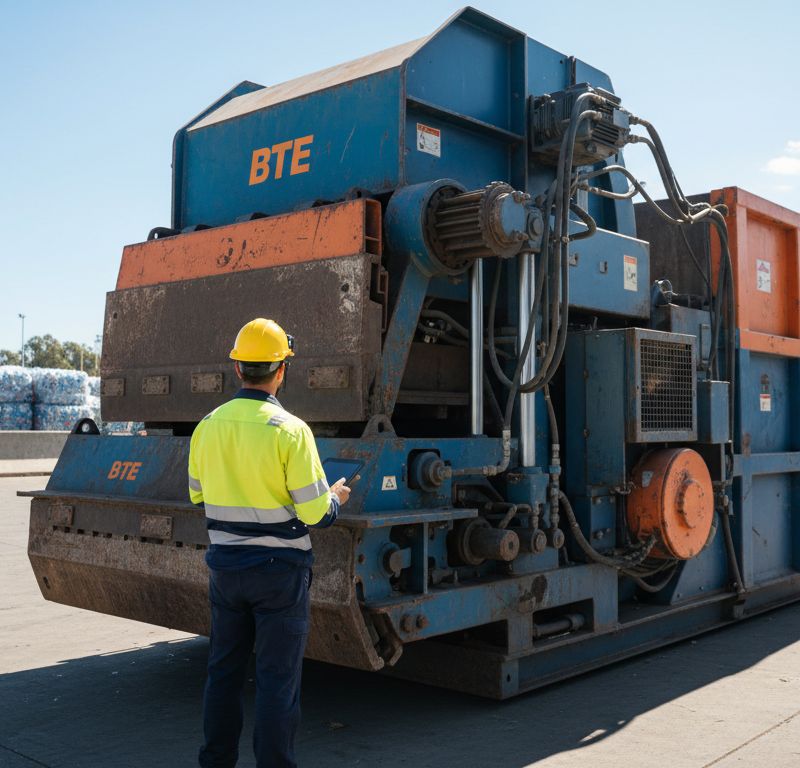
BTE Compactor Service Intervals: Manufacturer Baseline Recommendations
BTE compactors require hydraulic oil and filter changes every 1,000 operating hours or 12 months under standard duty cycle conditions, with proportional flow control valve inspection at 500-hour intervals. These baseline recommendations assume operation in controlled temperature environments below 30°C ambient and moderate dust exposure typical of urban waste collection routes. Operators should reference waste compactor brand comparison for NSW operators to understand how BTE service requirements compare to alternative manufacturers.
Hydraulic pump overhauls typically occur between 5,000-7,000 operating hours depending on pressure cycling intensity and contamination exposure. Compactors operating in continuous high-compaction applications with cycle times under 45 seconds experience accelerated wear on pump bearings and pressure compensator components, requiring earlier intervention than units operating intermittent duty cycles.
Australian Environmental Factors Affecting Service Frequency
High ambient temperatures exceeding 35°C common across northern Australia and inland NSW regions increase hydraulic oil degradation rates by 15-25% compared to temperate climate operation. Thermal breakdown of hydraulic fluid reduces viscosity index stability and accelerates additive depletion, requiring more frequent oil analysis and replacement to maintain system protection.
Industry Data
- —Data from the NSW EPA indicates that hydraulic fluid leaks from waste collection equipment represent 18% of pollution incidents reported under the Protection of the Environment Operations Act 1997 (NSW), with preventable maintenance failures identified in 67% of cases
- —The National Heavy Vehicle Regulator reports that hydraulic system failures account for 34% of roadside defect notices issued to waste collection vehicles, with inadequate maintenance cited as the primary contributing factor
- —According to the Waste Management and Resource Recovery Association of Australia, unplanned equipment downtime costs waste collection operators an average of $850-$1,200 per vehicle per day in lost productivity and contract penalties
Coastal operators in NSW must implement monthly corrosion inspections of structural steel components, hydraulic cylinder rods, and mounting hardware due to salt spray exposure. High tensile structural steel used in compaction chambers and ram assemblies requires protective coating maintenance to prevent stress corrosion cracking that compromises structural integrity under cyclic loading conditions.
Dust ingress represents the primary contamination pathway for hydraulic systems operating in mining, construction, and demolition environments. Airborne particulate matter bypassing breather filters causes accelerated wear on pump vanes, control valve spools, and cylinder seals, reducing component service life by 30-40% compared to clean environment operation.
Hydraulic System Maintenance Schedules for Compaction Equipment
Hydraulic oil viscosity grade selection must account for Australian temperature ranges, with ISO VG 46 specified for temperate regions and ISO VG 68 recommended for high-temperature applications above 35°C ambient. Multi-grade hydraulic fluids meeting ISO 11158 HV specifications provide improved viscosity index performance across seasonal temperature variations common in NSW climate zones. Operators should consult hydraulic system maintenance protocols for waste compactors for detailed fluid specification requirements.
Hydraulic oil analysis at 500-hour intervals detects contamination before component damage occurs, with laboratory testing measuring particle count per ISO 4406 cleanliness codes, water content, viscosity deviation, and acid number increase indicating oxidation. Target cleanliness levels for compaction equipment hydraulic systems should maintain ISO 18/16/13 or better to prevent accelerated wear on precision components including proportional flow control valves and load-sensing pumps.
Notice:
Hydraulic hose replacement intervals depend on pressure rating and environmental exposure rather than visual condition assessment. High-pressure hoses rated above 250 bar operating pressure require replacement every 2,000-3,000 operating hours due to internal wire braid fatigue from pressure cycling, even when external rubber covering appears serviceable. Return line hoses operating below 25 bar can extend to 4,000-hour intervals under normal conditions.
Daily Pre-Operation Checks Required Under AS 4024.1
AS 4024.1 (safety of machinery) establishes daily inspection requirements for mobile plant including compaction equipment, mandating operator verification of safety interlock function, hydraulic system integrity, and structural condition before commencing work. Fleet operators must implement documented pre-start inspection protocols that record findings and prevent operation of defective equipment.
- 01Hydraulic Leak InspectionVisual inspection of hydraulic hoses, cylinder rods, pump housing, and reservoir for fluid leaks or seepage indicating seal failure or connection loosening
- 02Safety Interlock Function TestVerification that compaction cycle cannot initiate with access doors open or safety guards removed, per AS 4024.1 guarding requirements
- 03Structural Crack DetectionVisual inspection of compaction chamber welds, ram guide mounting points, and high tensile structural steel for crack initiation indicating fatigue failure progression
- 04Hydraulic Oil Level VerificationReservoir level check with ram fully retracted to ensure adequate fluid volume for full cycle operation without cavitation risk
- 05Control Function VerificationTest of ram extension and retraction cycle under no-load conditions to verify proportional control response and identify abnormal noise indicating component wear
Documented pre-operation inspection records establish compliance with AS/NZS ISO 45001 (occupational health and safety management systems) and provide evidence of due diligence under work health and safety legislation. Electronic inspection systems linked to equipment hour meters prevent operation when inspection intervals are exceeded or defects remain unresolved.
High-Use Environment Service Adjustments: Mining, Construction, and Industrial Sites
BTE compactors operating in high-dust mining and construction environments require service interval reductions of 25-30% compared to baseline schedules due to accelerated hydraulic contamination and component wear. Operators should reference BTE equipment performance under heavy-use conditions to understand duty cycle impacts on maintenance requirements.
Continuous high-compaction operations with cycle times under 45 seconds and payload densities exceeding 600 kg/m³ increase hydraulic pump pressure cycling by 40-50% compared to intermittent duty cycles. This accelerated fatigue loading requires hydraulic oil changes at 750-hour intervals and pump overhaul assessment at 4,000 hours rather than standard 5,000-hour schedules.
Demolition site compactors processing concrete, brick, and steel waste experience elevated abrasive wear on compaction chamber surfaces and ram face plates. Monthly structural inspections should assess wear plate thickness and high tensile structural steel integrity to prevent catastrophic failure under load.
Compliance-Driven Service Requirements Under Protection of the Environment Operations Act 1997 (NSW)
While the Protection of the Environment Operations Act 1997 (NSW) does not explicitly mandate compactor service schedules, operators holding environment protection licences must demonstrate equipment is maintained to prevent environmental harm including hydraulic fluid leaks, noise emissions exceeding licence conditions, and fugitive dust generation from poorly sealed compaction chambers.
Service records form part of due diligence evidence during EPA inspections and pollution incident investigations. Operators must retain documented maintenance records including service dates, operating hours at service, technician qualifications, parts replaced, and hydraulic oil disposal documentation demonstrating compliance with waste tracking requirements under the Protection of the Environment Operations (Waste) Regulation 2014.
Hydraulic fluid leaks exceeding 10 litres constitute reportable pollution incidents under the Protection of the Environment Operations Act 1997 (NSW), requiring immediate notification to the EPA and implementation of containment measures. Preventative maintenance programs that identify seal degradation and hose deterioration before failure prevent reportable incidents and associated regulatory enforcement action.
Preventative Maintenance vs Breakdown Repair: Cost Analysis for Fleet Operators
Scheduled preventative maintenance costs approximately 35-40% of breakdown repair expenses when accounting for emergency callout fees, expedited parts procurement, and operational downtime. According to the Waste Management and Resource Recovery Association of Australia, unplanned equipment downtime costs waste collection operators an average of $850-$1,200 per vehicle per day in lost productivity and contract penalties.
Hydraulic pump replacement following catastrophic failure costs $8,500-$12,000 including labour, compared to scheduled overhaul costs of $4,200-$5,800 at recommended intervals. Secondary damage to control valves, hydraulic motors, and contaminated fluid throughout the system adds $3,000-$5,000 to breakdown repair costs that preventative maintenance avoids.
Fleet operators should calculate total cost of ownership including scheduled maintenance, unplanned repairs, and downtime costs when evaluating equipment procurement decisions. Operators can reference lifecycle cost considerations for waste collection equipment for comprehensive financial analysis frameworks.
Service Record Documentation for NHVR Mass Management Compliance
The National Heavy Vehicle Regulator (NHVR) requires operators participating in mass management accreditation schemes to maintain documented evidence of vehicle and equipment maintenance. Service records demonstrating hydraulic system integrity, structural condition, and payload restraint system functionality support compliance with Heavy Vehicle National Law (HVNL) mass limits and roadworthiness standards.
- ✓
Establish operating hour tracking system linked to service intervals (daily, 250hr, 500hr, 1000hr, 2000hr cycles) - ✓
Implement daily pre-operation inspection protocol covering hydraulic leaks, structural cracks, safety interlocks per AS 4024.1 - ✓
Schedule hydraulic oil analysis every 500 operating hours to detect contamination before component damage occurs - ✓
Document all service activities with date, operating hours, technician details, and parts replaced for NHVR compliance - ✓
Adjust service intervals based on duty cycle: reduce by 25% for continuous high-compaction operations or extreme temperature environments - ✓
Maintain manufacturer-specified hydraulic oil grade (typically ISO VG 46 or 68) suitable for Australian temperature ranges - ✓
Conduct annual structural integrity inspection of compaction chamber, ram guides, and mounting points by qualified engineer - ✓
Source genuine BTE replacement parts or verified equivalents meeting original equipment specifications to maintain warranty coverage
Electronic maintenance management systems that link service records to vehicle registration and NHVR compliance documentation streamline audit processes and demonstrate systematic maintenance practices. Operators should retain service records for minimum seven years to satisfy regulatory record-keeping obligations under transport and environmental legislation.
Total Cost of Ownership: How Service Frequency Impacts Equipment Lifecycle
Compactor service frequency directly impacts equipment lifecycle through hydraulic component longevity, structural fatigue management, and residual value at disposal. Equipment maintained at manufacturer-specified intervals achieves 12-15 year operational lifecycles with major overhauls at 5,000-hour intervals, compared to 8-10 year lifecycles for inadequately maintained units experiencing premature component failures.
Hydraulic system contamination represents the primary cause of premature component failure in compaction equipment. Maintaining ISO 18/16/13 cleanliness levels through scheduled oil changes and filtration system maintenance extends hydraulic pump life by 40-50% compared to contaminated systems operating at ISO 22/20/18 or worse cleanliness codes.
Residual equipment value at disposal or trade-in depends on documented maintenance history and structural condition assessment. Compactors with complete service records and no structural damage command 25-35% higher residual values than equivalent units lacking maintenance documentation, providing significant total cost of ownership benefits for operators maintaining rigorous service schedules.
When to Schedule Major Overhauls: Hydraulic Pump, Ram, and Structural Integrity Assessments
Hydraulic pump overhaul assessment should occur at 5,000 operating hours through flow rate testing, pressure compensator function verification, and bearing condition evaluation. Pumps demonstrating flow rate reduction exceeding 10% of rated capacity or pressure compensator drift beyond manufacturer specifications require overhaul or replacement to prevent secondary damage to control valves and hydraulic motors.
Ram cylinder overhaul intervals depend on seal material specification and operating pressure. Chrome-plated ram rods operating at 200-250 bar system pressure require seal replacement every 3,000-4,000 hours, with complete cylinder overhaul including rod re-chroming at 8,000-10,000 hours. Operators should monitor ram drift rates under load as early indicators of seal degradation requiring service intervention.
Structural integrity assessments by qualified engineers should occur annually for compactors operating in high-duty cycle applications or every 24 months for standard duty equipment. Non-destructive testing including dye penetrant inspection of critical welds, ultrasonic thickness measurement of wear plates, and magnetic particle inspection of high tensile structural steel identifies crack initiation before propagation to critical dimensions.
Wastecorp Equipment supplies genuine BTE compactor parts and provides factory-trained service support across NSW, ensuring your equipment meets manufacturer specifications and Australian compliance requirements.
Official distributor for MEC and OMB. Member of the Waste Contractors and Recyclers Association of NSW.
Frequently Asked Questions
What are the minimum service intervals for BTE compactors operating in NSW?
BTE compactors require hydraulic oil and filter changes every 1,000 operating hours or 12 months, whichever occurs first, with daily pre-operation safety checks mandated under AS 4024.1. Operators in high-dust environments including mining and construction sites should reduce intervals to 750 hours due to accelerated hydraulic contamination.
Does the Protection of the Environment Operations Act 1997 (NSW) require documented compactor maintenance?
While the Protection of the Environment Operations Act 1997 (NSW) does not explicitly mandate compactor service schedules, operators holding environment protection licences must demonstrate equipment is maintained to prevent environmental harm including hydraulic fluid leaks. Service records form part of due diligence evidence during EPA inspections.
How do Australian climatic conditions affect BTE compactor service frequency?
High ambient temperatures above 35°C common across northern Australia and inland NSW increase hydraulic oil degradation rates by 15-25%, requiring more frequent oil analysis and replacement. Coastal operators must implement monthly corrosion inspections of structural steel and hydraulic cylinders due to salt exposure.
What hydraulic system components require most frequent replacement on BTE compactors?
Hydraulic hoses and seals typically require replacement every 2,000-3,000 operating hours due to pressure cycling and environmental exposure. Proportional flow control valves and load-sensing systems should be inspected every 500 hours, with complete hydraulic pump overhauls scheduled at 5,000-7,000 hours depending on duty cycle.

 Member of Waste Contractors and Recyclers Association of NSW.