
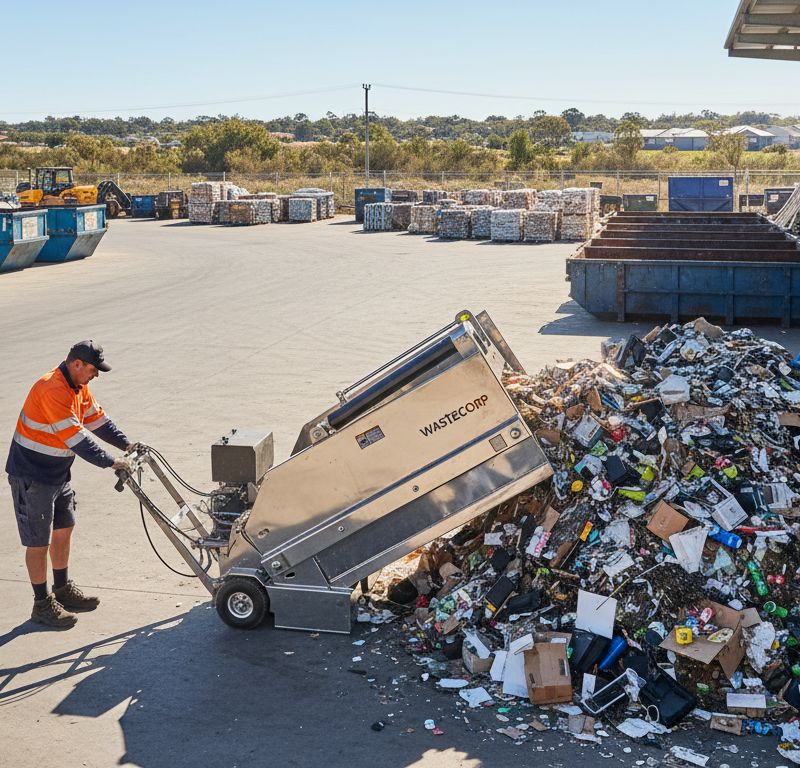
BTE compactors Australia installations continue to expand across commercial, industrial and municipal sectors as operators seek compliant, high-cycle compaction equipment that reduces waste collection frequency and improves site efficiency. Wastecorp Equipment supplies BTE compactors with full AS 4024 compliance documentation and WCRA-aligned engineering support across NSW and Australia-wide installations, supporting procurement officers and facility managers evaluating waste compactor brand comparison for NSW operators within the Australian market.
Understanding where BTE waste compactors deliver optimal performance requires analysis of waste stream characteristics, compaction ratio requirements, site infrastructure capacity, and compliance obligations under the Protection of the Environment Operations Act 1997 (NSW) and National Environment Protection (Used Packaging Materials) Measure 2011. This technical assessment examines industry-specific applications, hydraulic system specifications, and site preparation criteria for BTE compactor installations.
Industry Data
- —According to the Department of Climate Change, Energy, the Environment and Water (DCCEEW), Australia generated 75.8 million tonnes of waste in 2020-21, with commercial and industrial waste representing 39% of total generation
- —The Waste Management and Resource Recovery Association of Australia (WMRR) reports that compaction can reduce waste collection frequency by 60-75% in high-volume commercial applications, significantly lowering fleet operating costs
- —Sustainability Victoria data indicates that retail and commercial sectors generate approximately 240kg of cardboard and packaging waste per employee annually, requiring dedicated compaction infrastructure in facilities exceeding 50 staff
Why BTE Compactors Dominate High-Volume Waste Environments in Australia
BTE compactors achieve market penetration in Australian high-volume waste environments through hydraulic system reliability, standardised bin interface compatibility, and compliance with AS 4024.1 and AS 4024.3 safety of machinery standards. Static compactor configurations suit facilities generating consistent waste streams where space constraints, collection frequency reduction, and material recovery obligations under the National Environment Protection (Used Packaging Materials) Measure 2011 drive equipment selection.
The National Waste Policy 2018 (Cth) targets an 80% average recovery rate from all waste streams by 2030, driving demand for compaction equipment that improves transport efficiency and material recovery. BTE compactors address these policy objectives through compaction ratios between 4:1 and 6:1 for packaging materials, reducing transport movements and associated emissions while improving material density for downstream processing facilities.
Hydraulic pump motor specifications typically range from 7.5kW to 15kW depending on compactor chamber volume and ram force requirements, with three-phase 415V electrical supply standard across Australian installations. Operators must implement AS/NZS ISO 45001 occupational health and safety management systems covering compactor operation, hydraulic system maintenance protocols, and emergency response procedures.
Retail Distribution Centres and Warehousing: Cardboard and Packaging Compaction
Retail distribution centres and warehousing operations generate high volumes of corrugated cardboard, stretch film, and packaging materials requiring dedicated compaction infrastructure. BTE compactors installed at these facilities typically achieve 5:1 to 6:1 compaction ratios with dry cardboard, reducing bin exchange frequency from daily to weekly cycles in facilities processing 200-plus pallets daily.
Procurement officers evaluating BTE bins versus custom fabrication for heavy-use environments must consider standardised bin dimensions that integrate with existing hooklift fleet specifications and National Heavy Vehicle Regulator (NHVR) mass limit compliance. Distribution centres operating under the National Environment Protection (Used Packaging Materials) Measure 2011 require compaction equipment that maintains material segregation for Australian Packaging Covenant Organisation (APCO) reporting obligations.
Site infrastructure requirements include concrete pad construction with minimum 150mm thickness rated for combined compactor and loaded bin weight, typically 8-12 tonnes depending on bin capacity. Electrical supply must comply with AS/NZS 3000 wiring rules with appropriate circuit protection rated to hydraulic pump motor specifications.
Manufacturing and Industrial Facilities: Mixed Waste Stream Management
Manufacturing and industrial facilities generate mixed waste streams including packaging materials, production offcuts, and general solid waste requiring robust compaction equipment capable of high-cycle operation. BTE compactors installed in these environments operate 20-40 cycles daily, necessitating hydraulic system maintenance protocols aligned with manufacturer specifications and AS/NZS ISO 45001 preventive maintenance requirements.
Facilities holding environment protection licences under the Protection of the Environment Operations Act 1997 (NSW) must ensure compactor installations comply with waste storage volume limits and duration restrictions specified in licence conditions. Operators processing mixed waste streams must implement segregation protocols preventing hazardous materials, liquids, and prohibited items from entering compactor chambers.
Compaction performance with mixed waste streams typically achieves 3:1 to 4:1 ratios depending on material composition and moisture content. Industrial facilities generating metal offcuts, timber waste, or dense materials may require higher ram force specifications and reinforced chamber construction to prevent premature wear.
Hospitality and Food Service Sectors: Organic Waste and General Refuse
Hospitality and food service operations generate organic waste, food packaging, and general refuse requiring compaction equipment with appropriate hygiene specifications and drainage systems. BTE compactors serving these sectors typically incorporate sealed chambers with drainage ports and regular cleaning protocols to prevent odour and contamination issues.
Operators must evaluate compaction versus rear lift system selection criteria for organic waste streams, considering moisture content, collection frequency, and NSW EPA guidelines for putrescible waste storage. Facilities generating significant organic waste volumes may require dedicated organic waste processing systems rather than general compaction equipment.
Site assessment for hospitality sector installations must address access constraints in urban environments, noise attenuation requirements for residential proximity, and electrical supply capacity in older building infrastructure. Compaction ratios with mixed hospitality waste typically achieve 3:1 to 4:1 depending on packaging material proportion versus organic content.
Construction and Demolition Sites: Non-Hazardous Solid Waste Handling
Construction and demolition sites generate non-hazardous solid waste including packaging materials, timber offcuts, plasterboard, and general construction refuse suitable for compaction. BTE compactors deployed on construction sites must integrate with structural steel specifications for heavy-duty bins capable of withstanding compacted construction waste density and rough site conditions.
Site managers must ensure waste classification under NSW EPA guidelines excludes hazardous materials, asbestos, and contaminated soils from compactor chambers. Construction waste compaction typically achieves 2:1 to 3:1 ratios due to material density and irregular shapes limiting compression efficiency compared to packaging materials.
Temporary compactor installations on construction sites require stable pad construction or reinforced ground conditions capable of supporting compactor and loaded bin weight without settlement. Electrical supply may utilise temporary generator connections rated to hydraulic pump motor specifications with appropriate circuit protection.
Notice:
Municipal Waste Collection Operations: Kerbside and Commercial Service Integration
Municipal waste collection operations integrate BTE compactors at transfer stations, depot facilities, and commercial collection points to reduce transport movements and improve fleet efficiency. Councils evaluating procurement considerations for waste collection vehicles must assess compactor compatibility with existing hooklift and skip loader fleet specifications.
Transfer station compactor installations require National Heavy Vehicle Regulator (NHVR) compliance for loaded bin transport on public roads, ensuring payload remains within Heavy Vehicle National Law (HVNL) mass limits for vehicle class and axle configuration. Compacted waste density affects payload calculations, with typical compacted general waste achieving 400-600kg per cubic metre depending on material composition.
Municipal operators must implement maintenance schedules aligned with high-cycle operation, typically 50-80 compaction cycles daily at busy transfer stations. Wastecorp Equipment, as a member of the Waste Contractors and Recyclers Association of NSW (WCRA), provides engineering support for municipal compactor installations across NSW and regional Australia.
Shopping Centres and Large Format Retail: Space-Constrained Waste Management
Shopping centres and large format retail operations face space constraints requiring compact waste management infrastructure that reduces bin exchange frequency and minimises loading dock congestion. BTE compactors installed in these environments typically serve multiple tenants through centralised waste collection systems.
Site assessment must address access for bin exchange vehicles, requiring minimum 4m clearance width and overhead clearance for hooklift operation. Shopping centre installations often incorporate noise attenuation measures and operating hour restrictions to minimise impact on retail operations and customer experience.
Compaction ratios with retail waste streams typically achieve 4:1 to 5:1 with packaging-dominated waste, reducing collection frequency from daily to twice-weekly cycles. Facilities must implement segregation protocols ensuring recyclable materials remain separated for Australian Packaging Covenant Organisation (APCO) reporting under the National Environment Protection (Used Packaging Materials) Measure 2011.
Compaction Ratio Requirements by Industry: Matching Equipment to Waste Density
Compaction ratio performance varies with material moisture content, chamber loading technique, and ram force specification. Operators must calculate waste generation volume and required compaction performance to determine appropriate compactor chamber size and hydraulic system specifications.
Site Assessment Criteria: Electrical Supply, Pad Construction and Access Requirements
Site assessment for BTE compactor installations requires evaluation of electrical infrastructure capacity, concrete pad construction specifications, and vehicle access clearances for bin exchange operations. Procurement officers must verify site conditions meet minimum requirements before equipment deployment.
- 01Electrical Supply VerificationConfirm three-phase 415V supply capacity matches hydraulic pump motor specifications, typically 7.5kW to 15kW depending on compactor size. Electrical installation must comply with AS/NZS 3000 wiring rules with appropriate circuit protection and isolation switches.
- 02Concrete Pad ConstructionConstruct concrete pad with minimum 150mm thickness and appropriate load-bearing capacity for combined compactor and loaded bin weight, typically 8-12 tonnes. Pad dimensions must accommodate compactor footprint plus clearance for maintenance access.
- 03Vehicle Access AssessmentEnsure minimum 4m clearance width for bin exchange vehicles with adequate overhead clearance for hooklift or skip loader operation. Access routes must support vehicle gross combination mass under National Heavy Vehicle Regulator (NHVR) compliance requirements.
- 04Drainage and Environmental ControlsInstall appropriate drainage systems for compactor chambers handling waste with moisture content. Facilities must implement spill containment measures complying with Protection of the Environment Operations Act 1997 (NSW) requirements for waste storage areas.
Compliance Considerations: AS 4024 Safety Standards and POEO Act Obligations
BTE compactor installations must comply with AS 4024.1 and AS 4024.3 safety of machinery standards covering emergency stop systems, interlocked access doors, two-hand control operation, and audible alarms. Operators must implement AS/NZS ISO 45001 occupational health and safety management systems addressing compactor operation, lockout-tagout procedures, and emergency response protocols.
- ✓
Verify three-phase electrical supply capacity and circuit protection rating matches compactor hydraulic pump motor specifications - ✓
Confirm concrete pad construction meets minimum 150mm thickness with appropriate load-bearing capacity for compactor and loaded bin weight - ✓
Assess site access for bin exchange vehicles, ensuring minimum 4m clearance width and overhead clearance for hooklift or skip loader operation - ✓
Calculate waste generation volume and frequency to determine required compaction ratio and bin capacity under National Environment Protection (Used Packaging Materials) Measure obligations - ✓
Review Protection of the Environment Operations Act 1997 (NSW) licensing requirements for waste storage volumes and duration limits - ✓
Ensure compactor specification includes AS 4024 compliant safety systems: emergency stops, interlocked doors, two-hand controls, and audible alarms - ✓
Establish hydraulic system maintenance schedule aligned with manufacturer specifications and AS/NZS ISO 45001 preventive maintenance protocols - ✓
Confirm bin construction uses high tensile structural steel appropriate for compacted waste density and hooklift cycle loading
Facilities holding environment protection licences under the Protection of the Environment Operations Act 1997 (NSW) must ensure compactor installations comply with licence conditions covering waste storage volumes, duration limits, and waste classification requirements. Operators processing mixed waste streams must implement segregation protocols preventing hazardous materials, liquids, and prohibited items from entering compactor chambers.
Frequently Asked Questions
What compaction ratio do BTE compactors achieve with cardboard packaging waste?
BTE static compactors typically achieve 4:1 to 6:1 compaction ratios with corrugated cardboard and packaging materials, depending on chamber volume and ram force specification. Actual performance varies with material moisture content and bale density requirements under the National Environment Protection (Used Packaging Materials) Measure 2011.
Are BTE compactors compliant with AS 4024 machinery safety standards in Australia?
BTE compactors supplied through authorised Australian distributors must comply with AS 4024.1 and AS 4024.3 safety of machinery standards, including emergency stop systems, interlocked access doors, and two-hand control operation. Operators must also implement AS/NZS ISO 45001 occupational health and safety management systems for compactor operation.
What electrical supply is required for a stationary BTE compactor installation?
Most BTE static compactors require three-phase 415V electrical supply with appropriate circuit protection rated to hydraulic pump motor specifications, typically 7.5kW to 15kW depending on compactor size. Site electrical infrastructure must comply with AS/NZS 3000 wiring rules and local distribution network service provider requirements.
Can BTE compactors handle mixed waste streams under NSW EPA licensing requirements?
BTE compactors can process mixed general solid waste (non-putrescible) provided the waste facility holds appropriate licensing under the Protection of the Environment Operations Act 1997 (NSW). Operators must segregate hazardous waste, liquids, and prohibited materials as specified in EPA waste classification guidelines.
Wastecorp Equipment supplies BTE compactors with full AS 4024 compliance documentation and WCRA-aligned engineering support across NSW and Australia-wide installations.
Official distributor for MEC and OMB. Member of the Waste Contractors and Recyclers Association of NSW.

 Member of Waste Contractors and Recyclers Association of NSW.