
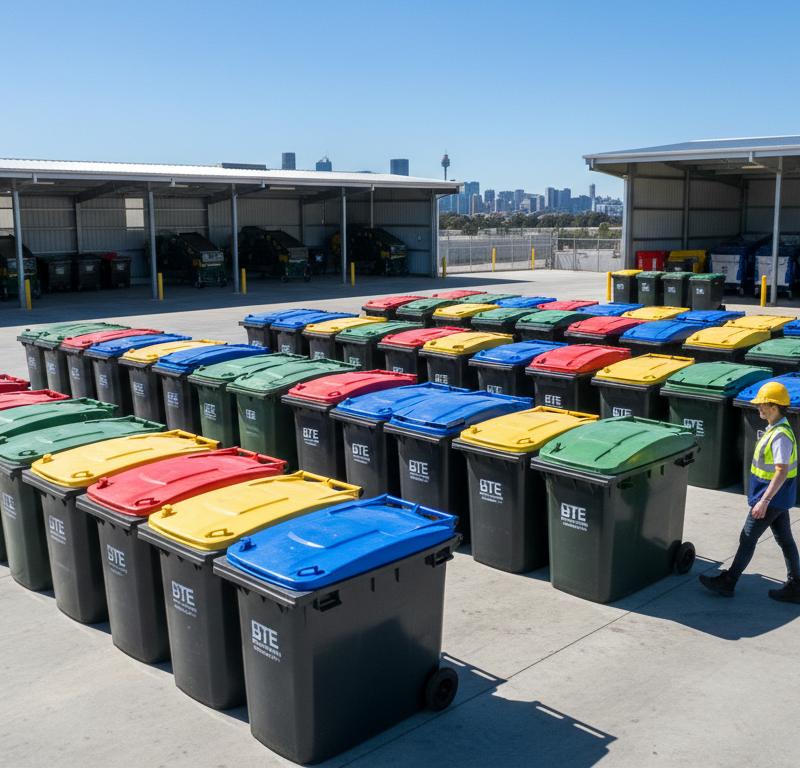
Fleet managers and waste contractors face a recurring procurement challenge: selecting BTE industrial bins that match both their collection system’s mechanical requirements and the waste stream’s material characteristics. Incorrect bin specification results in payload inefficiencies under Heavy Vehicle National Law (HVNL) mass limits, premature structural failure when material grade is inadequate, or complete incompatibility when rail width or lifting mechanism does not match the vehicle’s hydraulic system. This buyers guide addresses the technical criteria governing bin selection, from hook-lift rail standards to material specifications required for construction and demolition waste.
The National Waste Policy 2018 (Cth) targets an 80% average recovery rate from all waste streams by 2030, driving demand for segregated collection systems requiring multiple bin types per site (Australian Government Department of Climate Change, Energy, the Environment and Water). This regulatory push toward source separation means operators must now specify bins for distinct waste streams — organics, mixed recyclables, construction waste, and residual — each requiring different capacity, aperture, and material configurations.
Industry Data
- —The National Waste Policy 2018 (Cth) targets an 80% average recovery rate from all waste streams by 2030, driving demand for segregated collection systems requiring multiple bin types per site (Australian Government Department of Climate Change, Energy, the Environment and Water)
- —NSW generated 20.8 million tonnes of waste in 2020-21, with construction and demolition waste representing 44% of total generation, requiring heavy-duty bin specifications for abrasive materials (NSW Environment Protection Authority, Waste and Resource Recovery Report 2020-21)
Hook-Lift Compatible BTE Bins: Capacity and Rail Width Standards
Hook-lift bins interface with hydraulic hook-lift hoists through a standardised rail channel system. BTE hook-lift bins are manufactured to a 1060mm rail width standard, matching the ISO 1161 corner casting spacing used across Australian hook-lift systems. This dimensional consistency ensures compatibility with most hydraulic hook-lift hoists operating under National Heavy Vehicle Regulator (NHVR) mass management requirements.
The rail channel itself must be fabricated from high tensile structural steel to withstand cyclical loading during the hook engagement and rollover sequence. Inadequate rail material or improper welding at the rail-to-body junction results in fatigue cracking, particularly when bins are used for dense materials like soil, concrete, or metal scrap. Understanding hook-lift system compatibility requirements is essential before specifying bin capacity, as the hydraulic hoist’s lifting capacity determines maximum bin tare weight plus payload.
BTE hook-lift bins are available in capacities ranging from 8m³ to 40m³, with tare weights from approximately 1,200kg (small open skip) to 2,500kg (large enclosed compactor bin). The selection must account for both volumetric capacity and the waste stream’s bulk density. A 30m³ bin filled with green waste at 250kg/m³ generates a 7,500kg payload, whereas the same bin filled with construction rubble at 1,400kg/m³ would exceed most vehicle GVM limits.
Skip Bins vs Hook-Lift Bins: Matching Bin Type to Collection System
Skip bins and hook-lift bins are not interchangeable despite both being classified as industrial waste bins. The fundamental difference lies in the lifting mechanism. Skip bins use a chain and jib arm system that engages with lifting lugs welded to the bin’s upper edge. The skip loader’s hydraulic jib arm extends, hooks the chain through the lifting lugs, and tilts the bin upward for transport or emptying.
Hook-lift bins use a hook and roller system with standardised rail channels running longitudinally along the bin’s underside. The hook-lift hoist’s articulated arm extends beneath the bin, engages the front rail channel, and rolls the bin onto the truck bed using a combination of hook retraction and roller support. This system distributes load more evenly and permits faster cycle times, making it preferable for high-volume commercial routes.
The skip loader versus hook-lift operational comparison demonstrates that skip bins are typically limited to 12m³ capacity due to the mechanical constraints of chain lifting, whereas hook-lift systems can handle bins up to 40m³. Fleet managers must specify bin type based on their existing collection vehicle configuration — retrofitting a skip loader to accept hook-lift bins requires complete replacement of the hydraulic lifting system.
Compactor-Compatible BTE Bins: Feed Hopper and Aperture Requirements
When BTE industrial bins are used in conjunction with stationary compactors or rear-lift compactor systems, aperture dimensions become critical. The bin’s top opening must align with the compactor’s feed hopper to ensure material transfers cleanly without spillage or jamming. Standard rear-lift compactor hoppers measure 1,800mm wide by 1,200mm deep, requiring bins with corresponding aperture dimensions or larger.
Enclosed compactor bins — often called “packer bins” — feature a sealed body with a single access door that mates with the compactor’s discharge chute. These bins must be specified with door aperture dimensions matching the compactor manufacturer’s specifications. Wastecorp Equipment supplies BTE compactor-compatible bins engineered to interface with MEC and OMB rear-lift systems, ensuring dimensional compatibility across the collection chain.
The rear-lift compactor system specifications dictate not only aperture dimensions but also the bin’s internal volume. Compacted waste achieves ratios between 3:1 and 5:1 depending on material composition, meaning a 30m³ compactor bin can hold the equivalent of 90-150m³ of loose waste. Operators must calculate bin capacity based on compaction ratio to optimise collection frequency and vehicle utilisation.
Material Specifications: Structural Steel vs Mild Steel BTE Bins
Material selection directly affects bin service life, particularly when handling abrasive or high-density waste streams. BTE bins are available in both mild steel and high tensile structural steel configurations, each suited to different operational demands.
Mild steel bins use 3-4mm plate for floor and walls, adequate for general municipal waste, cardboard, and light commercial refuse. The lower material cost makes mild steel bins economical for low-intensity applications where bins are emptied frequently and waste density remains below 400kg/m³. However, mild steel exhibits poor fatigue resistance when subjected to impact loading from construction debris, metal scrap, or demolition waste.
Structural steel bins use 6mm plate for floor and walls, with 8mm reinforcement at high-stress points including corners, rail attachment zones, and door hinges. This specification aligns with AS 4024 machinery safety standards and provides adequate fatigue resistance for abrasive materials like concrete, brick, and metal. The mild steel versus structural steel construction comparison demonstrates that structural steel bins achieve 3-5 times the service life of mild steel equivalents when used for construction and demolition waste, offsetting the higher initial capital cost.
NSW generated 20.8 million tonnes of waste in 2020-21, with construction and demolition waste representing 44% of total generation (NSW Environment Protection Authority, Waste and Resource Recovery Report 2020-21). This volume concentration in high-density, abrasive waste streams necessitates structural steel specifications for the majority of commercial and industrial bin applications.
Bin Capacity Selection: Matching Volume to Waste Stream Density
Bin capacity must be specified based on waste stream density rather than volume alone. A 30m³ bin appears identical whether filled with cardboard at 100kg/m³ or soil at 1,600kg/m³, yet the payload difference is 3,000kg versus 48,000kg — the latter exceeding all legal vehicle mass limits under Heavy Vehicle National Law (HVNL).
Common waste stream densities for capacity planning include: cardboard and paper 80-150kg/m³, mixed municipal waste 150-250kg/m³, green waste 250-400kg/m³, construction timber 300-500kg/m³, mixed construction and demolition waste 800-1,200kg/m³, concrete and masonry 1,400-1,800kg/m³, and soil 1,400-1,600kg/m³. These figures represent loose-filled material before compaction.
The council green waste bin sizing standards provide municipal context for capacity decisions. Most councils specify 240-litre mobile bins for kerbside green waste, but commercial landscaping operations require 8-12m³ hook-lift bins to achieve economical collection frequency. A 10m³ bin filled with green waste at 300kg/m³ generates a 3,000kg payload, well within the capacity of a standard hook-lift truck rated to 12-tonne GVM.
Operators must calculate bin fill level based on waste density to avoid exceeding vehicle mass limits. For high-density materials, bins should be filled to 50-70% volumetric capacity to remain within legal payload limits. This operational constraint often necessitates specifying larger bin volumes than initially apparent from waste generation rates alone.
BTE Standard Bins vs Custom-Built Configurations
BTE manufactures standard bin configurations in common capacities (8m³, 10m³, 12m³, 20m³, 30m³) with fixed dimensions, aperture sizes, and rail spacing. These standard bins suit the majority of commercial waste collection applications and offer shorter lead times and lower unit costs due to production volume efficiencies.
Custom-built bins become necessary when operational requirements fall outside standard specifications. Common customisation requests include non-standard aperture dimensions to match proprietary compactor systems, reinforced flooring for exceptionally abrasive materials, integrated weighing systems for waste tracking compliance under the Protection of the Environment Operations Act 1997 (NSW), or modified rail spacing to suit imported hook-lift systems using non-ISO dimensions.
The decision between BTE bins versus custom fabrication options requires evaluating whether the operational benefit justifies the cost premium and extended lead time. Custom bins typically add 15-25% to unit cost and extend delivery from 4-6 weeks to 10-14 weeks depending on fabrication complexity.
Wastecorp Equipment maintains stock of standard BTE hook-lift bins in 10m³, 12m³, and 20m³ capacities, with custom fabrication available through our St Marys facility. As an official distributor for MEC and OMB and member of the Waste Contractors and Recyclers Association of NSW (WCRA), we provide engineering consultation to determine whether standard bins meet operational requirements or custom specifications are justified.
NHVR Mass Limits and Bin Payload Calculations
Heavy Vehicle National Law (HVNL) establishes maximum mass limits enforced by the National Heavy Vehicle Regulator (NHVR) across all Australian jurisdictions except Western Australia and the Northern Territory. These limits apply to Gross Vehicle Mass (GVM), axle group masses, and bridge formula calculations that restrict total vehicle weight based on axle spacing.
Maximum payload equals the vehicle’s GVM minus the tare weight of the truck chassis, hook-lift hoist system, and empty bin. A typical hook-lift truck configuration includes: truck chassis 4,500-6,000kg, hydraulic hook-lift system 1,200-1,800kg, and bin tare weight 800-2,500kg depending on capacity and material specification. For a vehicle rated to 16,500kg GVM with a 6,000kg chassis, 1,500kg hoist, and 2,000kg bin, available payload is 7,000kg.
Bin tare weight significantly affects payload capacity. A 30m³ mild steel bin weighs approximately 1,800kg, whereas the same capacity in 6mm structural steel weighs 2,400kg — a 600kg difference that directly reduces available payload. Operators must obtain certified mass documentation for each bin to maintain NHVR compliance records demonstrating that vehicle combinations do not exceed legal mass limits.
Notice:
Axle group limits further constrain payload distribution. A two-axle rigid truck is typically limited to 16,500kg GVM, while a three-axle rigid can operate to 22,500kg GVM. The additional axle capacity permits larger bins or denser waste streams without exceeding legal limits. Fleet managers must specify bin capacity based on their vehicle configuration’s legal mass limits rather than volumetric capacity alone.
AS 4024 Safety Requirements for Industrial Waste Bins
AS 4024 (Safety of Machinery) establishes design requirements for industrial equipment including waste bins. Key provisions relevant to BTE bin specification include edge protection, lifting point certification, structural integrity testing, and hazard identification marking.
Edge protection requirements mandate that bin top edges incorporate rolled or capped profiles to eliminate sharp edges that present laceration hazards during manual handling or maintenance. Lifting lugs on skip bins and rail attachment points on hook-lift bins must be load-tested to 150% of rated capacity and permanently marked with Safe Working Load (SWL) ratings. This certification must be documented and available for inspection by workplace health and safety auditors.
Structural integrity testing verifies that bin bodies can withstand cyclical loading without fatigue failure. BTE bins engineered to AS 4024 standards undergo finite element analysis of stress concentration points and physical load testing of welded joints, particularly at rail-to-body connections where fatigue cracking most commonly initiates. Bins must also incorporate hazard identification marking including capacity ratings, tare weight, and material restrictions where applicable.
AS/NZS ISO 45001 (Occupational Health and Safety Management Systems) requires organisations to identify and control risks associated with waste handling equipment. Bin procurement specifications should mandate AS 4024 compliance as a minimum standard, with manufacturers providing certification documentation confirming design compliance and load testing results. Wastecorp Equipment supplies BTE industrial bins engineered to AS 4024 standards with full certification documentation for workplace safety compliance.
- ✓
Confirm hook-lift rail width matches your fleet standard (1060mm is Australian norm) - ✓
Calculate bin tare weight against vehicle GVM to determine actual payload capacity under HVNL - ✓
Specify material grade: mild steel for general waste, structural steel for C&D and industrial - ✓
Verify bin aperture dimensions match compactor feed hopper if using rear-lift systems - ✓
Check AS 4024 compliance for safety features including edge protection, lifting point certification, and structural integrity testing - ✓
Assess whether standard BTE bin volumes suit your waste stream density or require custom sizing - ✓
Confirm bin manufacturer provides NHVR-compliant mass documentation for fleet compliance records
Frequently Asked Questions
What rail width do BTE hook-lift bins use as standard?
BTE hook-lift bins are manufactured to a 1060mm rail width standard, matching the ISO 1161 corner casting spacing used across Australian hook-lift systems. This ensures compatibility with most hydraulic hook-lift hoists operating under National Heavy Vehicle Regulator (NHVR) mass management requirements. The rail channels are fabricated from high tensile structural steel and welded to the bin underside at standardised positions to permit hook engagement and rollover during the loading sequence.
Can BTE bins be used with both skip loaders and hook-lift systems?
No — skip bins and hook-lift bins have fundamentally different lifting mechanisms. Skip bins use a chain and jib arm system requiring specific lifting lugs welded to the bin’s upper edge, while hook-lift bins use a hook and roller system with standardised rail channels running longitudinally along the underside. Each bin type must match the collection vehicle’s hydraulic system. Attempting to lift a hook-lift bin with a skip loader, or vice versa, results in equipment damage and presents serious safety hazards under AS 4024 machinery safety requirements.
What material thickness is required for BTE bins handling construction waste?
BTE heavy-duty bins for construction and demolition waste typically use 6mm structural steel plate for floor and walls, with 8mm reinforcement at high-stress points including corners, rail attachment zones, and door hinges. This specification aligns with AS 4024 machinery safety standards and provides adequate fatigue resistance for abrasive materials like concrete, brick, and metal. Mild steel bins using 3-4mm plate are unsuitable for construction waste due to rapid wear and fatigue cracking under impact loading from dense materials.
How do I calculate maximum payload for a BTE bin under HVNL?
Maximum payload equals the vehicle’s Gross Vehicle Mass (GVM) minus tare weight of truck chassis, hook-lift system, and empty bin. Under Heavy Vehicle National Law (HVNL), operators must not exceed axle group limits or GVM. BTE bins range from 800kg (small skip) to 2,500kg (large hook-lift), significantly affecting available payload. For example, a 16,500kg GVM truck with 6,000kg chassis, 1,500kg hoist, and 2,000kg bin has 7,000kg available payload. Operators must obtain certified mass documentation for each bin to maintain National Heavy Vehicle Regulator (NHVR) compliance records.
Wastecorp Equipment supplies BTE industrial bins engineered to AS 4024 standards with full NHVR mass documentation. Contact our St Marys team for bin specifications matched to your collection system and waste stream requirements.
Official distributor for MEC and OMB. Member of the Waste Contractors and Recyclers Association of NSW.

 Member of Waste Contractors and Recyclers Association of NSW.