
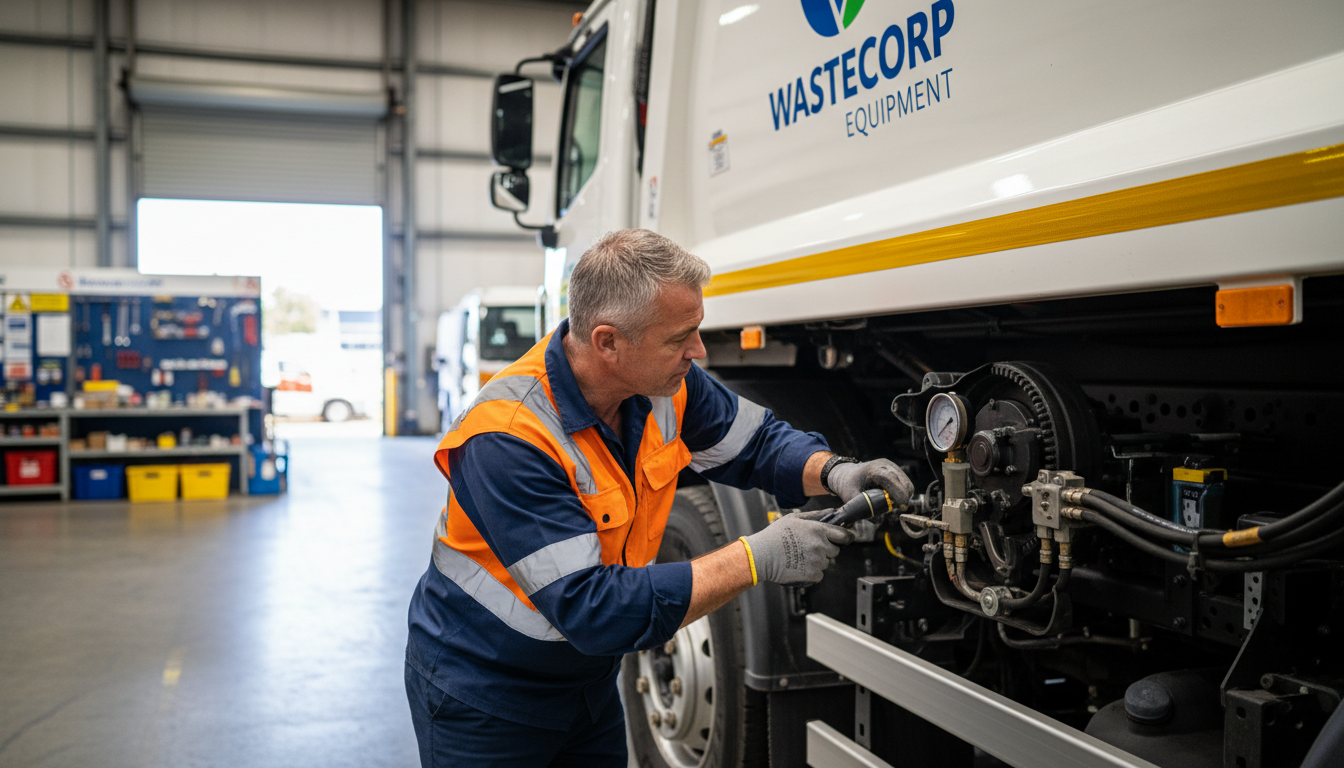
NSW waste collection fleets operating OMB rear lift systems face strict servicing requirements driven by the Protection of the Environment Operations Act 1997 (NSW), which mandates proper waste handling equipment maintenance, and the Heavy Vehicle National Law (HVNL), which requires roadworthy hydraulic systems under Chain of Responsibility provisions. Fleet managers must balance council contract uptime requirements with preventative maintenance scheduling that satisfies AS 4024 safety of machinery standards and AS/NZS ISO 45001 occupational health and safety obligations. This guide outlines specific OMB rear lift servicing NSW protocols across seven critical maintenance domains, from daily pre-operation checks through structural inspection protocols and documentation requirements.
Wastecorp Equipment supplies OMB rear lift systems with comprehensive aftermarket support including genuine parts, hydraulic servicing, and NHVR compliance documentation for NSW fleet operators. As an official distributor for OMB and member of the Waste Contractors and Recyclers Association of NSW (WCRA), we provide technical guidance on servicing intervals that align with both manufacturer specifications and regulatory obligations.
Industry Data
- —The Australian Bureau of Statistics reported 67 million tonnes of waste generated nationally in 2020-21, with municipal solid waste collection representing 13.6 million tonnes requiring rear lift and compactor fleet servicing (ABS, Waste Account Australia Experimental Estimates 2021)
- —NSW EPA data indicates that waste collection vehicle downtime costs Sydney metropolitan councils an average of $1,200-$1,800 per vehicle per day in contractor penalties and route disruption, making preventative maintenance scheduling critical for fleet operators (NSW EPA, Waste and Resource Recovery Infrastructure Study 2020)
Understanding OMB Rear Lift System Architecture
OMB rear lift systems employ a hydraulic hoist mechanism integrated with tailgate compaction assemblies, bin engagement arms, and safety interlock systems that collectively manage 800-1,200 lift cycles per shift in typical NSW municipal routes. The hydraulic architecture comprises a power take-off driven pump, control valve manifold, dual-acting lift cylinders rated to 1,200-1,800 kg payload capacity, and a closed-loop filtration system maintaining operating pressures between 180-220 bar.
Understanding OMB rear lift system integration requirements provides essential context for maintenance protocols, as servicing intervals directly correlate with system architecture and operational demands. The tailgate mechanism incorporates high tensile structural steel pivot points subjected to cyclic loading, while hydraulic seals operate in contaminated environments exposed to leachate, dust, and temperature fluctuations characteristic of Western Sydney collection routes.
The operational differences between skip loaders and rear lift systems significantly influence service requirements. Rear lift systems experience higher cycle counts and more frequent bin engagement operations compared to skip loaders, accelerating wear on hydraulic seals, pivot bushings, and control valve components. This operational intensity necessitates more frequent inspection intervals and proactive component replacement strategies.
NHVR Compliance and AS 4024 Safety Requirements for Serviced Equipment
The National Heavy Vehicle Regulator (NHVR) enforces roadworthiness standards under the Heavy Vehicle National Law (HVNL) that directly impact OMB rear lift servicing schedules. Chain of Responsibility provisions place legal obligations on fleet managers to maintain hydraulic systems in safe operating condition, with service records serving as primary evidence of compliance during NHVR audits or incident investigations.
AS 4024 safety of machinery standards establish minimum requirements for guarding, emergency stops, and hydraulic system integrity on waste collection equipment. Rear lift systems must maintain functional safety interlocks preventing tailgate operation during vehicle movement, pressure relief valves calibrated to manufacturer specifications, and hydraulic hose assemblies meeting AS 1180 standards with visible date stamps for replacement tracking.
AS/NZS ISO 45001 occupational health and safety management systems require documented risk assessments for maintenance activities, including lockout/tagout procedures for hydraulic system servicing, confined space protocols for hopper inspections, and personal protective equipment specifications for technicians working with pressurised hydraulic components. These requirements extend beyond the equipment itself to encompass maintenance procedures and technician competency verification.
Daily Pre-Operation Checks for OMB Rear Lift Systems
Daily pre-operation inspections form the foundation of preventative maintenance programs, identifying developing faults before they escalate into costly failures or safety incidents. NSW fleet operators typically conduct these checks during pre-shift briefings, with documented inspection results retained for NHVR compliance and council contract verification.
- 01Hydraulic Oil Level and Condition VerificationCheck reservoir sight glass for oil level between minimum and maximum markers. Inspect oil colour and clarity—milky appearance indicates water contamination requiring immediate oil change, while dark brown or black colour suggests oxidation and approaching service interval. OMB systems typically hold 60-80 litres of ISO VG 46 hydraulic oil.
- 02Hydraulic Hose and Fitting InspectionVisually inspect all hydraulic hoses for abrasion, cracking, bulging, or seepage at crimped fittings. Pay particular attention to hoses routing near tailgate pivot points where flexing occurs during lift cycles. Any hose showing wire braid exposure or fluid weeping requires immediate replacement before vehicle operation.
- 03Safety Interlock System Functional TestVerify that tailgate controls are inoperative when vehicle transmission is engaged, confirming safety interlock functionality per AS 4024 requirements. Test emergency stop function by activating e-stop button and confirming immediate cessation of hydraulic movement. Document any interlock malfunctions and remove vehicle from service until repairs are completed.
- 04Bin Engagement Mechanism and Pivot Point LubricationInspect bin engagement arms for wear, cracks, or deformation at contact points. Apply grease to pivot bushings and engagement pins—OMB specifications typically require lithium-based EP2 grease applied at pivot points showing metal-to-metal contact. Verify smooth operation through full engagement cycle without binding or excessive play.
- 05Structural Weld and Mounting Point InspectionExamine welds at tailgate mounting points, lift cylinder attachment brackets, and chassis integration points for cracks or separation. Look for rust staining or paint cracking that may indicate developing structural fatigue. Any visible cracks require immediate engineering assessment before vehicle operation to prevent catastrophic failure under load.
Operators should document daily inspection results using digital fleet management systems or paper logbooks, with findings reviewed by maintenance supervisors weekly to identify developing trends requiring proactive intervention. This documentation serves as primary evidence of due diligence under Protection of the Environment Operations Act 1997 (NSW) and HVNL Chain of Responsibility provisions.
Hydraulic System Service Intervals: Oil, Filters, and Pressure Testing
Hydraulic system maintenance represents the most critical service domain for OMB rear lift systems, with oil condition directly impacting component longevity and system reliability. NSW fleet operators should establish service intervals based on operating hours rather than calendar periods, as cycle count intensity varies significantly between urban residential routes and rural collection operations.
OMB recommends hydraulic oil changes every 2,000 operating hours or 12 months, whichever occurs first, using ISO VG 46 anti-wear hydraulic oil meeting ISO 11158 HM specifications. Western Sydney summer conditions with ambient temperatures reaching 35-45°C demand oils with viscosity index above 100 to maintain consistent hydraulic pressure throughout lift cycles. Fleet operators should verify oil meets AS 4024 fire resistance requirements where equipment operates near waste transfer stations handling combustible materials.
Hydraulic filter replacement intervals depend on contamination levels and operating environment. Return line filters typically require replacement every 250 operating hours in dusty NSW collection routes, while suction strainers should be inspected and cleaned every 500 hours. Pressure line filters operating at 180-220 bar require replacement at 500-hour intervals or when differential pressure indicators show red, indicating restricted flow that reduces lift cycle speed and increases pump load.
Understanding broader hydraulic system maintenance protocols applicable to rear lift systems provides fleet managers with comprehensive maintenance frameworks that extend beyond OMB-specific requirements to encompass general hydraulic best practices for waste collection equipment.
Hydraulic oil analysis programs provide predictive maintenance capabilities by identifying contamination, wear metals, and oil degradation before component failure occurs. Fleet operators managing five or more vehicles should implement quarterly oil sampling, sending samples to accredited laboratories for particle count analysis, viscosity testing, and wear metal detection. Elevated iron content indicates cylinder wear, while silicon contamination suggests inadequate air filtration on reservoir breathers.
Critical Wear Components and Replacement Schedules
OMB rear lift systems incorporate high-wear components requiring scheduled replacement based on cycle count rather than time-based intervals. NSW municipal routes averaging 800-1,200 lifts per shift accelerate wear on hydraulic seals, pivot bushings, and bin engagement components compared to commercial collection operations with lower cycle counts.
Hydraulic cylinder rod seals typically require replacement every 4,000-6,000 operating hours depending on contamination exposure and operating temperature. Seal failure manifests as visible oil weeping past the rod, reduced lift speed due to internal bypass, or cylinder drift when holding loads. Proactive seal replacement during scheduled maintenance windows prevents roadside failures and the associated council contract penalties averaging $1,200-$1,800 per vehicle per day according to NSW EPA data.
Tailgate pivot bushings experience cyclic loading during each lift operation, with wear accelerated by inadequate lubrication or contamination from waste materials. Bronze or polymer bushings should be measured for wear annually using inside micrometers, with replacement recommended when clearance exceeds 0.5mm beyond original specification. Excessive bushing wear causes tailgate misalignment, uneven bin engagement, and accelerated wear on hydraulic cylinders compensating for geometric changes.
Implementing effective wear component replacement strategies requires maintaining adequate spare parts inventory to minimise downtime during scheduled maintenance. Critical components including hydraulic seals, tailgate pivot bushings, and bin engagement pins should be stocked based on fleet size and historical consumption rates.
Bin engagement pins and retention mechanisms require replacement every 2,000-3,000 operating hours in high-cycle municipal operations. Worn engagement pins allow bins to shift during lifting, creating impact loads that damage tailgate structure and hydraulic cylinders. Fleet managers should establish measurement protocols using pin gauges to assess wear, replacing pins when diameter reduction exceeds 2mm from original specification.
Structural Inspection Protocols Under AS/NZS ISO 45001
AS/NZS ISO 45001 occupational health and safety management systems require documented structural inspection protocols for load-bearing equipment including rear lift systems. Annual inspections by certified welding inspectors or structural engineers provide independent verification of equipment integrity, satisfying both regulatory obligations and insurance requirements.
Structural inspections should focus on high-stress areas including tailgate mounting welds, lift cylinder attachment brackets, chassis integration points, and hopper floor welds subjected to impact loading from waste materials. Non-destructive testing methods including dye penetrant inspection or magnetic particle testing identify surface cracks not visible during routine visual inspections. Any cracks exceeding 10mm length or located in primary load paths require immediate repair by coded welders using procedures qualified to AS/NZS 1554 standards.
Fatigue cracking typically develops at weld toes where stress concentration occurs, particularly in areas subjected to cyclic loading during lift operations. Fleet operators should photograph inspection findings annually, creating historical records that document crack propagation rates and inform replacement decisions for ageing equipment approaching end of economic life.
Corrosion assessment forms a critical component of structural inspections, particularly for equipment operating in coastal NSW regions where salt exposure accelerates high tensile structural steel degradation. Ultrasonic thickness testing identifies section loss in chassis rails and tailgate structure, with replacement recommended when thickness reduction exceeds 20 percent of original specification or localised pitting exceeds 3mm depth.
Comparing Rear Lift vs Compactor Maintenance Cycles
Understanding maintenance cycle differences between rear lift systems and compactor units enables fleet managers to optimise service scheduling and resource allocation across mixed equipment fleets. While both systems employ hydraulic technology, operational demands and component wear patterns differ significantly.
Reviewing compactor servicing intervals for comparison provides fleet managers with comprehensive maintenance planning data across equipment types, enabling optimised workshop scheduling and technician resource allocation.
The higher cycle count and exposed operating environment of rear lift systems necessitate more frequent hydraulic filter replacement and seal inspection compared to compactor units. However, compactor systems experience higher hydraulic pressures during compaction cycles, typically 250-280 bar compared to 180-220 bar for rear lift operations, placing greater stress on pump components and pressure relief valves.
Procurement Considerations for Service-Optimised Fleets
Fleet procurement decisions significantly impact long-term maintenance burden and total cost of ownership. NSW council procurement officers evaluating OMB rear lift systems should consider serviceability factors including parts availability, hydraulic component accessibility, and compatibility with existing workshop tooling and technician competencies.
OMB rear lift systems feature modular hydraulic valve manifolds that enable component-level replacement without removing entire assemblies, reducing service duration and parts costs compared to integrated valve blocks requiring complete replacement. Hydraulic cylinders employ standard seal kits compatible with multiple OMB models, simplifying parts inventory management for fleet operators running mixed-age equipment.
Understanding rear lift system selection criteria that influence long-term maintenance burden enables procurement officers to evaluate total cost of ownership beyond initial capital expenditure. Systems featuring easily accessible hydraulic components, standardised fasteners, and comprehensive service documentation reduce maintenance labour hours and minimise specialised tooling requirements.
Wastecorp Equipment provides OMB rear lift systems with comprehensive technical documentation including hydraulic schematics, torque specifications, and service procedures aligned with AS 4024 safety requirements. As an official OMB distributor and WCRA member, we maintain genuine parts inventory for immediate supply to NSW fleet operators, minimising downtime during scheduled maintenance or emergency repairs.
Fleet operators should evaluate supplier aftermarket support capabilities including parts availability, technical support responsiveness, and field service coverage when selecting rear lift systems. Equipment suppliers offering 24-hour parts supply and mobile hydraulic servicing provide significant operational advantages for fleets operating under strict council contract uptime requirements.
Documentation Requirements Under Protection of the Environment Operations Act 1997 (NSW)
The Protection of the Environment Operations Act 1997 (NSW) establishes environmental protection obligations for waste transport operations, with equipment maintenance records serving as evidence of proper waste handling capability. NSW EPA compliance audits may request service documentation demonstrating that collection vehicles maintain functional hydraulic systems preventing waste spillage during transport.
Fleet operators must maintain comprehensive service records including dates, operating hours at service, components replaced, hydraulic oil specifications used, and technician identification. Digital fleet management systems enable centralised record keeping with automated service interval alerts, reducing administrative burden while ensuring compliance documentation availability during regulatory audits or council contract reviews.
Service documentation should include hydraulic pressure test results, structural inspection reports, and safety interlock function verification to satisfy AS/NZS ISO 45001 occupational health and safety requirements. These records demonstrate due diligence in maintaining equipment in safe operating condition, providing legal protection under HVNL Chain of Responsibility provisions in the event of incidents or accidents.
Council waste collection contracts typically specify minimum service intervals and documentation requirements as contract conditions. Fleet operators must provide service records upon request, with failure to maintain documented maintenance schedules potentially constituting breach of contract and grounds for penalty assessment or contract termination.
- ✓
Establish 250-hour hydraulic filter replacement schedule aligned with OMB specifications for high-cycle municipal routes - ✓
Implement daily pre-start inspection protocol covering tailgate hydraulics, bin engagement arms, and safety interlock systems per AS 4024 requirements - ✓
Schedule annual structural weld inspection by certified inspector to satisfy AS/NZS ISO 45001 occupational health and safety obligations - ✓
Maintain digital service logs documenting all hydraulic oil changes, pressure tests, and component replacements for NHVR Chain of Responsibility compliance - ✓
Stock critical wear components including hydraulic seals, tailgate pivot bushings, and bin engagement pins to minimise downtime during scheduled maintenance windows - ✓
Coordinate servicing schedules with council collection contracts to avoid route disruption, particularly during high-volume periods following public holidays - ✓
Verify all replacement hydraulic hoses meet AS 1180 standards and are date-stamped for tracking replacement intervals
Frequently Asked Questions
What are the mandatory service intervals for OMB rear lift systems operating in NSW municipal contracts?
While the Protection of the Environment Operations Act 1997 (NSW) does not prescribe specific service intervals, OMB recommends hydraulic oil changes every 2,000 operating hours or 12 months, whichever occurs first. Fleet operators must maintain service records demonstrating compliance with AS 4024 safety of machinery standards and manufacturer specifications to satisfy council contract requirements and NHVR roadworthiness obligations. Hydraulic filter replacement should occur every 250 operating hours in high-cycle municipal routes, with annual structural inspections by certified welding inspectors required under AS/NZS ISO 45001 occupational health and safety management systems. Council contracts typically specify minimum service intervals as contract conditions, with documented maintenance records required for contract compliance verification.
How does OMB rear lift maintenance differ from front-loading compactor servicing?
OMB rear lift systems typically require more frequent hydraulic seal inspection due to higher cycle counts in residential collection routes—often 800-1,200 lifts per shift compared to 200-400 compaction cycles. Rear lift tailgate mechanisms and bin engagement systems demand weekly lubrication, whereas compactor rams operate in enclosed environments with less frequent greasing intervals, usually every 40 operating hours. Hydraulic filter replacement intervals differ significantly, with rear lift systems requiring 250-hour filter changes due to contamination exposure compared to 500-hour intervals for enclosed compactor hydraulics. However, compactor systems operate at higher hydraulic pressures (250-280 bar versus 180-220 bar for rear lifts), placing greater stress on pump components and requiring more frequent pressure relief valve testing. Service duration for major maintenance typically ranges 4-6 hours for rear lift systems compared to 6-8 hours for compactor units due to ram seal replacement complexity.
What hydraulic oil specifications does OMB require for NSW climate conditions?
OMB rear lift systems require ISO VG 46 anti-wear hydraulic oil meeting ISO 11158 HM specifications for NSW operating temperatures. Western Sydney summer conditions (35-45°C ambient) demand oils with viscosity index above 100 to maintain hydraulic pressure consistency across temperature ranges and prevent viscosity breakdown during extended operation. Operators must verify oil meets AS 4024 fire resistance requirements where equipment operates near waste transfer stations handling combustible materials, with some applications requiring phosphate ester or water glycol formulations. Hydraulic oil should contain anti-wear additives (typically zinc dialkyldithiophosphate) at 0.03-0.05 percent concentration to protect pump components operating at 180-220 bar pressure. Synthetic hydraulic oils offer extended drain intervals and superior thermal stability but require compatibility verification with existing seal materials before conversion from mineral-based oils.
Are there NHVR compliance implications for operating rear lift systems with overdue servicing?
Yes. The Heavy Vehicle National Law (HVNL) requires waste collection vehicles to maintain roadworthy condition, which includes functional hydraulic braking and load restraint systems integral to rear lift operation. NHVR audits can request service records, and operating equipment beyond manufacturer-specified intervals may void insurance coverage and constitute a breach of Chain of Responsibility obligations under HVNL for fleet managers. Hydraulic system failure resulting from inadequate maintenance can lead to prosecution under HVNL provisions, with penalties including fines up to $300,000 for corporations and potential director liability under Chain of Responsibility provisions. Fleet operators must demonstrate documented maintenance programs satisfying AS 4024 safety of machinery standards and AS/NZS ISO 45001 occupational health and safety requirements. Council contracts typically include indemnity clauses requiring contractors to maintain equipment in compliance with all applicable regulations, with breach potentially triggering contract termination and liability for resulting damages.
Wastecorp Equipment supplies OMB rear lift systems with comprehensive aftermarket support including genuine parts, hydraulic servicing, and NHVR compliance documentation for NSW fleet operators
Official distributor for MEC and OMB. Member of the Waste Contractors and Recyclers Association of NSW.

 Member of Waste Contractors and Recyclers Association of NSW.